Total Pageviews

Thursday, March 9, 2017

Arjun Mk.2 MBT Now A Firm Reality

Contrary to widespread speculation, the Indian Army (IA) has not forsaken or given up on the Arjun Mk.2 main battle tank (MBT). Instead, for the past four years, the IA’s Directorate General of Mechanised Warfare has been overseeing a collective developmental effort involving the DRDO, and the MoD-owned defence public-sector undertakings and private-sector OEMs that will in the near future result in a fully-loaded 60-tonne MBT armed with a 120mm smoothbore cannon while retaining the existing 1,400hp powerpack.
Under the supervision and guidance of the DRDO’s Avadi-based Combat Vehicles Research & Development Establishment (CVRDE), and with the help of the MoD’s Directorate General of Quality Assurance (DGQA) and the IA’s Corps of Electronics & Mechanical Engineers (EME), a number of key decisions have been to achieve a weight reduction of 8 tonnes in the existing design of the 68-tonne Arjun Mk.1A MBTs, 118 of which are now in delivery. 
For starters, the baseline hull of the Arjun Mk.2 will no longer be built with imported low-carbon, nickel-chromium-molybdenum rolled homogeneous armor (RHA) steel, but with lighter high-nitrogen steel (HNS) whose production technology has been mastered by the DRDO’s Hyderabad-based Defence Metallurgical Research Laboratory (DMRL) and has been transferred to Jindal Stainless Steel Ltd (Hisar). HNS will also be used by TATA Motors Ltd for producing the 83 Kestrel 8 x 8 armoured personnel carriers already on order.   
HNS is produced in a four-step process: primary melting of the steel can carried out in either induction furnace or electric arc furnace by using appropriate raw materials; secondary melting can be carryout in by nitrogen gas-purging in to the metal; under ladle refining, ferro-nitrates are added to molten metal for obtaining final nitrogen content in the alloy if it is required and hot-rolling is carried out in a single heat, without reheating. Minimum percentage of reduction should not be less than 75% of the slab thickness. To be placed in strategic locations in both the hull and turret will be the DRDO-developed ‘Kanchan’ ceramics-based composite laminate armour tiles as well as indigenously-built explosive reactive armour (ERA) tiles developed by the DRDO’s High Energy Materials Research Laboratory (HEMRL) on the front and sides of the hull and turret sections.
To ensure optimal weight budgeting during the production engineering stage, the CVRDE has contracted Dynamatic Technologies Ltd, which specialises in complex, five-axis robotic machining, as well as in converting two-dimension paper blueprints into three-dimension computer model that are more precise, and have tighter tolerances. Digitising the drawings creates a baseline configuration for greater accuracy. This in turn streamlines manufacturing, since conventional manufacturing based on two-dimensional paper blueprints tend to leave tiny gaps between the different components of an assembly that were filled with shims, leading to increased weight. But by digitising blueprints, those tiny gaps can be entirely eliminated during the manufacturing process.
Under another weight-reduction exercise, the CVRDE has contracted the Alicon Group for building all-aluminium road-wheels and ventilators for not only the Arjun Mk.2, but also for the IA’s existing upgraded T-72CIA medium tanks. They will replace the all-steel road-wheels built by Sundaram Industries for the Arjun Mk.1A. Similarly, TATA Power SED has been contracted for producing all-electric turret stabilisation/traverse systems, in place of the existing electro-hydraulic system.  
Improvements have also been made to the 1,400hp powerpack (comprising the MTU 838 Ka-501 diesel engine and RENK’s RK-304S gearbox) through the usage of indigenously developed cooling systems.
However, the area that will see the Arjun Mk.2 emerging as a true new-generation MBT will be vectronics, and in particular the battlespace management system (BMS), which has been designed to operate at the unit-level and below, and which will synthesise the battlespace situational awareness picture for the unit commander, whether it be a mechanised infan­try regiment or an armoured regiment. The MBT and selected infan­trymen will thus become situational awareness platforms. 
This project, which was started only in 2008, has since been pushed at a faster rate as this constitutes the cutting edge of the IA’s theatre-level Command Information Decision Support System (CIDSS) programme that is being run by IA HQ’s Directorate of Information Systems. The Future Infantry Soldier as a System (F-INSAS), which is also a part of the CIDSS project, is being progressed by the IA HQ’s Directorate of Infantry but will be a part of the overall BMS and battlespace surveillance system (BSS) network of the IA.
The BSS and BMS are in turn being integrated by IA HQ’s Directorate of Signals with other components of the fourth-generation Tactical Command, Control, Communications and Information (TAC-C3I) system through the CIDSS channel. Through the BMS and BSS the IA wants to provide a Divisional-level command-and-control system spanning the entire tactical battle area (TBA) spreading across individuals, detachments, combat platforms, sensors, sub-units, units to the Brigade Commander/Regimental Commander; achieve faster reaction capability and flexibility in command and control by providing information automatically in the right place at the right time, thereby compressing the OODA loop; provide a strong foundation for making decisions based on near-real time situational awareness and battlespace transparency, providing consistent and well-structured information, thereby enhancing the information handling capability of commanders at all levels; and strengthening information exchange by having a strong messaging and replication mechanism.
The BMS will be a highly mobile and integrated system with high data transmission rates, comprising a tactical hand-held computer with individual soldiers, tactical computers at Battle Group HQ, and armoured vehicles employing application/database servers connected via a data-enabled TAC-C3I communications network, all of which generate a common operational picture of the TBA. The software-defined radio-based communications nets will optimally utilise the bandwidth available for military communications, and will not interfere with the legacy communications hardware. They will be fitted to MBTs, ICVs and APCs and will be scalable to ensure their availability to all elements ranging from man-portable SDRs to high-power SDRs for armoured vehicles.
The original proposed time-lines for implementation of the BMS and BSS were as follows:
Phase-1: Integration of the system, establishment of the testbed lab and field-trials at testbed locations (one Combat Group and three Infantry Battalion Groups) by 2012. However, this timeline was subsequently stalled for two years due to indecision in the delimitation between the BMS and the F-INSAS.
Phase-2: Equipping of all armoured and mechanised infantry formations commencing in 2017.
Phase-3: Upgradation of the system by 2022.
Both the BMS and F-INSAS will make use of a host of digitised GIS-based tools (pertaining to both friendly and enemy territories) that are now available (work on them began in 2009) for the IA’s South-Western, Western and Northern Command HQs and that can be readily uploaded on to any armoured vehicle’s autonomous land navigation system (ALNS) and BMS terminal. Military Geospatial Information System (MGIS) helps in generating terrain trafficability maps, commonly referred to as Going Maps (GM), when data pertaining to five thematic layers, viz., soil, slope, moisture, land use, and landform is fed into the system. It is then integrated to produce the GMs in a three-level hierarchical manner. Terrain Feature Extraction System (TFES) is used for extracting terrain parameters or themes (land-use/land cover, landform, and soil type) from satellite images and associated knowledge base in an automated mode. The land use, landform, and soil layer has 10, 28, and 12 classifications, respectively. For land-use classification, a multi-layer perceptron (MLP) is used for training and subsequent generation of corresponding themes. The landform classification uses a texture-based method for creating a database that is used for training MLP. Terrain Reasoner System (TRS) helps decision-makers (troop commanders, wargamers and mission planners) in a combat development setting for arriving at route alternatives that are largely determined by the threat capability of the obstacles and strategic nature of the regions to be negotiated for a pre-specified mission accomplishment risk factor (MARF). The problem of navigation and route planning of vehicles or troops is defined as the final behavioural outcome of a sequence of complex decisions involving several criteria that are often conflicting and difficult to model. A fuzzy inference system has been built to implement the perceive-reason-act decision cycle of a moving agent representing a vehicle or a foot soldier in a safety-critical tactically driven scenario. Terrain Matching System (TMS) is an intelligent decision-support system based on the integration of CBR and fuzzy multi-criteria decision-making.
The F-INSAS project will be implemented in three phases—Phase-1 includes weapons, body armour, clothing and individual equipment; Phase-2 is the target acquisition system and Phase-3 comprises the computer sub-system, SDR sub-system, and operating software integration. Since the Directorate of Infantry has been developing Phase-3 of F-INSAS on its own, rather than being part of the BMS project, this has amounted to re-inventing the wheel. Instead, what should have been done was to develop Phase-3 of F-INSAS as part of the overall BMS developmental effort.

Wednesday, March 1, 2017

SpyDer-SR LL-QRM/QR-SAM Deliveries Have Begun, Aerostat-Mounted EL/M-2083s To Follow Next

Following a nine-year wait, both the Indian Air Force (IAF) and Indian Army (IA) are now poised to replace their existing inventories of OSA-AKM and ZRK-BD Strela-10M SHORADS with the RAFAEL of Israel’s Spyder-SR system. The IAF refers to the Spyder-SR as a low-level quick reaction missile (LL-QRM), while the Army calls it quick-reaction surface-to-air missile (QR-SAM). First to deploy them will be the IAF, which will use the SpyDer-SRs to defend its six air bases spread throughout Jammu & Kashmir, Punjab and Haryana.
The Ministry of Defence (MoD) had approved the IAF’s requirement in July 2008, and a US$293 million contract for the supply of an initial 18 launchers (making up one squadron) was signed in December 2008. Deliveries were to begin in early 2012 and were to be concluded by August 2012. However, the deliveries could not begin due to a last-minute decision by both the IAF and IA to use high-mobility trucks supplied by TATA Motors, instead of the BEML-supplied TATRA high-mobility trucks.
The IA had received the green light to procure four regiments of the Spyder-SR in August 2009, and a $900 million contract was inked later that year. The Spyder-SR is the culmination of joint R & D efforts undertaken by RAFAEL and Israel Aerospace Industries (IAI). It is a short-range (15km range), low-level (from 20 metres through to 9,000 metres altitude) integrated, all-weather air-defence system that makes use of the ground-launched Python 5 imaging infra-red guided and Derby radar-guided missiles, which complement each other in their target detection, tracking and pursuit profile . Both missiles are equipped with lock-on before launch (LOBL) and lock-on after launch (LOAL) modes for faster response time and improved engagement flexibility.
A Spyder-SR battery includes up to six missile launch vehicles (each equipped with four missile launchers), missile reloaders and a command-and-control Unit that also accommodates the IAI/ELTA Systems-built EL/M-2106NG ATAR 3-D surveillance radar and two operating consoles. The radar can simultaneously track and engage up to 60 targets at a range beyond 35km (depending on the terrain). The command-and-control unit interfaces with the missile launch vehicles via wireless data-link (for up to as distance of 100km) to enable optimal unit dispersion for effective area coverage, mutual protection and survivability. The system's high cross-country mobility offers quick deployment and operational agility. The Spyder-SR also has VHF/HF communications networks for internal squadron-level communication and to upper-tier commands. Once the operator decides to launch a missile, an automatic procedure begins. 
The command-and-control centre assigns the target to the appropriate launch vehicle and the selected missile will start to search for the target. If the target is within acquisition range the missile will be launched in LOBL mode. If the target is beyond seeker acquisition range the missile will be launched in LOAL mode. The seeker searches for the target and when it acquires the target it begins the terminal homing phase. Both LOAL and LOBL modes are available for the Derby and Python 5. Destruction of the target is achieved either by the warhead blasting upon impact or by proximity fuze.
Providing early-warning cues for the IAF’s plains-deployed SpyDer-SRs will be the DRDO-developed and BEL-built Ashwini LMRSRs.
To be delivered later this year will be six aerostats (supplied by Russia’s Rosoboronexport State Corp and procured by Reliance Defence Ltd, a wholly owned subsidiary of Reliance Infrastructure Ltd) that will all be fitted with IAI-supplied EL/M-2083 early-warning radars. The IAF already operates two such aerostat-mounted radars that were ordered in 2005 and were delivered in 2007.

Tuesday, February 21, 2017

Aero India 2017 Highlights-2

This year’s expo showcased two new-generation weapon systems that are expected to enter service by 2020 at best, these being the QR-SAM for the Indian Army’s Corps of Air-Defence Artillery (CADA), and the MPATGM for the Indian Army’s infantry battalions.
The QR-SAM will use a surface-launched version of the Astra-1 BVRAAM and it will use a Ku-band seeker developed by the DRDO’s Research Centre Imarat (RCI) and produced by VEM Technologies. The target detection and engagement radars are being developed by the DRDO’s LRDE laboratory, while overall systems integration is the responsibility of Bharat Electronics Ltd.
LRDE is also developing a new-generation target acquisition/fire-control system, called ATULYA, for the L-70 and ZU-23 anti-aircraft artillery guns used by CADA.
Meanwhile, series-production of the Barak-8 family of LR-SAM/MR-SAM is picking up steam. The Barak-8’s critical design review was completed by early May 2008 and its DRDL-developed two-stage pulsed rocket motor was successfully test-fired earlier the same year. The first six sets of these rocket motors were shipped to IAI by the DRDL in July 2008 for further test and integration activities. Series production by BDL began in 2013. From the Indian side, the principal R & D players for both variants of the Barak-8 are the DRDL, Hyderabad-based Research Centre Imarat (RCI) and Advanced Systems Laboratory (ASL), the Bengaluru-based Electronics R & D Establishment (LRDE) and Larsen & Toubro. Israeli companies participating in the joint venture are the MLM and ELTA Systems business divisions of IAI. While IAI/MLM was responsible for developing the guided-missiles along with the DRDL, RCI and ASL, IAI/ELTA has co-developed along with the LRDE and Bharat Electronics Ltd (BEL) the command-and-control system and related fire-control system (for both variants of the Barak-8).
It may be recalled that India and Israel inked the Barak-8 surface-to-air missile’s (SAM) joint five-year R & D contract--valued at US$556 million--on January 27, 2006, following 17 months of exhaustive negotiations. For extended ground-based long-range air defence India’s Cabinet Committee on National Security had on July 12, 2007 approved a $2.47 billion project to co-develop the long-range-SAM variant. Subsequently, on February 27, 2009 India signed a $1.4 billion R & D contract with the MoD-owned Bharat Dynamics Ltd (BDL) for the Barak-8 MR-SAM for the IAF, and this was followed in April the same year by a $1.1 billion contract for procuring the Barak-8’s naval LR-SAM variant. The IAF has already committed itself to procuring an initial batch of nine Barak-8 MR-SAM squadrons. The procurement contract will be inked later this year, with deliveries commencing within 72 months. The vertical launch cell modules for the Barak-8 have since been developed by Mumbai-based Larsen & Toubro Ltd, with an eight-cell module weighing 1,700kg. For the IAF’s ground-based MR-SAM variant, command-and-control plus fire-control will be provided by a containerised system weighing only 1,300kg.
Another indigenous field artillery-specific solution developed by the DRDO’s LRDE lab is the L-band ‘Swathi’ weapon locating radar (WLR) at a cost of US$49 million. 
Under development since April 2002, this WLR was ready for series-production by Bharat Electronics Ltd by late 2011 and deliveries of 30 units are presently underway.
The IA had in September 2004 awarded a $300 million contract to Bharat Electronics Ltd to develop the Shakti ACCCS. Production deliveries commenced in 2008 and the system was commissioned on June 12, 2009. The ACCCS is a network of military grade tactical computers that automates and facilitates decision support for all the operational aspects of artillery functions from the Corps down to a Battery-level in a networked environment. It was jointly developed by the DRDO’s Centre for Artificial Intelligence & Robotics (CAIR), Armament Research & Development Establishment (ARDE) and IA HQ’s Directorate General of Information Systems (DGIS). ACCCS is the artillery component of the IA’s TAC-C3I grid. Shakti’s three main electronic devices are the enhanced tactical computer, gun display unit and the hand-held computer. With these, five critical functions are performed, including ‘Technical Fire Control’ for trajectory computations, and ‘Tactical Fire Control’ involving the processing of fire-assault requests and ammunition usage/supply management. It also ensures ‘Deployment Management’ for field howitzers and forward observation/fire direction posts for defensive and offensive operations, ‘Operational Logistics’ for assisting in the timely provisioning of ammunition and logistics support, and ‘Fire Planning’ to facilitate the production of interleaved fire-assault plans, tasking tables and automatic generation of gun engagement programmes.
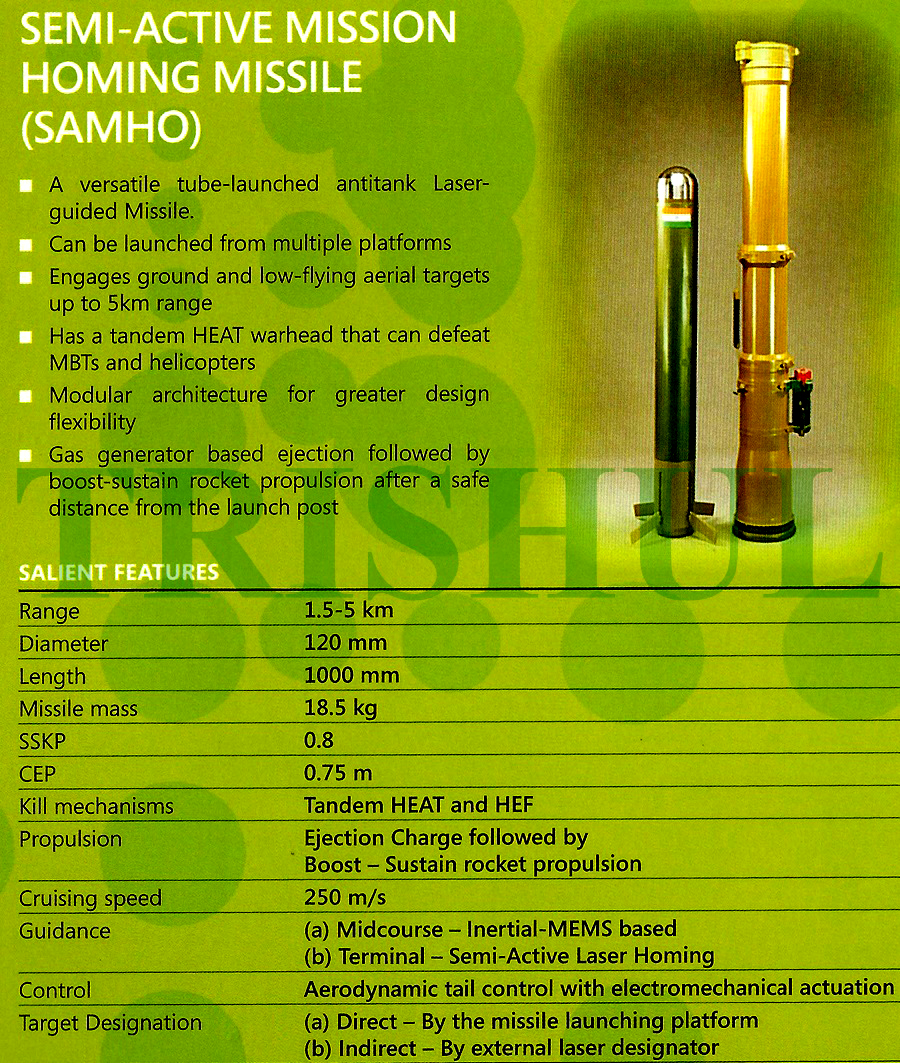
Most of the bureaucratic decks have already been cleared for a landmark, long-awaited  agreement between India and the US that calls for the joint development and production of the Indian Army’s next-generation manportable ATGM (MPATGM) that will use thermobaric-HEDP and tandem shaped-charge warheads optimised for high-altitude warfare and anti-armour engagements. This ATGM has been the subject of much speculation, like it being the SAMHO, or a derivative of Raytheon’s third-generation FGM-148 Javelin fire-and-forget ATGM.
In reality, the MPATGM has been under development since 2009 by the DRDL, with VEM Technologies being responsible for product engineering development. Raytheon has already secured US approval for 97% transfer-of-technology (ToT) for licence-producing the missile’s cooled mid-wave imaging infra-red (MWIIR) seeker, and will withhold only the target acquisition algorithms. Both Bharat Dynamics Ltd (BDL) and Ordnance Factory Board (OFB) will be responsible for the joint development of thermobaric-HEDP and HE/FRAG penetration-cum-blast warheads, while the re-usuable launchers and missiles will be built by both VEM Technologies and BDL. A cooled MWIIR sensor can passively lock-on to targets at up to 50% farther range than an uncooled sensor, thus allowing the firing crew greater and safer standoff distance, and less likely to be exposed to counter-fire. An uncooled long-wave infra-red (LWIR) sensor on the other hand brings increased repairs, decreased operational availability, and dangerous vulnerabilities, while a cooled IIR sensor saves lives, lessens fratricide, minimises collateral damage, lowers risk, and protects its firing platforms/crew. Present plans call for equipping the Indian Army’s existing 356 infantry battalions of the 1.13 million-strong Indian Army and the projected 30 infantry battalions to be raised in the 13th five-year defence plan (2018-2022) with some 6,000 MPATGM launchers and up to 26,000 missile-rounds (including war wastage reserves).
A similar practice had earlier led to the development of the 4km-range Nag ATGM and its air-launched HELINA variant. Back in 2005, the IA had ordered 443 Nag missiles and 13 NAMICA tracked carrier/launch vehicles, and is expected to order another 7,000 Nag missiles and around 200 NAMICAs. The 4km-range Nag uses a RCI-developed uncooled LWIR sensor containing an IR-CCD supplied by France-based ULIS/Sofradir. For the 6km-range HELINA, the DRDO has developed a two-way RF command-video data-link. The missile-to-helicopter down-link used to pass the LWIR seeker video works in the S band and the helicopter-to-missile up-link to pass steering commands works in the C band. In addition, a DS-SS modulation scheme is used for the command up-link while a conventional FM technique is used for video down-link, respectively.
Despite the fact that the LCA AF Mk.2’s (the term Tejas Mk.2 has now been discarded) final design has yet to be frozen, ADA nevertheless went ahead and released conceptual illustrations of this MRCA that can only serve to create further ill-informed confusion and false assumptions.
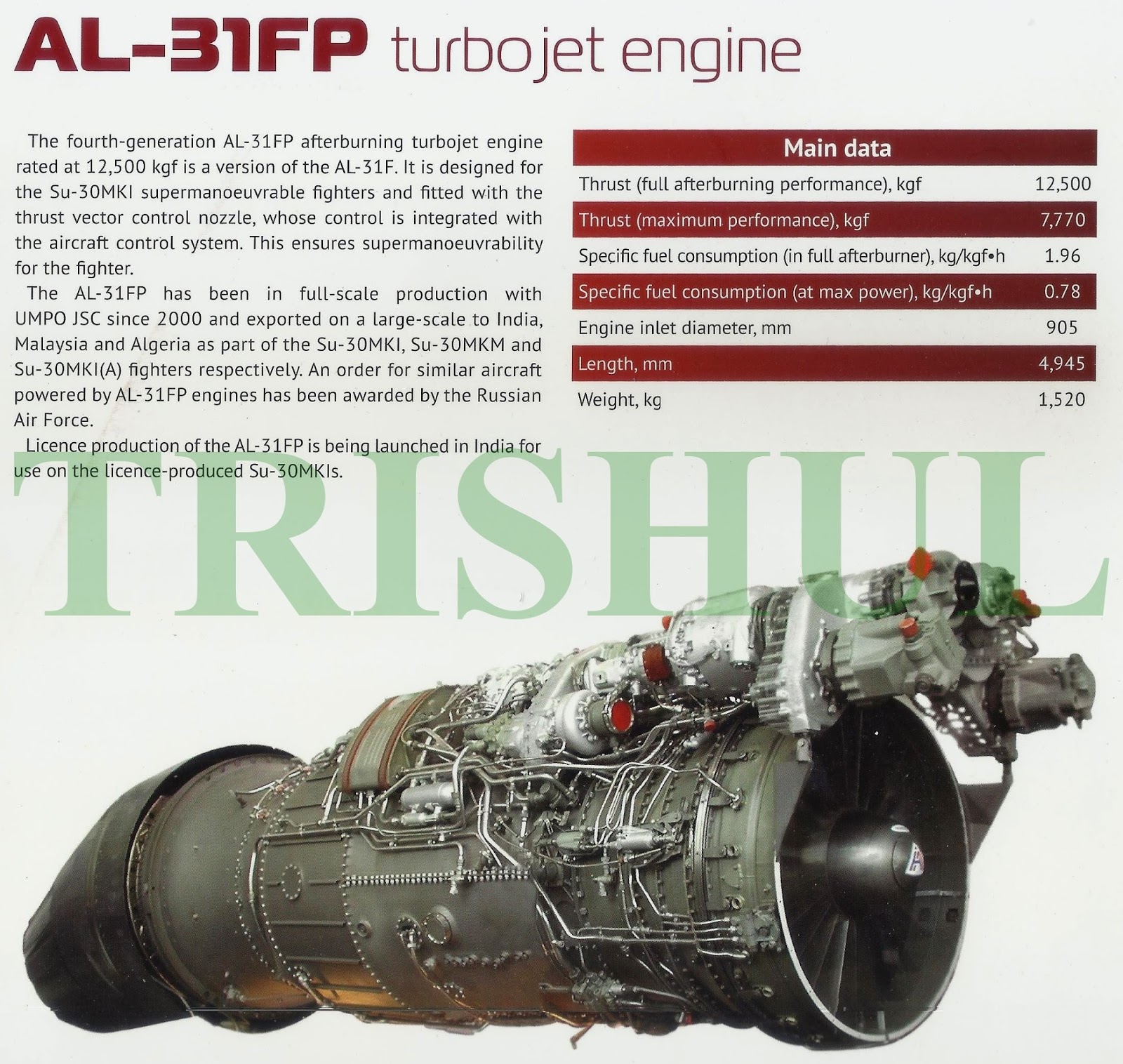
The two slides below explain the performance parameters of the Su-30MKI’s existing powerplant (AL-31FP) and the one (AL-41F-1S) that will power these H-MRCAs after the expiry of the TTSLs of the existing turbofans.
Instead of trying to re-invent the wheel and cling on to legacy designs, HAL would be well-advised to join forces with KAMOV OKB of Russia to co-develop the next-generation Ka-92 MRH. If this were to be done, it will offer India the way to squeeze out of the earlier ill-fated/ill-advised commitment to procure the Ka-226T.
The slide above is the first definitive illustration of the SAAW directed-energy weapon that is now being co-developed by RAFAEL of Israel and the DRDL.
Seen above and below are slides showing the future developmental objectives of the DRDO for both target acquisition optronic/RF seekers, and for their on-board navigation systems.
This will be the RVV-AE-ZRK LRAAM to go on board the FGFA. It will also be qualified on the Super Su-30MKI. 
Shown below are the next-generation AAMs now being developed in China.