


Conclusive Evidence of Successful IAF Air-Strike on JeM-Owned Madrassa Taleem al-Quran at Jabba Top, Balakot, in KPK, Pakistan
A little known fact that now needs to be
highlighted is that back in the last quarter of 2016, after the Indian Army had
conducted what was then officially as a low-intensity, cross-LoC counter-terror
operation on the night of September 28/29, India was roundly castigated behind
closed doors by all her wellwishers, especially the US, UK, France and Russia.
And this was not for conducting the cross-LoC raids, but for not doing it on a
far greater scale. In other words, India was berated for continuing to punch
way below her weight, while her adversary was engaged in doing just the
opposite since the early 1990s. To be fair, it was then unrealistic to expect a
revolutionary thought-paradigm from a bureaucratic and political establishment
that had inherited the dogma and scepticism prevailing over the past 26 years. As a result, India had clung to an attrition-heavy strategy, fatalistically
accepting casualties. Matters were in their worst state between 2007 and
September 2016 when India had argued that she was not ready to test the
escalation ladder, this being highly reflective of the characteristics of a
diffident power. However, the shocking messages and words of advice that India
received post-September 29, 2016 at last provided the long-overdue shock-therapy
that forced India’s bureaucratic and political establishment to draft new
red-lines in the war against terrorism and this was to be the genesis for the
planning and eventual conduct of the February 26 airstrikes by the Indian Air
Force (IAF) against a principal Jaish-e-Mohammad (JeM) terror training facility
inside Pakistan.
While conceiving and planning such a
coordinated airstrike is second-nature to the IAF, acquisition of the necessary
implementation tools, especially the high-accuracy locational coordinates of
the targetted facility as well as high-accuracy navigational waypoints inside
hostile airspace in areas where no sympathetic local human resources were bound
to be available, was the principal challenge. And this is where the strategic
partnership between Afghanistan and India was to play a decisive role, in
particular the human resource assets of Afghanistan’s Riyasat-e Amniyat-e Milli, or
the National Directorate of Security (NDS) embedded within Pakistan’s Khyber
Pakhtunkhwa (KPK) province, within which the targetted JeM facility was
located. After acquiring the mandatory high-accuracy locational coordinates, it
was the turn of the Safran Electronics &
Defense-supplied Mission Analysis and Restitution System (MARS) of the IAF to
be put to use. In essence, this tool creates flight and attack plans; analyzes
missions, with video playback; provides tactical situational awareness (flight
corridors, positions of threats, etc.) and geographical 2-D and 3-D environment
(digital maps, terrain profiles, meteorological conditions, etc.); and finalises
weapons-to-target matching parameters and operating protocols for electronic
systems (electronic warfare, target acquisition/designation pods, radio, IFF,
etc). All these taskings were completed by February 18, i.e. within four days
of getting the political go-ahead. Another five days were consumed by various
asset mobilisation efforts throughout the IAF’s Western and Central Air Commands,
which involved the following:

1) Adampur AFS: 8 Wing’s 47 ‘Black Archers’ Sqn and 223 ‘Tridents’ Sqn with MiG-29B-12s and MiG-29UPGs.
2) Bhisiana AFS: 34 Wing’s 17 ‘Golden Arrows’ Sqn with Su-30MKIs and 200 ‘Netra’ Sqn with EMB-145I AEW & CS platforms.
3) Gwalior AFS: 40 Wing’s 1 ‘Tigers’ Sqn, 7 ‘Battleaxes’ Sqn and 9 ‘Wolfpack’ Sqn with Mirage 2000Hs/THs/INs.
4) Halwara AFS: 34 Wing’s 220 ‘Desert Tigers’ Sqn with Su-30MKIs.
5) Pathankot AFS: 18 Wing’s 26 ‘Warriors’ Sqn with MiG-21 Bisons and 108 ‘Hawkeyes’ Sqn with MiG-21Ms.
6) Sirsa AFS: 45 Wing’s 21 ‘Ankush’ Sqn with MiG-21 Bisons.
7) Avantipora AFS: 1 Wing’s 51 ‘Sword Arms’ Sqn with MiG-21 Bisons.
8) Agra AFS: A-50EI PHALCONs of 50 Sqn and 78 ‘Valorous Mars’ Sqn with IL-78MKI aerial refuelling tankers.

Also activated were the radar stations at Barnala in Punjab and Patni Top in Jammu, both of which host aerostat-mounted EL/M-2083 L-band active phased-array medium-power radars. Command and control for the entire air operation was to be exercised by HQ Western Air Command.

By February 22 the mobilisation
was completed and mission rehearsals began the very next day, especially over the
skies of Punjab, Haryana and Jammu & Kashmir. Reacting to this, the
Pakistan Air Force (PAF) intensified its number of combat air patrols (CAP) throughout
its Northern and Central Air Commands, with the Rafiqui air base monitoring the
sorties mounted by IAF combat aircraft taking off from Bhisiana, and
the Kamra and Sargodha air bases monitoring the sorties mounted by IAF combat aircraft taking off from Adampur,
Halwara, Srinagar and Avantipora.

Shortly after 2am on February
26, six Mirage 2000Hs (three of which were each armed with three 1,000lb HSLD bombs while the other three were each armed with two Spice-2000 PGMs) took off from
their home-base in Gwalior and entered a pre-determined air-corridor that took
them to Agra, where they were refuelled in mid-air by two IL-78MKIs. By 3am,
another six Mirage-2000Hs that had already re-deployed from Gwalior to
Adampur a day earlier, headed for eastern Himachal Pradesh where they, along with
the Mirage-2000s from Agra, were all refuelled by three IL-78MKIs. This
combined force then turned northwest towards northern Jammu & Kashmir. Meanwhile,
as part of an elaborate deception plan, the IAF, between 3.30am and 4pm,
launched two six-aircraft sorties in a staggered manner from Bhisiana towards Okara-Bahawalpur,
and from Halwara towards Lahore—this being to distract the two CAPs of the PAF
that were airborne that night from Rafiqui and Sargodha.
 Meanwhile, the six-unit Mirage-2000 strike formation broke into two, with the three Mirage 2000s armed with HSLD bombs resorting
to terrain-masking flight-profiles when commencing the 21-minute attack-run
from Tangdhar and setting course for Balakot. The remaining three Mirage-2000s armed with six Spice-2000s too entered PoK airspace at 3.30am and headed for a location northwest of Muzaffarabad (north-east of Garhi Habibullah inside KPK) while adopting a terrain-masking flight-profile. About 10 minutes later, the remaining six Mirage
2000s started mounting a medium-altitude CAP over the Keran Valley inside PoK and these were
detected by the PAF’s Kamra-based airspace surveillance radar, which in turn
ordered a scramble of two F-16s from Chaklala air base in Rawalpindi. However, by then the three Mirage-2000s had by 3.35am already launched five Spice-2000s from an altitude of 20,000 feet so that the target was attacked by these PGMs by 3.45am from the southwest (while one did not launch due to a technical malfunction). Immediately after this, the three Mirage-2000s began their return journey, while the three HSLD bomb-armed Mirage-2000s took only four minutes to
arrive over Balakot from a northeastern direction and succeeded in bombing the targetted JeM facility for a second time between 3.45am
and 3.53am IST, while the PAF’s F-16s were still 120km away (their reached
Balakot only four minutes later).
Meanwhile, the six-unit Mirage-2000 strike formation broke into two, with the three Mirage 2000s armed with HSLD bombs resorting
to terrain-masking flight-profiles when commencing the 21-minute attack-run
from Tangdhar and setting course for Balakot. The remaining three Mirage-2000s armed with six Spice-2000s too entered PoK airspace at 3.30am and headed for a location northwest of Muzaffarabad (north-east of Garhi Habibullah inside KPK) while adopting a terrain-masking flight-profile. About 10 minutes later, the remaining six Mirage
2000s started mounting a medium-altitude CAP over the Keran Valley inside PoK and these were
detected by the PAF’s Kamra-based airspace surveillance radar, which in turn
ordered a scramble of two F-16s from Chaklala air base in Rawalpindi. However, by then the three Mirage-2000s had by 3.35am already launched five Spice-2000s from an altitude of 20,000 feet so that the target was attacked by these PGMs by 3.45am from the southwest (while one did not launch due to a technical malfunction). Immediately after this, the three Mirage-2000s began their return journey, while the three HSLD bomb-armed Mirage-2000s took only four minutes to
arrive over Balakot from a northeastern direction and succeeded in bombing the targetted JeM facility for a second time between 3.45am
and 3.53am IST, while the PAF’s F-16s were still 120km away (their reached
Balakot only four minutes later).


Out of the earmarked strike-package of six IAF Mirage 2000s, it can now be safely inferred (based on local eye-witness accounts from Jabba Village in Balakot who spoke to the BBC) that in the pre-dawn hours of February 26, the villagers first heard five loud explosions at 1- to 2-minute intervals (these being the exploding Spice-2000s), and these were followed by the overhead noise of the three HSLD bomb-armed Mirage-2000s that sequentially made a 360-degree circle around the target, following which one after another they dropped the bombs (as per local eye-witnesses) on Jabba Top (at an elevation of 4,000 feet above sea-level) at Kagan Gali along the Kunhar River inside KPK. This means that the two separate air-strike packages were totally successful, with the five Spice-2000s achieving pinpoint accuracy and causing damage through its high-fragmentation warheads, with the HSLD bombs finishing off the job by demolishing whatever was left standing through their blast-fragmentation explosive materials.

RAFAEL Advanced Defence
Systems’ Smart, Precise Impact and Cost-Effective (SPICE), is a guidance and manoeuvring kit, with the former comprising a
miniature fibre-optic gyro, an optional GPS receiver, and an IIR seeker for terminal-stage
pinpoint accuracy, and control-fins. Weighing about 907kg, the Spice-2000 can
glide out to a range of 60km while not being affected by heavy cloud-cover and other weather conditions, unlike
laser-guided bombs. A man-in-the-loop guidance mechanism ensures that the
Spice-2000’s IIR seeker relays the forward field-of-view imagery to the
launch-aircraft in real-time via a PEGASUS data-link pod attached to an
underbelly pylon of the launch-aircraft. Such an operating mode, however, is
used when the PGM is required to hit its target in a shallow dive.


In case of
the February 26 air-strike, the Spice-2000 was employed in a shallow-dive but
top-attack flight-profile (with the target recognition algorithm being
programmed to lock-on to a hilltop-sited target that stands out from among
other man-made structures at lower altitudes), thereby doing away with the need
for real-time man-in-the-loop guidance cues. It was in 2013 that the IAF had
ordered the Spice-2000s, with final deliveries concluding by December 2015. Its
first operational usage in a “non-military pre-emptive
action” thus indicated the IAF’s air-strike was not an act of revenge or
retribution, but was of a sub-conventional nature and an act of self-defence to
prevent a likely terror attack in the future.

Each of the three Mirage 2000s that were armed with three OFB-built 1,000lb high-speed low-drag bombs (thereby accounting for a total of nine HSLD bombs being dropped) wre also equipped with Litening-2 target acquisition/laser designation pods whose IR imagery of the terrain below was displayed on the Mirage-2000's HUDs when operating in the raster-display mode.


Imagery (below) emanating from the targetted area from Pakistani sources indicates that the shallow craters and blown-up trees were not due to the exploding HSLD bombs (since the trees would have been burnt-up had the bombs exploded nearby), but were from IED explosions, most probably triggered by the trainee JeM cadres or their instructors for training purposes in the recent past.


In the IAF’s MRCA inventory, the most versatile platforms are the Dassault Aviation-built Mirage 2000s as they have highest number of weapons-to-target-matching combinations, a feat that will be equaled in future by the Dassault Aviation-built Rafale M-MRCAs.


The aerial confrontation on the morning of February 27 involved eight F-16s, four Mirage-IIIEAs and four JF-17s of the PAF, and three MiG-21 Bisons, two upgraded Mirage 2000INs and four Su-30MKIs. But there was only one aerial engagement, this being between two PAF F-16s and two IAF MiG-21 Bisons.

The main PAF strike force comprised four F-16A/Bs each armed with two DENEL-supplied Raptor
TV-guided gliding PGMs, while the remaining four F-16A/Bs and four JF-17s were tasked with the protection of the strike package while remaining in a rear area over PoK. The composition of the strike package is indicative of the fact that neither the JF-17 nor the Mirage-IIIEAs are as yet able to launch standoff PGMs.

The following targets were selected by the PAF for the air-strikes: Bhimber Gali (elevation of 5,479 feet), Krishna Ghati (Nangi
Tekri) at
a height of 4,665 feet, Potha at an elevation of 4,073 feet, and an ammunition point in Narian (belonging to the 25 Infantry Division of the Indian Army) at an elevation of
2,000 feet.


On February 27 at 9:58am
the four F-16s ingressed into Indian airspace to a depth of 7km through the Bhimber Gali, Naushara/Sunderbani
and Rajouri/Lam/Kalal sectors in Jammu. However, all the ordnance dropped by
these MRCAs exploded in uninhabited
areas. Within
two minutes, however, the PAF strike package was confronted by two MiG-21
Bisons, two upgraded Mirage 2000INs and four Su-30MKIs.

The
four PAF F-16s were resorting to terrain-masking by flying parallel to the western
portion of the Pir Panjal Range and the Trikuta Range.

 However, the moment they gained altitude
for crossing into the areas east of these Ranges and approached their
designated targets in Jammu at altitudes varying from 300 feet to 500 feet,
they were detected by the IAF’s medium-power radars and accompanying radar
finger-printing systems by 10.25am, which in turn vectored three airborne
MiG-21 Bisons (all armed with R-73E SRAAMs) towards their respective intercept
courses.
However, the moment they gained altitude
for crossing into the areas east of these Ranges and approached their
designated targets in Jammu at altitudes varying from 300 feet to 500 feet,
they were detected by the IAF’s medium-power radars and accompanying radar
finger-printing systems by 10.25am, which in turn vectored three airborne
MiG-21 Bisons (all armed with R-73E SRAAMs) towards their respective intercept
courses.


The Su-30MKIs were kept on standby to engage those PAF F-16s that were
still orbiting over PoK airspace further to the west. It must be noted here
that for close combat over mountainous terrain, the defender always has the
upper hand if heat-seeking SRAAMs are used against the fleeing low-flying hostile
targets, since active Ku-band terminal seekers of BVRAAMs always suffer from
ground-clutter phenomena over such terrain and are therefore next-to-useless in
such situations.

While cruising at 15,000 feet altitude, the MiG-21 Bison flown by Wing
Commander Abhinandan Varthaman engaged
the PAF F-16 that had approached the Indian Army’s ammunition depot at Narian and
was exiting that location at an altitude of 9,000 feet. While the MiG-21 Bison
made a shallow dive to get within R-73E firing range of the F-16, the latter’s
pilot was alerted about the impending attack and so he took an evasive measure
by going into a steep climb to about 26,000 feet. By this time Wg Cdr
Abhinandan had skillfully manoeuvred
his MiG-21 Bison behind the fleeing F-16 and had positioned himself at a 60-degree
angle of elevation below the F-16 for maximum impact. He then fired an R-73Em
which effortlessly struck the rear fuselage of the F-16.

However, even as R-73E was closing on to its target, the wingman of the
F-16 moved in from behind and fired an AIM-120C-5 AMRAAM from a distance of less
than 12km, hitting the centre-fuselage of the MiG-21 Bison. A second AIM-120C-5 that was probably fired against Wg Cdr Abhinandan’s wingman failed to
hit its target and consequently it slammed
into Mamankote Mallas village, Reasi, and caused an explosion that spread
splinters and missile parts within a radius of 100 metres. The entire aerial engagement ended at
around 10:45am.

While one MiG-21 Bison piloted by Wing Commander Abhinandan Varthaman successfully engaged and shot down a tandem-seat F-16 (B or D variant) with one R-73E IIR-guided missile within a 90-second period, this very MiG-21 Bison was shot down by one AIM-120C-5 AMRAAM missile fired by another F-16. Another AIM-120C-5 AMRAAM was unsuccessfully fired toward the second MiG-21 Bison, and this missile eventually harmlessly landed inside Indian territory.


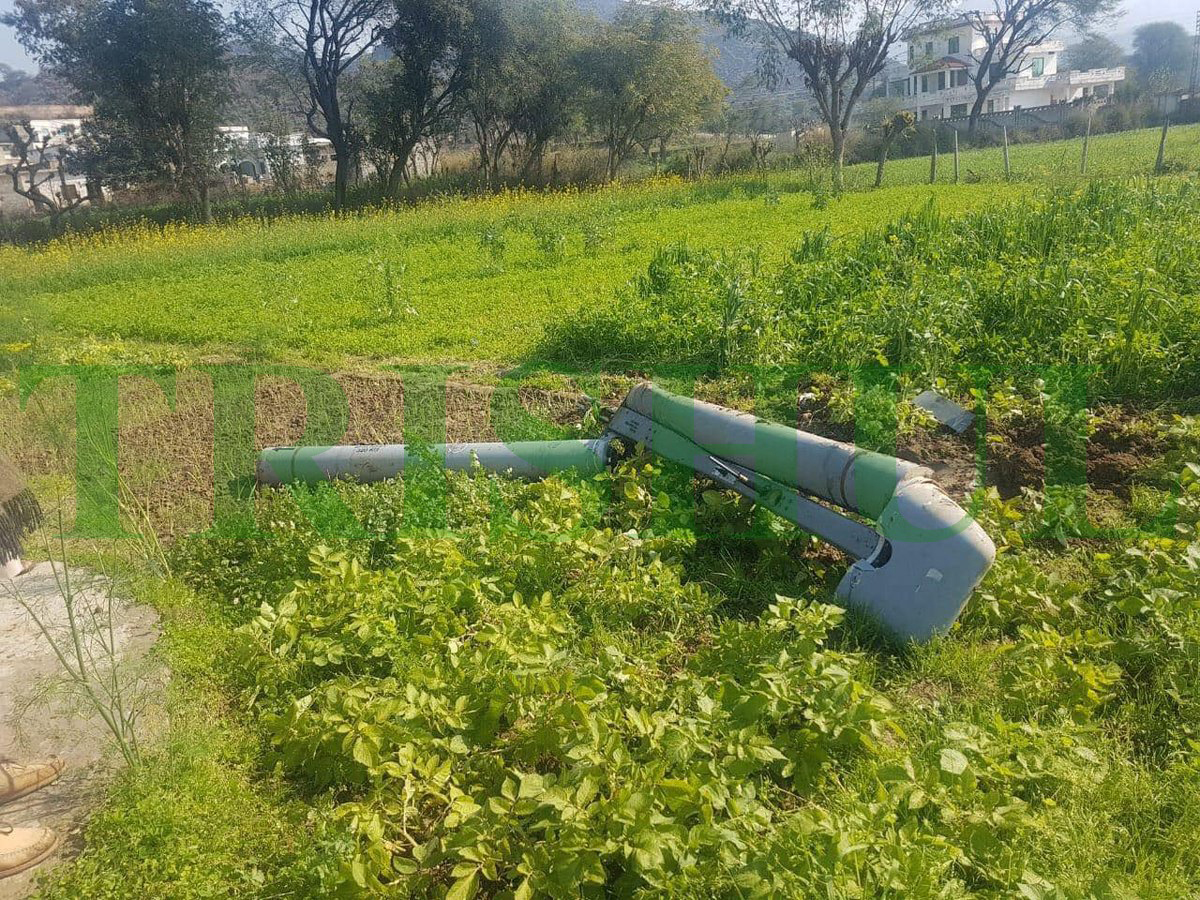
 The downed PAF F-16 was shot down over the Jhangar area of Jammu & Kashmir, but its wreckage
fell in Khuiratta inside PoK, opposite the Lam Valley. The MiG-21 Bison, on the
other hand, went down near Horra’n village, located
7km west of the LoC in PoK’s Bhimber
district. The entire aerial engagement ended at around 10:45am.
The downed PAF F-16 was shot down over the Jhangar area of Jammu & Kashmir, but its wreckage
fell in Khuiratta inside PoK, opposite the Lam Valley. The MiG-21 Bison, on the
other hand, went down near Horra’n village, located
7km west of the LoC in PoK’s Bhimber
district. The entire aerial engagement ended at around 10:45am.


There are only two plausible reasons why
the PAF preferred to use BVRAAMs instead of SRAAMs for this aerial engagement:
1) The PAF was unsure whether or not the IAF’s Su-30MKIs equipped with IRST
sensors would join the battle (if they were to, then they would have easily had
the upper hand since they can cruise at higher altitudes from where the R-73E
SRAAM/Sura-1 HMDS combination can be used with devastating effect); 2) The PAF,
devoid of all-aspect SRAAMs that can be guided wide off-boresight by the Joint
Helmet-Mounted Cueing System (JHMCS), was extremely vary of initiating
within-visual-range engagements due to the guaranteed and combat-proven
lethality and superior engagement envelope of the R-73E SRAAM/Sura-1 HMDS
combination found in the MiG-21 Bison and Su-30MKI.

The only plausible reason why all other IAF MRCAs airborne in that area were directed NOT TO engage those AIM-120C-5 AMRAAM-armed PAF F-16s orbiting over PoK was because the latter was maintaining a 10km distance from the LoC (as per the 1989 bilateral agreement on confidence-building measures between India and Pakistan). In retrospect, this appears to be a wrong interpretation of the 1989 bilateral agreement, which in turn led to a flawed rules of engagement put in motion by the IAF.


When it comes to self-protection, the IAF adheres to the practice of one of every two airborne MRCAs (the lead aircraft and the wingman) being equipped with the EL/L-8222 jamming pod. Consequently, the aircraft not equipped with this pod must always be within the effective jamming envelope of the second aircraft carrying this pod. Hence, while the Su-30MKIs equipped with EL/L-8222 maintained formation and were thus protected from inbound AIM-120C-5 AMRAAMs (which have 70km max range), the two-unit MiG-21 Bison flight somehow broke-up, which in turn led to the MiG-21 Bison flown by Wg Cdr Abhinandan being left defenceless against any type of inbound BVRAAM.

Another plausible reason that explains
the IAF’s reticence to engage the PAF’s large-sized strike package is the lack of tactical
data-links (TDL) on-board the IAF’s fleet of combat aircraft and on the fleet
of AEW & CS platforms, which prevents the latter from providing real-time
airborne battle management cues to airborne IAF combat aircraft while operating
inside contested/hostile airspace. TDLs come in two types: the L-band TDL for two-way
line-of-sight communications; and a UHF-band SATCOM TDL, for which the IAF’s
combat aircraft need to be equipped with SATCOM receivers.

Meanwhile, efforts have commenced on procuring
473 + 3,125 software-defined radios for achieving
real-time connectivity between all IAF aircraft/helicopters and the Integrated
Aerospace Command, Control & Communications System (IACCCS), especially via
the GSAT-7A’s SATCOM transponders.


UAS Interceptions

At around 6am on February 26 near
Nanghatad village in Abdasa taluka of Kutch district in Gujarat on, a Pakistan
Navy-operated ScanEagle UAS was detected and shot down by an IAF-operated
SpyDer-SR SHORADS as the UAS, suspected to have been launched from an area near
Sir Creek, was approaching from the sea the IAF’s Naliya AFS, which is home to 12
FBSU’s 45 ‘Flying Daggers’ Sqn
operating MiG-21 Bisons and 101 ‘Falcons’ Sqn
flying MiG-21Ms. The Pakistan Navy had inducted into service the ScanEagles—built by Insitu, a Boeing subsidiary—on August 31, 2016.


The second UAS interception took place
on March 4, 2019 at around 11am when a PAF-operated Falco UAS, which
had taken off from Bahawalpur Airport, entered Indian airspace near the BSF’s
Soorma and K K Tibba outposts at Anupgarh in Rajasthan’s Sri Ganganagar
district.

There are two IAF air bases in this area, these being
the Nal/Bikaner AFS housing 46 Wing’s 3 ‘Cobras’ Sqn with MiG-21 Bisons;
and Jodhpur AFS housing 32 Wing’s 10 ‘Winged Daggers’ Sqn,
29 ‘Scorpions’ Sqn and 37 ‘Panthers’ Sqn with MiG-27UPG,
32 ‘Thunderbirds’ Sqn with MiG-21 Bisons and 31 ‘Lions’ Sqn
with Su-30MKIs. The intruding Falco was shot down by a Su-30MKI with 30mm
cannon-fire and debris of this UAS fell just inside Pakistan. The
Falco UAS can fly at an altitude of 18,000 feet for 14 hours at a speed of
105nm per hour.


The only plausible
reason why these UAS platforms were sent from Pakistan was to ascertain whether
the IAF had conducted any preparations for undertaking a missile-strike (with ground-launched BrahMos-1 Block-3 missiles) against
probable targets like the JeM’s headquarters at Bahawalpur, or the Karachi-based
seafront villa owned by Dawood Ibrahim at D-13, Block-4, Karachi
Development Authority, Scheme-5, Clifton.


(to be concluded)
