Total Pageviews

Wednesday, July 6, 2011

All-Weather Friendship Scales New Heights

Pakistan’s efforts to have a sea-based minimum credible nuclear deterrent vis-a-vis India took a significant step forward last May when the state-owned, Wuhan-based China State Shipbuilding Industrial Corp (CSIC) ferried the first Qing-class conventional attack submarine (SSK) to Shanghai to begin a year-long series of sea trials, which is likely to include the test-firing of three CJ-10K submarine-launched, 1,500km-range land attack cruise missiles (LACM) capable of being armed with unitary tactical nuclear warheads. Called the Qing-class SSK, it is a variant of the Type 041A Improved Yuan-class SSK, which is also due to begin its sea trials later this month. It is now believed that the contract inked between CSIC and Pakistan early last April calls for the CSIC’s Wuhan-based Wuchang Shipyard to supply six Qing-class SSKs, all of which will be equipped with a Stirling-cycle AIP system and will be able to carry up to three nuclear warhead-carrying CJ-10K LACMs each. The double-hulled Qing-class SSK, with a submerged displacement close to 3,600 tonnes, bears a close resemblance to the Russian Type 636M SSK, and features hull-retractable foreplanes and hydrodynamically streamlined sail. The first such SSK was launched in Wuhan on September 9 last year, and a total of three such SSKs are on order from China’s PLA Navy as well.

The AIP system for the Qing-class SSK was developed by the 711th Research Institute of CSIC. R & D work began in June 1996, with a 100-strong team of scientists and engineers led by Dr Jin Donghan being involved in developing the Stirling-cycle engine, while another team led Professor Ma Weiming of China’s Naval Engineering University began developing the all-electric AIP system. The two projects entered the production engineering stage in 2007, with the Shanghai Qiyao Propulsion Technology Ltd, a wholly owned subsidiary of the 711th Institute, becoming the principal industrial entity charged with producing the AIP system. Incidentally, the Qing-class SSK’s all-electric propulsion system is a derivative of a similar system that was developed about a decade ago for the PLA Navy’s six Type 093 Shang-class SSGNs and three Type 094 Jin-class SSBNs.

The submarine-launched CJ-10K LACM has been developed by the China Aerospace Science and Industry Corp’s (CASIC) Hubei-based Ninth Academy (also known as the Sanjiang Aerospace Group, or 066 Base) on cooperation with the Third Academy’s Beijing-based  Xinghang Electromechanical Equipment Factory (159 Factory). Final assembly of the CJ-10K is undertaken by the Beijing-based Hangxing Machine Building Factory (239 Factory). The CJ-10K features an imaging infra-red optronic system for terminal homing, and it makes use of a ring laser gyro-based inertial navigation system combined with a GPS receiver to receive navigational updates from China’s ‘Beidou’ constellation of GPS navigation satellites.

In another development, during Pakistani Prime Minister Yousuf Raza Gilani’s four-day official visit to China beginning May 17, the decks were cleared for the Pakistan Navy to acquire for a 10-year lease period the two Jiangkai I-class Type 054 guided-missile frigates (FFG) Ma’anshan (FFG-525) and Wenzhou (FFG-526), which have been in service with the PLA Navy’s East Sea Fleet since 2005. The Type 054 Jiangkai I-class FFG, built by CSTC’s Shanghai-based Hudong-Zhonghua Shipyard and the Guangzhou-based Huangpu Shipyard, displaces around 4,300 tonnes, and comes armed with twin quadruple launchers amidships housing the YJ-83 anti-ship cruise missile (equipped with a 165kg warhead), one CPMIEC-built eight-cell Hong Qi-7 short-range SAM system designed to engage aircraft in all-weather conditions out to a range of 12km, a single-barrel 100mm main gun developed by China’s 713 Institute, four six-barrel 30mm AK-630M close-in weapon systems (CIWS), twin 18-tube countermeasures dispensers, and twin Type 87 six-tube 240mm anti-submarine rocket launchers, with 36 rockets. The FFG has a combat management system built by China Electronics Technology Group Corp (CETC), and a sensor suite that includes a Type 360S 2-D air/surface radar operating in E/F-band and having a range of 150km, one I-band MR-36A surface search radar, an I-band Type 347G radar for CIWS fire-control, an I/J-band Type 344 radar for main gun targetting, SNTI-240 SATCOM radio, HZ-100 EW suite, twin I-band RM-1290 navigation radarsm and a J-band Type 345 radar for fire-control of the Hong Qi-7 SHORADS. The FFG also comes fitted with a Russian MGK-335 fixed hull-mounted medium-frequency active/passive panoramic sonar suite. The propulsion system is of the combined diesel and diesel (CODAD) arrangement and employs four SEMT Pielstick (now MAN Diesel SA) 16 PA6V-280 STC diesel engines to give the FFG a cruise speed of 27 Knots. China imported the 16 PA6V-280 STC’s production rights in the late 1990s and is now producing the engines locally under licence at Shaanxi Diesel Factory. Each 16 PA6V-280 engine can produce a sustained power of 4,720kW (6,330hp), giving a total power of 18,880kW (25,320hp). The Jiangkai 1-class Type 054 FFG also has a helicopter deck capable of housing a Harbin Z-9EC multi-role shipborne helicopter, three of which are presently in service with the Pakistan Navy.—Prasun K. Sengupta

Tuesday, July 5, 2011

More Details Emerge About ‘Prahaar’

Further details are now emerging about the solid-fuelled ‘Prahaar’ surface-to-surface battlefield support missile, which is destined to replace about 350-odd existing Prithvi SS-150 liquid-fuelled battlefield interdiction missiles that are now nearing the end of their service lives. The ‘Prahaar’ will reportedly come packed in a six-unit pod configuration on board a high-mobility BEML-TATRA wheeled vehicle housing both a SATCOM-equipped command-and-control shelter as well as a transporter-erector-launcher mechanism designed by Larsen & Toubro. The ‘Prahaar’ follows a relatively simple three-element design, comprising a warhead in the fore section, propulsion unit, including the solid-fuel rocket motor with a nozzle. The nozzle is encircled by the navigation, flight control and guidance unit, which includes the integrated avionic guidance and flight control section, cruciform tail control surfaces, actuators, related antennas and connectors. The ‘Prahaar’ can be launched within few minutes, from unprepared positions. In fact, any target whose location is known within the range of the missile can be attacked within less than 10 minutes from the launch decision. Each ‘Prahaar’ will be housed within a disposable sealed cannister providing a 10-year service-life and very low maintenance costs.

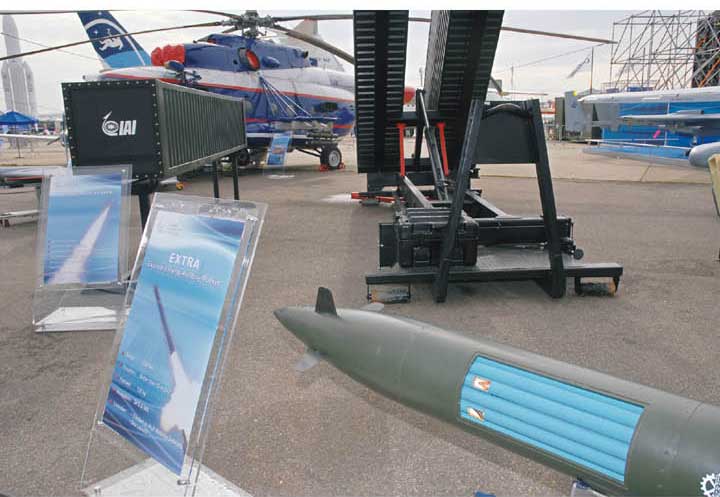
The EXTRA projectile, which has served as inspiration for the Prahaar, has a range of 150km and carries a 125kg (275lb) warhead. Launch weight is about 430kg (990lb), and CEP is well within 10 metres. Equipped with a fibre-optic gyro-based inertial navigation system combined with a GPS receiver, the EXTRA uses an aft section fitted with stabilising fins and a solid-rocket motor. The warhead section is built as a modular compartment, designed to carry various types of sub-munitions or a unitary warhead. For example, it will be able to carry up to 400 AT/AP bomblets, scatterable mines, anti-runway munitions and similar loads. The fin-mounted control section will store the guidance and control avionics, driving four flight control surfaces for trajectory shaping. The Prahaar's payload compartment is being developed by the DRDO in cooperation with Israel Aircraft Industries’ (IAI) MLM Systems Integration Division and Israel Military Industries’ (IMI) Rocket Systems Division as a modular kit. By adjusting the ballistic trajectory of the missile to compensate for wind drift and other meteorological effects the EXTRA’s flight control system is claimed to have improved the accuracy of the missile by 4 times the average accuracy of existing unguided MBRL-launched rockets. The EXTRA’s sub-munitions are 30cm in diameter and 3.97 metres (13 feet) in length.—Prasun K. Sengupta

Sunday, July 3, 2011

Here Comes The ‘Prahaar’…At Last

Come July 17, the ITR at Chandipur-at-Sea will play host to the maiden test-firing of the long-awaited 150km-range ‘Prahaar' (to strike) surface-to-surface quick-reaction tactical non-line-of-sight (NLOS) battlefield support surface-to-surface missile, which has been under development for the past four years. First unveilled early last year in scale-model form at the booth of Larsen & Toubro during DEFEXPO 2010, the ‘Prahaar’ will be a road-mobile NLOS weapon—similar to the BrahMos supersonic multi-role cruise missile—with each motorised transporter-erector-launcher (TEL) carrying six cannisterised, vertically-launched missiles armed with conventional warheads. A separate wheeled vehicle is being developed to act as a missile resupply station, carrying six cannistered missile rounds. In fact, it would not be wrong to claim that the 'Prahaar' is an Israel Aerospace Industries-built EXTRA long-range artillery rocket with Indian characteristics. Thus, the solid-fuelled ‘Prahaar’ is, in essence, a product that overcomes all the deficiencies displayed by the Prithvi family of battlefield support missiles (the SS-150, SS-250 and SS-350), which makes uses of liquid fuel and is consequently cumbersome both in terms of transportation and launch readiness procedures. Furthermore, the Prithvi was never a quick-reaction system and its flight trajectory can be easily tracked by early warning radars as it is a single-stage missile. In contrast, the ‘Prahaar’ reportedly boasts a three-element flight-control system, with the third and final stage comprising only the manoeuvring warhead section. The ‘Prahaar’ will eventually replace all existing Prithvi SS-150 missiles that are now deployed by the three Missile Groups attached to the Indian Army’s two Field Artillery Divisions.

A photo of the scale-model of the TEL carrying the ‘Prahaar’ can be seen at: 
 https://blogger.googleusercontent.com/img/b/R29vZ2xl/AVvXsEiJAFioYFVG2H0YnWubd9bYHIPzIQtg2YM0wzAxbJKEExgAd1LZUN-_rvl8oDjpm5cVWtzlqPkwLHanIlOj2Zy6o23CQtQ7VZJWniMywkyQXehm5DH5pNK66d-uw6ZVS4FPNuo-ZIiNq4eF/s1600-h/CIMG2863.JPG

Introduction of such a new precision-guided munition (PGM) is bound to pose some unique challenges to a ground forces commander’s operational art. Just to get an idea of what such challenges might be, I’ve enclosed below an interesting development now taking place within Israel, involving the application of similar PGMs:
A power struggle has erupted between Israel’s IDF-Air Force and the IDF’s Ground Forces Command (GFC) over the training of air support officers to be deployed in infantry units. The air support officers are to assist the units in coordinating air strikes during large operations. The position of air support officer was established following the Second Lebanon War in 2006 and grew in importance after Operation Cast Lead in Gaza in 2009. Up until now, the positions have been filled by reservist pilots stationed in infantry and armoured brigades; the pilots undergo special training with the ground forces to learn how to direct air support where IDF troops operate. Now, however, the GFC has asked the General Staff to create the post not just within brigades but also within battalions and even companies. Currently, if a battalion commander wants aerial support, he cannot speak directly with pilots, but needs to put in a request to the brigade where the air support officer then coordinates the strike. Due to this indirect process, the IAF demands that the distance between the target and the nearest IDF troops in the area be at least 1,000 metres. “This is not an effective process,” one senior IDF officer said, “not to mention that in other Western militaries the distance required is around 300 metres and not 1,000.” The IDF-AF, however, says it does not have enough reservist pilots for the role. The GFC has suggested the IDF-AF take some of its squad leaders and train them to become air support officers, but the IAF rejected the proposal, contending that someone who was not a pilot could not fill the position--even though army officers do so in other Western militaries. The issue recently came up at a meeting of the General Staff and, despite the IDF-AF’s opposition, is said to be close to resolution--either by training squad leaders for the positions, or having the GFC buy new rocket systems that would reduce its dependence on air strikes. The GFC recently made an attempt to procure advanced and accurate rocket systems and, despite the IAF’s objections, it is now seeking a budget for the rocket systems as part of the IDF’s new multi-year plan, set to begin in 2011. One candidate is the Accular, developed by Israel Military Industries. It is a 60mm. autonomous surface-to-surface missile guided by a GPS system that puts it within a few meters of a target. The rocket, designed to destroy artillery batteries and infantry command posts, was successfully tested earlier this year in southern Israel. If these rockets are purchased, the GFC would be able to reduce its current level of dependence on IAF air support. This would take some of the load off the IDF-AF and allow it to focus strictly on strategic targets deep in enemy territory. With the new rocket systems, the IDF would create a division of responsibility between the Artillery Corps and IDF-AF to clarify who is responsible for which targets and at which ranges.

Friday, July 1, 2011

Tejas Mk2 MRCA’s R & D Effort Gathers Pace

The full-scale engineering development efforts of India’s Tejas Mk2 multi-role combat aircraft (MRCA) recently took a significant step forward when the Bangalore-based Aeronautical Development Agency (ADA), in consultation with the Indian Air Force (IAF), froze the MRCA’s design, which will now have a length of 14.2 metres (1-metre more than that of the Tejas Mk1 for incorporationg a stretched nose section and a modified fuselage section aft of the cockpit for housing an expanded complement of mission avionics LRUs), height of 4.6 metres (as opposed to 4.4 metres of the Tejas Mk1) to accommodate an enlarged vertical tail-section, and a wingspan of 8.2 metres—same as that of the Tejas Mk1—that, however, will feature an increased wing area. External stores capacity will be boosted to 5,000kg (as opposed to 3,500kg for the Tejas Mk1), while the twin internal air-intake ducts will be minimally enlarged to cater to the increased airflow requirements of the 98kN thrust F414-GE-INS6 turbofan built by GE Aero Engines. The Ministry of Defence had, last January, sanctioned US$542.44 million (Rs2,431.55-crore) for ADA to develop the IAF’s Tejas Mk2 variant and the Indian Navy’s LCA Mk2 (Navy) variant so that the first Tejas Mk2 prototype can roll out by September 2013 and fly by December 2014, following which the MoD-owned Hindustan Aeronautics Ltd (HAL) would begin series-producing the MRCA by 2016. While the IAF is committed to procuring an initial 83 Tejas Mk2s, the Navy has expressed its firm requirement for 46 LCA Mk2 (Navy). Just like the Tejas Mk1, the airframe of the Tejas Mk2 will incorporate 13 major composites-built structures fabricated by TATA Advanced Materials Ltd (TAML), which was awarded the contract after the state-owned National Aerospace Laboratory (NAL) expressed its failure to deliver the structures on time. Structures to be produced by TAML for each aircraft will include a rudder assembly, fin assembly, 60 carbon-fibre reinforced (CFC) wing spars, 38 wing fuselage fairing skins, 20 wing fuselage fairing blocks, 41 CFC centre fuselage components, two forward undercarriage doors and two aft undercarriage doors.

Vendor selection by the IAF for supplying various sub-systems for the Tejas Mk2 too is gathering pace. What has been confirmed thus far is that the two-way airborne operational data-links (ODL) will be supplied by HAL, which, among other systems, will be supplying a newly-designed mission computer (to cater to the increased processing requirements of the new fire-control system and IDAS), the RAM-1701AS radio altimeter, TACAN-2901AJ and DME-2950A tactical air navigation system combined with the ANS-1100A VOL/ILS marker, CIT-4000A Mk12 IFF transponder, COM-1150A UHF standby comms radio, UHF SATCOM transceiver, and the SDR-2010 SoftNET four-channel software-defined radio (working in VHF/UHF and L-band for voice and data communications), and the Bheem-EU brake control/engine/electrical monitoring system, all of which have been developed in-house by the Hyderabad-based Strategic Electronics R & D Centre of HAL. SAGEM Défense Sécurité will supply the Sigma-95N ring laser gyro-based inertial navigation system coupled to a GPS receiver (which is also on board the Su-30MKI and Tejas Mk1). The open-architecture integrated defensive aids suite (IDAS), which has been under joint development by the DRDO’s Bengaluru-based Defence Avionics Research Establishment (DARE) and Germany-based Cassidian since 2006, will include the AAR-60(V)2 MILDS F missile approach warning system, the EW management computer and Tarang Mk3 radar warning receiver (all to be built by Bharat Electronics Ltd), countermeasures dispenser built by Bharat Dynamics Ltd, and Elettronica of Italy’s ELT-568 directional jammers (now being installed on the IAF’s MiG-29UPGs), which make use of active phased-array transmitters for jamming hostile low-band (E-G) and high-band (G-J) emitters. The redesigned digital flight-control computer will be built by BEL, while the HMD chosen is the TARGO from Elbit Systems. For tactical strike missions, the ‘Tejas’ Mk2 will be equipped with the Litening-3 LDP, supplied by RAFAEL Advanced Defence Systems of Israel. The actuated retractable aerial refuelling probe, mounted on the Tejas Mk2’s starboard cockpit section, will be supplied by UK-based Cobham Mission Equipment. The same vendor will also supply the pneumatic air-to-ground stores ejection systems like release units, practice bomb carriers, multiple stores carriers, AGML-3 triple-rail launchers, and high-velocity ejection launchers, almost all of which are already operational on the IAF’s fleet of BAE Systems Hawk Mk132 lead-in fighter trainers. Cobham will thus join a growing list of foreign vendors associated with both the Tejas Mk1 and Mk2, which include Intertechnique SA, SAFRAN Group’s SAGEM Défense Sécurité subsidiary and IN-LHC ZODIAC of France; US-based GE Aero Engines, Hamilton Sunstrand, EATON Aerospace, MOOG, and Goodrich Aerospace; UK-based CHELTON Avionics, Penny + Giles, and Martin Baker (supplier of Mk 16LG zero-zero ejection seats); Italy’s Secondo Mona; and Germany’s Cassidian and Faure Herman. Indian companies involved include HAL, TAML, Data Patterns Pvt Ltd, Government Tool Room and Training Centre (GT & TC), and SLN Technologies Pvt Ltd.

By the year’s end, the IAF is expected to select the foreign vendor for supplying the integrated fire-control system (including an infra-red search-and-track sensor, or IRST, integrated with an AESA-based multi-mode radar), and a frameless canopy actuation system. The former, which will, in essence, dictate the Tejas Mk2’s combat capabilities, is likely to keenly contested by vendors from the US, France, Israel and Italy. US-based OEM Raytheon intends to offer its RACR AESA-based MMR along with a chin-mounted IRST sensor, while THALES Avionics is likely to propose a scaled-down variant of its RBE-2 AESA-based MMR integrated with the nose-mounted Optronique Secteur Frontal (OSF) IRST, which comprises two optical modules. The right-side module has a long-wave (8-12 micron) infra-red sensor used for target search and track out to 90km in ideal conditions. The left-side module carries a CCD TV camera for daytime target identification. The system also includes a laser rangefinder for use against airborne targets. The OSF is primarily an air-to-air search, track, identification, and localisation sensor, with a limited air-to-ground localisation and identification function as of now. A future enhancement of the OSF will include a night target-identification function (for precision air-to-ground strikes and anti-ship operations) based on a mid-wave IR sensor that would replace the CCD TV camera. The ELTA Systems subsidiary of Israel Aerospace Industries (IAI) is expected to proposed its EL/M-2052 AESA-based MMR integrated with an in-house nose-mounted IRST sensor, while Selex Galileo of Italy will most likely propose its Vixen 1000ES AESA-based MMR  integrated with its 55kg Skyward nose-mounted IRST. Choice of the optimum combination of air combat missiles (both within-visual-range and beyond-visual-range) will be totally dependent on which fire-control system is finally selected, with the principal contenders being Raytheon (AIM-9X/AIM-120C AMRAAM), RAFAEL of Israel (Python-5/Derby), MBDA (MICA family) and Russia’s Vympel JSC (RVV-MD/RVV-SD combination), which IAI/ELTA Systems will likely propose in case the Python-5/Derby solution is rejected by the IAF.—Prasun K. Sengupta

Wednesday, June 22, 2011

A Dream Come True For The IAF

Back in 2007, when the Indian Air Force (IAF) began work on commissioning its advanced landing grounds (ALG)—spread along the rolling valleys and hills in the mountainous and forested northwestern and northeastern regions of India, it soon realised that some of these ALGs, with modest upgradations, could also serve as peacetime locations housing dedicated intelligence, surveillance and reconnaissance (ISR) platforms on temporary deployments. The only item lacking at that time was the availability of high-wing STOL turboprop aircraft equipped with ISR sensors and mission management suites. Specifically, the IAF wanted a platform that could overcome the otherwise unmanageable clear air turbulence owing to mountain waves, low-level wind shear, and low clouds, and which could easily take off from and land on ALG located at altitudes of between 4,000 feet and 6,200 feet, and whose runways have a length of between 3,600 feet and 4,200 feet and a width of between 60 and 75 feet (which is half that of a normal runway), and which, unlike conventional airfields, are not equipped with stopways, overruns and undershoots.

It would now appear that the IAF’s prayers have finally been answered. For, on June 21 at the on-going Paris Air Show in Le Bourget, Airbus Military and Israel Aerospace Industries (IAI) decided to combine forces to jointly develop and market a new version of the Airbus Military-built C-295 platform fitted with a fourth-generation airborne early warning and control (AEW & C) system produced by ELTA Systems, a wholly owned IAI subsidiary. The primary sensor of this AEW & C platform will be a 360° rotating AESA-based multi-mode radar that will also be capable of conducting ground surveillance and real-time moving ground target indication from standoff distances. A Memorandum of Understanding (MoU) to this effect was signed at the Le Bourget Airshow by IAI Corp’s VP and ELTA President, Nissim Hadas, and Airbus Military CEO Domingo Ureña. The network-centric C-295 AEW & C is being designed to provide high-quality 360° surveillance for creating in real-time an integrated air, ground and maritime ‘Situation Picture’ and the electronic order of battle. A C-295 fitted with a rotodome demonstrator has been conducting flight-trials from Airbus Military’s Seville facility since June 8. Initial tests have shown that the aircraft is aerodynamically an excellent platform for this purpose. ELTA Systems and Airbus Military are now conducting engineering studies to integrate the mission suite, including the rotodome-mounted AESA radar and EADS/CASA’s seven-man FITS mission management suite, into the aircraft. In order to optimise the platform for operating in and out of ALG-type airfields, the C-295 AEW & C will come equipped with a chin-mounted FLIR. It will also house a belly-mounted radome housing a 360° rotating inverse synthetic aperture radar, which will perform ground-mapping and ground target profiling operations.

As per the IAF’s future force structure projections, at least six such platforms are required for supplementing the existing fleet of three A-50EI PHALCON AEW & C platforms. A follow-on order for two additional A-50EIs was placed by India’s Ministry of Defence with IAI last March.—Prasun K. Sengupta

Monday, June 20, 2011

Giving Realistic Options A Chance

There are several reasons why India’s Ministry of Defence (MoD) should be disinclined to approve the proposed ‘limited’ upgrade programme involving the 51 Dassault Aviation-built Mirage 2000H/TH multi-role combat aircraft in service with the Indian Air Force (IAF). Firstly, there is the issue of the techno-economic matrix, meaning whether or not the high expenditure to be incurred is justified. To understand this, one has to note that the term ‘limited’ upgrade excludes the option of re-engining the aircraft. In addition, there are to be no airframe modifications, no changes to major aircraft systems, no modification to equipment bays, limited cockpit modifications, and minimum retrofit line-modification facilities/activities. This would mean that even if the Mirage 2000H/THs are to receive a brand-new open-architecture mission/cockpit avionics suite and see their airframes being refurbished and re-lifed to stay in airworthy condition for the next 20 years, they still will not be able to remain flyable till 2038 (due to the 35-year guaranteed service-life warranty issued by Dassault Aviation) simply because the existing SNECMA Moteurs-built M53P2 turbofans would have reached the end of their certified total technical service lives (TTSL) by 2029.

This then brings us to the issue of costs. As is now known, THALES has refused to reduce its quotation of Rs96.4 billion (US$2.1 billion) for the ‘limited’ upgrade programme of the IAF’s Mirage-2000 fleet. The MoD considers this price—Rs1.96 billion ($41 million) per aircraft—unacceptably high, given that the engines will not be changed. THALES, as prime contractor has reportedly offered to deliver the first two upgraded aircraft from its facilities in France within 40 months of signing, while it will help Hindustan Aeronautics Ltd (HAL) upgrade two more aircraft in India to gain familiarity. Thereafter, HAL would upgrade one aircraft every month, for 47 months. Initially, THALES had quoted $2.9 billion), which it brought down to the current level of $2.1 billion after the IAF diluted its upgrade requirements. The IAF had floated a request for proposal (RFP) for undertaking the ‘limited’ upgrade in April 2008, to which THALES had replied in July 2008. Interestingly, the IAF refused to even consider an alternative option offered by a joint team of Israel Aerospace Industries (IAI) and HAL under which each of the Mirage 2000H/THs can be upgraded for only Rs520 million ($11.5 million). The reason being given by the IAF: a policy decision taken almost a decade ago by the MoD to appoint only the Original Equipment Manufacturers (OEM)—like Dassault Aviation and THALES in case of the Mirage 2000—as prime contractors for all aircraft upgrade programmes—be they ‘limited’ or ‘deep’ in terms of the scope of work. But if this is indeed the case, then how come the MoD had appointed HAL as the prime contractor when carrying out the Limited Upgrade Sea Harrier (LUSH) programme (codenamed Project Tiger) for 14 BAE Systems-built Sea Harrier carrier-based V/STOL combat aircraft between March 2005 and December 2009? And why was the DARIN-2 mission avionics upgrade programme for the IAF’s fleet of Jaguar IS/IM interdictor/strike aircraft carried out jointly by HAL and the DRDO in the late 1990s without appointing BAE Systems as the prime contractor? And what about the limited upgrade programme involving the IAF’s MiG-27M strike aircraft, which too was carried out jointly by HAL and the DRDO without any participation by Russia’s United Aircraft Corp? And if one is to safely assume that over the years both HAL and the DRDO have acquired the core technological competencies (thanks to the investments made in the Tejas LCA’s R & D effort) required for indigenously designing and developing open-architecture mission/cockpit avionics suites meant for both Europe-origin and Russia-origin combat aircraft, then why is HAL being prevented from being appointed as the prime contractor for the Mirage 2000 upgrade programme, especially when it is the French themselves who are now ‘advising’ the IAF to instead invest the huge sums of money (earmarked for the ‘limited’ upgrade) in the forthcoming M-MRCA procurement effort?

There is also another point to be noted: for reasons best known to them, both Dassault Aviation and THALES have, over the past decade, failed to offer a range of ‘limited’ upgrade options for the Mirage 2000—more than 600 of which have been built for nine air forces worldwide. One would like to believe that companies like Dassault Aviation, THALES and Sagem Défense Sécurité would be actively promoting their respective aircraft service life extension/avionics suite upgrade packages to countries like Brazil (with 10 ex-French Air Force Mirage 2000Cs and two Mirage-2000Bs), Egypt (16 single-seat Mirage-2000Ms and four tandem-seat Mirage-2000BMs), France (87 Mirage-2000Cs, 30 Mirage 2000Bs, 75 Mirage-2000Ns, 37 Mirage 2000-5F, and 86 Mirage-2000Ds, Greece (36 single-seat Mirage 2000EGs and four tandem-seat Mirage-2000 2000BGs and 15 Mirage 2000-5 Mk2s), India (52 Mirage-2000Hs and seven Mirage-2000THs), Peru (10 Mirage-2000Ps and two Mirage-2000DPs), Qatar (nine Mirage-2000-5EDAs and three Mirage-2000-5DDAs), Taiwan (48 Mirage-2000-5EIs and 12 Mirage-2000-5DIs), and the United Arab Emirates (22 Mirage-2000EADs, eight Mirage-2000RADs, six Mirage-2000DADs, 20 Mirage-2000-9s and 12 Mirage-2000-9Ds).  However, it is the opposite that holds true.

As far back as early 2007 both Dassault Aviation and THALES had a golden opportunity to offer a new-generation mission/cockpit avionics suite for prospective Mirage 2000 upgrade programmes when  the French Centre d'Experiences Aeriennes Militaires (CEAM, or Military Aerial Experimentation Center) and the CEV flight-test center in Cazaux, southwest France, modified a Mirage 2000 B501 to flight-qualify the combination of the THALES-built Radar à Balayage Electronique-2 (RBE-2) AESA-MMR and the Optronique Secteur Frontal (OSF) infra-red search-and-track (IRST) sensor for eventual fitment into the Rafale M-MRCA. If at that time THALES had taken a decision to develop lower-cost derivatives of both the RBE-2 and OSF as viable retrofit options (like what Northrop Grumman, Raytheon and IAI/ELTA Systems are now doing with the SABR, RACR and EL/M-2052 AESA-MMRs and what SELEX Galileo is doing with the Skyward IRST sensor) for the Mirage 2000, then THALES today would have been in an enviable position, especially in India. Since this has not happened, it makes little sense for the IAF now to opt for a mission avionics package that uses a RDY-2 X-band multifunction Doppler radar with a mechanically scanning antenna and which is devoid of an IRST sensor.

A far better option, therefore, could see the IAF selecting a package co-offered by HAL and IAI that would comprise a fully integrated but open-architecture mission avionics suite (integrated by the Bangalore-based Defence Avionics Research Establishment, or DARE) to include a new-generation mission computer; AESA-MMR; an IRST sensor; helmet-mounted display (HMD); two-way airborne data-links for communicating with friendly combat aircraft, AEW & C platforms and unmanned aerial vehicles; an integrated defensive aids suite (IDAS) that includes a combined radar/missile approach warning system, countermeasures dispenser, and an internal self-protection jammer; an air-to-air/air-to-ground software-defined radio system that harnesses the power of its distinctive automatic routing and relay capabilities to offer extended range, while offering video, voice and data simultaneously at an exceptionally high data rate; a laser designator pod; tactical reconnaissance pod; and escort jamming pod. Structurally, the aircraft’s weapons pylons could be modified to accept triple-ejector racks capable of launching precision-guided munitions (PGM) like the 125kg/250kg AASM (from the France-based Sagem Défense Sécurité subsidiary of the SAFRAN Group) laser-/GPS-/imaging infra-red sensor-equipped standoff munition, small-diameter laser-guided bombs, and CBU-105 sensor-fuzed weapons from Textron Systems. As far as the X-band AESA-based MMR goes, the EL/M-2052 would be the ideal choice, while the IRST sensor could be SELEX Galileo of Italy’s 55kg Skyward. The HMD could come from Elbit Systems. HAL could supply the RAM-1701AS radio altimeter, TACAN-2901AJ and DME-2950A tactical air navigation system combined with the ANS-1100A VOL/ILS marker, CIT-4000A Mk12 IFF transponder, COM-1150A UHF standby comms radio, UHF SATCOM transceiver, and the SDR-2010 SoftNET four-channel software-defined radio (working in VHF/UHF and L-band for voice and data communications), and the Bheem-EU brake control/engine/electrical monitoring system, all of which have been developed in-house by the Hyderabad-based Strategic Electronics R & D Centre of HAL. The open-architecture IDAS, which has been under joint development by DARE and Germany-based Cassidian since 2006, would include the AAR-60(V)2 MILDS F missile approach warning system, the EW management computer and Tarang Mk3 radar warning receiver (developed by DARE and built by Bharat Electronics Ltd), and  countermeasures dispenser built by Bharat Dynamics Ltd. Contenders for supplying the pod-mounted escort jammer could include IAI/ELTA with its ELL-8251, and RAFAEL’s Skyshield. For self-protection, Elettronica of Italy’s Virgilius family of directional jammers (as part of the IDAS suite), which make use of active phased-array transmitters for jamming hostile low-band (E-G) and high-band (G-J) emitters, could be installed. For tactical strike missions, the Mirage 2000 could be equipped with the Litening-3 LDP and RecceLite tactical reconnaissance pod—both built by RAFAEL.

There is also an urgent need by the MoD to take a final call on the proposed ‘deep’ upgrade package for up to 100 MiG-27Ms, which has been under consideration since 2006. Under this proposal, HAL and the DRDO will be supplying an open-architecture mission/cockpit avionics package similar to the DARIN-3 package already developed by HAL and the DRDO for the 120 to-be-re-engined Jaguar IS interdictors. On the other hand, United Aircraft Corp along with HAL and MMPP Salyut will re-engine the MiG-27Ms with the 99-30S turbofan, which is derived from the NPO Saturn-built AL-31FP turbofan already powering the IAF’s Su-30MKIs. The 99-30S turbofan offers increased thrust (1 ton more than the existing Klimov R29B-300), is lighter by 200kg, and offers fuel savings of up to 15%.—Prasun K. Sengupta

Monday, June 13, 2011

Travails Of India’s DPSUs: The BEL Experience

Soon after he took charge as Union home minister in 2008, P. Chidambaram cleared a long-awaited proposal to procure 32,766 telescopic night vision devices (NVDs) for the paramilitary forces. Bharat Electronics Limited (BEL), a prestigious public sector undertaking, bagged the contract. BEL started supplying the NVDs in September 2010. Till March 2011, it supplied 5,000 NVDs, of which 2,000 were tested. Ten per cent of the tested pieces were found to be faulty; the promised life of a piece was 10 years. The remaining 3,000 pieces are stored at defence depots, as the ministry is wary about deploying them in the field. Apparently, BEL charged the ministry twice the market price. And, there are fears about some of the components being sourced from the grey market. Regarding the NVDs in storage, a senior paramilitary officer said, “[As they were not tested], we will not be in a position to identify defective devices and seek replacement under the one-year warranty cover from BEL.” Following complaints, the home ministry has asked the defence ministry to investigate whether proper trial procedures have been followed and whether kickbacks have been paid. The story began in December 2006, when the home ministry put out a tender for NVDs. The tender stated that the devices were to be compatible with INSAS rifles and light machine guns (LMG) used by the paramilitary forces. For a long time, the ministry was unable to find a supplier. On November 19, 2008, during a target fixation meeting with the ministry, the Ordnance Factory Board said the Ordnance Factory Dehradun was developing an NVD for 5.56mm rifles and LMGs. It offered the device for trial. On February 23, 2009, Dinesh Batra, senior deputy general manager, BEL, wrote to R.S. Sharma, then director of procurement, home ministry, that it could supply the required device. BEL claimed that it had developed a state-of-the-art NVD based on XD-4 technology, in technical collaboration with Prizmatech, a subsidiary of Star Defence Systems, Israel. The company web site claims that “Prizmatech was established as Israel Defence Force’s biggest source for night vision devices.” In early 2009, a fresh ‘request for proposal’ was issued, leading to BEL winning the contract. On June 23, 2009, a trial was conducted at the Border Security Force range in Gurgaon. The trial team consisted of officers of the BSF, Indo-Tibetan Border Police, National Security Guard and Central Reserve Police Force. BEL provided two models for trial—PR-1614 F and BEANS-0802. Ordnance Factory Dehradun also supplied two models—PNS-3X for INSAS and PNS-5.5X for LMG. Both failed the trials. BEANS-0802 failed the trial and the other one scraped through. P.C. Joshi, joint manager, Ordnance Factory Dehradun, declined to talk to THE WEEK about the trial procedure and results. Allegedly, the trial team endorsed BEL’s claims without testing the device’s magnification, operating temperature, battery life (which should be 15 hours) and resolution. But the trial team insisted that the device should have cheek-rests. But, no cheek-rests have been provided till date. The trial team had also found that the NVDs were not fitting snugly on to the assault rifles as BEL had not integrated the sights with the guns. These issues created a lot of inconvenience to the shooters. So, the trial team strongly recommended that BEL submit the NVD for a retrial after fitting a cheek-rest and solving the slotting issues. Surprisingly, despite the shortcomings, no second trial or field trial was conducted. Normally, all equipment is trial-evaluated in varying locations and climatic conditions such as summer, winter, high altitude and desert. “That never happened,” revealed an officer who was on the board. Lt-Gen. (retd) P.C. Katoch, former director-general (information systems), Indian Army, said that a device being procured after a single trial was unheard of. “It should be tested in the places where it is going to be used,” said he. “It should be subjected to battlefield conditions.” Katoch said the four important performance parameters of an NVD are its signal-to-noise ratio (SNR), resolution, modular transfer function and lifetime (see box). “SNR is by far the most important parameter for an image intensifier tube [II tube],” said Katoch. An II tube is a vacuum tube device for increasing the intensity of available light in an optical system, and it constitutes 70 per cent of the cost of the device. THE WEEK learnt that BEL’s NVDs were not tested for SNR. In August 2009, the home ministry cleared the Rs:1,000 crore deal. On January 7, 2010, S. Chattopadhyaya, inspector-general, BSF, issued a proprietary article certificate in favour of BEL stating that no other Indian firm manufactured passive night vision telescopic sights. “A proprietary article is given if a company develops three parts—casing, optics and II tubes,” said an officer who was on the trial team. “BEL developed none of these three critical objects. I am surprised how they were awarded this certificate.” The proprietary article certificate was false because the Broadcast Engineering Consultants India Limited (BECIL) and the Ordnance Factory Dehradun have supplied NVDs to paramilitary forces. In 2010, Assam Rifles had procured 2,000 night vision devices from BECIL, of which only five have developed snags. BECIL developed the NVD in collaboration with a Russian firm. The Opto Electronics Factory, under the Ordnance Factory Board, also makes night vision devices. Ordnance Factory Dehradun has supplied night vision devices to the CRPF in 2000, to Assam Rifles in 2002 and to the ITBP in 2007. On April 25, 2007, the ITBP paid only Rs:1,74,300 per piece to Ordnance Factory Dehradun, while BEL charged the home ministry Rs:3,50,000 per piece. BEL told THE WEEK that it had been supplying large numbers of binocular and monocular devices to the paramilitary forces over the past five years and that only a few devices had developed faults, which were being attended to. “Regarding supply of weapon sights for INSAS and LMG for paramilitary forces, BEL received the first order and started deliveries from September 2010,” BEL said. “Till March 2011, we have supplied close to 5,000 numbers of these night sights. These are currently under deployment and we have not received any complaints from our customers regarding supplies made up to now.” Documents accessed by THE WEEK reveal that BEL did not manufacture the NVDs. It was only sourcing them from Prizmatech in “complete knocked down condition” and assembling them. Prizmatech, in turn, was procuring the II tubes from Photonics, a French company. THE WEEK has with it a letter of intent dated January 26, 2006, reference number CV/CB/150601, signed by Cor Boet, director, Photonics, addressed to Moti Solomon, reportedly a majority shareholder of Prizmatech. The letter proves the Prizmatech-Photonics deal. Interestingly, many of the II tubes do not have the mandatory identification number. Paramilitary officials told THE WEEK that some of the II tubes could have been bought off the grey market. “If a device does not have an identification number, that simply means that it has been taken from the grey market,” said Katoch. What created suspicion about the authenticity of the II tubes was its low figure of merit (FOM), which characterises the performance of the tube. The FOM of an II tube is arrived at by multiplying the number of line pairs per millimetre with the tube’s signal-to-noise ratio. The BEL equipment’s FOM should have been around 1,000, but a senior paramilitary officer said, in field trials, it was less than 750 (see box). The officer also told THE WEEK that when the issue of the unmarked II tubes was raised, BEL temporarily stopped supply. It had reportedly promised to deliver 22,200 devices by March 2011. About the delay in delivery schedule, BEL told THE WEEK that it had not received any request for 22,200 NVDs to be provided before March 2011. The available orders were being executed as per the agreed delivery schedules, BEL said. When THE WEEK inquired with BEL about the missing cheek-rests, its reply was that cheek-rests were not needed, and therefore were not provided. “We have received a complaint about BEL’s night vision devices,” Home Secretary G.K. Pillai told THE WEEK. “We have asked the defence ministry to inquire about it because BEL works under the defence ministry. We hope to get the report from the defence ministry soon.” According to reliable sources, high on the suspicion list is R.S. Sharma, former director (procurement), home ministry (see box on page 44). “We have registered a case against him for allegedly granting undue favours to certain private firms in the procurement of 59,000 bullet-proof jackets,” said CBI spokesman R.K. Gaur. “We are also investigating his role and involvement in other procurement deals.” Another surprising element of the NVD deal was that there was no commitment from BEL and Prizmatech to provide spare parts. By the end of the trials, it was clear the device, in its current form, was not fit for service. So, the board proposed three options to the ministry. First, if BEL overcomes the shortcomings, the procurement may be made from BEL on nomination basis. Second, the NVDs may be procured through limited tender from PSUs. Third, procurement through a global tender. “The best option was to go global so that we could have chosen the best device at the best cost,” said a senior paramilitary officer. Pillai agreed to this view: “Normally, we go for a global tender. It is always good to go for a global tender because you get to know what the competitive cost of equipment is. If we do not have different prize disclosures, then we would not know whether that cost is the best cost for the weapon system.” Then why was standard procedure not followed? “We will look into the case and see what went wrong,” said Pillai. The lack of NVDs was felt acutely after the Maoist attack in Dantewada on April 6, 2010, which claimed the lives of 76 CRPF personnel. An internal inquiry report on Dantewada pointed out that the inability to spot the enemy at dawn left the troops at the mercy of well-armed Maoists. “Night vision goggles and gunsights are absolute treasures,” said Vijay Raman, former special director-general, CRPF, who was in charge of anti-Maoist operations. “The view through a passive NVD may be 40,000 to 50,000 times brighter than what the unaided eye sees. With them, you own the night. But if the device fails or creates hindrance, then the consequences will be severe. It may take a soldier’s life.” With the Indian market for NVDs projected at $1 billion, companies like Prizmatech are bullish on India. A defence ministry official said that one of the easy routes for foreign companies to enter India’s defence and domestic security market is through ‘transfer of technology’ deals, where they share technology with India. In the NVD deal, transfer of technology was allegedly the cover to win the contract. BEL told THE WEEK that initially some NVDs were supplied in fully finished form from Israel. “In the second phase, items were supplied in completely knocked-down condition. Assembly and testing was done at BEL before supply,” BEL said. For the rest, BEL did what it calls an “in-depth manufacturing of mechanical and optical components”. But the question remains: how can Prizmatech transfer technology, when the II tubes were made by Photonics? In the end, the ultimate benefactor of the deal was Prizmatech, which used BEL as a cover to sell a device they did not even manufacture! The ball is now in the defence ministry’s court. If BEL is found guilty of flouting procurement rules and procedures, will the home ministry cancel the deal? In this investigation, the defence ministry may find itself in an awkward situation as the Army has recently signed another contract with BEL for 30,634 third-generation NVDs.
http://week.manoramaonline.com/cgi-bin/MMOnline.dll/portal/ep/theWeekContent.do?BV_ID=@@@&contentType=EDITORIAL&sectionName=TheWeek COVER STORY&programId=1073755753&contentId=9452197

Lt-Gen. (retd) P.C. Katoch is confident that technology will form the backbone of all future wars and conflicts, and that the man on the ground needs to be empowered with the best equipment available. Excerpts from an interview:
How important are night vision devices (NVDs) in modern warfare?
Today, most of the fighting happens at night. Whether it is war or fighting insurgency or terrorism, the soldier wants to fight at night. It enables you to surprise your enemy. Therefore, NVDs are critical for operational success. You should be able to see your enemy before he sees you and you should be able to fire at him and fire effectively. Every soldier must have an NVD.
How is the trial of an NVD done?
There should be a comprehensive trial directive. The trial for NVDs must be done in different locations under different weather conditions. It should be exposed to battlefield conditions. In the BEL case, they should have approached the Army for technical support to conduct the trials. The Army has been using NVD-fitted weapons for years.
What are the common problems with NVDs?
A common damage factor is exposure to bright light, rain, fog or even extreme humidity. These may damage NVDs. The battery is another issue. Every day, in Kashmir or in the northeast, troops are out on patrolling or search operations. At times it is not easy to recharge the battery. Then the question is whether we have sufficient batteries for the devices. When the handheld thermal imagers (HHTIs) were first imported from Israel and France, only one charger for four HHTIs was procured. That forced the infantry to improvise chargers, which may have caused damage to the equipment. The problem is that our public sector undertakings are way behind in developing NVDs. The NVDs of DRDO and BEL are not good; they are bulky and heavy.
How can we distinguish between real and fake NVDs?
Every part of the device should have an identification number. It is like a passport, it verifies your birthplace. A night vision scope has a set of optics, batteries, transformer, regulators and capacitors and an image intensifier tube. All these must have separate identification numbers. If an II tube does not have a number, it simply means it was purchased from the grey market.
http://week.manoramaonline.com/cgi-bin/MMOnline.dll/portal/ep/theWeekContent.do?BV_ID=@@@&contentType=EDITORIAL&sectionName=TheWeek COVER STORY&programId=1073755753&contentId=9452198

In 2010, the Central Bureau of Investigation arrested R.S. Sharma, former director (procurement), home ministry, on charges of corruption. A 1984-batch officer of the Indian Railways Service of Mechanical Engineers, he was on deputation to the ministry. The CBI nabbed him for a scam in the procurement of 59,000 bullet-proof vests. Now, his name is at the centre of the night vision device scam, too. He is currently out on bail. The ministry had floated the tender for the vests in 2009. But as the deal ran into murky waters, it was put on hold for a year and Sharma was arrested. The immediate victims of the scam are the paramilitary forces, as they have to fight Maoists and armed insurgents without body armour. The case was a serious blow to the home ministry, as Sharma was involved in the modernisation of central police forces and in procuring and allocating weapons for them. The CBI had arrested Sharma’s alleged accomplices, too,—R.K. Gupta and wife Lavina Gupta, owners of Anjani Technoplast, an armouring firm. The charge was that Sharma favoured Anjani Technoplast’s bid for the vests, despite its product failing the trials. He is accused of leaking confidential data about the tenders and the trial process to Anjani Technoplast. The CBI has registered a case under the Prevention of Corruption Act, 1988. The night vision device scam has also come under the radar of the agency. Allegedly, Sharma and other government officials took bribes for providing inside information that gave BEL and Prizmatech, Israel, an unfair advantage while bidding for contracts. Home Secretary G.K. Pillai told THE WEEK that Sharma had been shifted from the ministry and that the ministry was fully cooperating with the CBI investigation. Said Pillai: “We have given the matter to the CBI. They are investigating not only this [bullet-proof vest scam] deal but other deals, too, which may come up during their investigation. As of now, Sharma stands suspended and charge-sheeted.”
http://week.manoramaonline.com/cgi-bin/MMOnline.dll/portal/ep/theWeekContent.do?BV_ID=@@@&contentType=EDITORIAL&sectionName=TheWeek COVER STORY&programId=1073755753&contentId=9452196