Total Pageviews

Tuesday, November 22, 2011

More Naval Updates

The day-at-sea organised by the Indian Navy’s (IN) Western Naval Command on November 14 provided some additional insights into the force modernisation activities of the IN. For instance, most of the frontline warships and fleet-support vessels are now being refrofitted with RAFAEL Advanced Defense Systems Ltd’s C-PEARL-M ESM system, which enables the automatic detection, data measurement and identification of threats. The C-PEARL-M system is known as SANKET. Other items being refrofitted include the RUKMINI SATCOMS-suite, which is imported directly from Israel’s ORBIT Communication Systems, Ltd through its Indian agent Bharat Electronics Ltd (BEL); and Consilium Selux X-band navigation radars and ECDIS (electronic navigation chart display) systems supplied by Consilium AB of Sweden. All this will also go on board the three Project 15A guided-missile destroyers (DDG), four Project 15B DDGs, and the seven projected Project 17A guided-missile frigates.
As far as AEW operations go, the present practice calls for one Ka-31 to be stationed 96km ahead of an aircraft carrier-based battle group, with all AEW-related data being relayed by a secure data-link (known as Link-S) to the aircraft carrier’s combat information centre (CIC), and not directly to the MiG-29Ks or Sea Harriers. In future, depending on availability of the GSAT-7 satellite (which will be the IN’s first dedicated fleet satellite communications satellite, expected to be launched next year), both the existing ship-to-ship Link-2 and Link-S data-links will be making use of SATCOMS channels for two-way relay of data and communications. The GSAT-7 (INSAT-4F) will be a multi-band satellite carrying payloads in UHF, S-band, C-band and Ku-band. The satellite will weigh 2,330kg with a payload power of 2,000W. The follow-on GSAT-7A will be an IAF-specific communications satellite.—Prasun K. Sengupta

Saturday, November 19, 2011

Air-Sea Battle Concept Explained

It was on November 9, 2011 that the US Department of Defense announced the creation of a new office to integrate air and naval combat capabilities in support of emerging US national security requirements. In the 2010 Quadrennial Defense Review, former US Secretary of Defense Robert Gates had directed the US Navy, US Air Force and US Marine Corps to develop a comprehensive concept to counter emerging anti-access/area denial (A2/AD) challenges, primaril;y of Chinese origin. The US armed services consequently collaborated to develop the Air-Sea Battle (ASB) concept. On August 12, 2011, US Navy Admiral Jonathan Greenert, US Marine Corps Gen Joseph Dunford, and USAF Gen Philip Breedlove established the Air-Sea Battle Office (ASBO), thereby creating a framework to implement the ASB concept. The ASB concept will guide the US armed services as they work together to maintain a continued US advantage against the global proliferation of advanced military technologies and A2/AD capabilities. ASB will leverage military and technological capabilities that reflect unprecedented US Navy, Marine Corps and USAF collaboration, cooperation, integration, and resource investments. The ASBO will oversee the concept implementation by facilitating coordination among the US armed services, influencing tri-services war-games, fostering development and integration of air and naval capabilities, and collaborating with the joint forces. The Air Force, Navy, and Marine Corps will each dedicate a minimum of two field-grade officers or civil service equivalents to the ASBO. Implementation of the ASB concept by the Air Force, Navy, and Marine Corps will endeavour to foster positive changes in the institutional relationships among the services, the integration of acquisition strategies, and the conceptual approach to warfare. The ASB concept is a natural and deliberate evolution of US warfighting to counter emerging A2/AD threats that include conventional ballistic missiles, long-range precision cruise missiles, advanced integrated air and missile defence systems, electronic and cyber warfare capabilities, submarines, surface combatants, and modern combat aircraft. According to the US Defense Department, ASB will also enable the projection of force in defence of US interests and those of its allies and by sustaining stability and freedom of access throughout the global commons.
At a recent seminar organised in New Delhi, it was explained by visiting US officials that ASB initially was conceived as a way to increase inter-operability between the USAF and US Navy through increased training and improved technical interoperability. Given the overlaps in their strike capabilities, especially in aircraft, it makes perfect sense for the two most technical services to work closely to ensure inter-operability. But like its progenitor, AirLand Battle (ALB), ASB has progressed to an operational concept to address a specific military problem. While ALB was conceived to counter the Soviet Union, ASB is billed as the answer to growing anti-access/area-denial capabilities generically, but as everyone knows, specifically the People’s Republic of China. ALB and ASB are different in that ALB required the integration and inter-operability of two distinct domains, ground and air. Because of the overlap between USAF, US Marine Corps and the US Navy in strike assets, and because ASB is focused on strike (kinetic, electronic, cyber), the integration required for ASB is far more limited than that required for ALB. Additionally, ASB assumes that a confrontation between two great powers (US and China) can be resolved with only half the nation’s military assets. It is the first conception, since early advocates of nuclear warfare, that envisions no or extremely limited use of ground forces. This has no precedent in the history of conventional warfare and should in itself give one pause. ALB posited an asymmetric approach in relation to the erstwhile Soviet Union. ALB would attack all echelons of the Soviet forces with aviation and long-range fires because NATO was badly outnumbered on the ground. In contrast, ASB is symmetrical, pitting US precision strike against Chinese precision strike. Since ASB is by definition an away game, how can the US be expected to build sufficient expeditionary naval and air forces to counter Chinese forces that possess a home-court advantage? Is it prudent to expect the weapon magazines of an entire industrial nation to be smaller than those of the US Navy and USAF deployed more than 3,000 miles from home? What happens when the vertical-launch systems of US warships and the bomb bays of USAF aircraft are empty? From a strike perspective, one therefore must consider China’s ground-based strike and intelligence, reconnaissance and surveillance systems a seamless extension of its navy. One cannot simply compare its navy to the US Navy; one must compare all relevant combat power applicable to an anti-access/area-denial fight. Just on the face of it, one should recognise the need for an asymmetric approach to counter China’s growing war-waging capabilities. The US simply can’t afford to outgun China symmetrically. ASB’s symmetrical approach is also highly escalatory given China’s shore-based “fleet-in-being”. The US cannot close its naval and tactical air forces into theatre without striking the Chinese mainland. Surely, given the nuclear weapons China possesses and its growing irregular warfare and economic assets, one should question very seriously any operational concept that requires extensive strikes on the Chinese mainland. There are alternatives, after all.
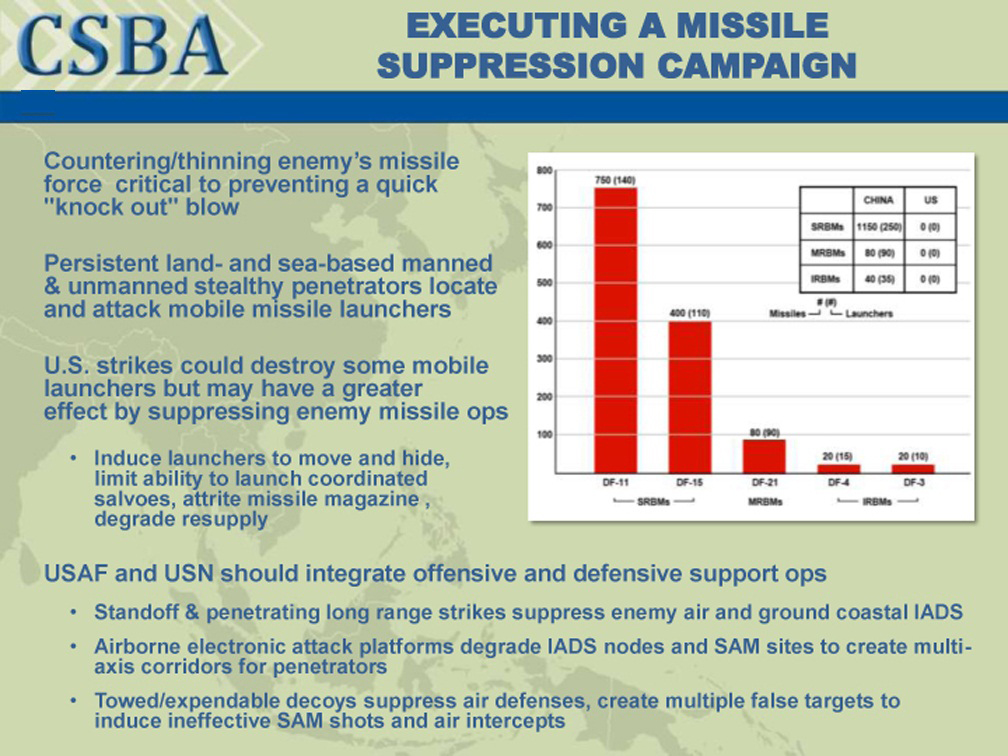
China is surrounded by littoral nations interested in balancing China’s new assertiveness. The US should therefore look for ways to establish co-binding relationships with these countries to assure sovereign access to the region beyond the more easily challenged access to the commons. The threshold for China to strike these sovereign countries is certainly higher than the threshold to attack US warships in the commons. The US should make use of this advantage by encouraging the use of “dual-use” infrastructure that would improve their port facilities for commerce but would also facilitate the use of these ports for basing or periodic use by US sealift and combatant naval forces. For example, a large, medium-speed, roll-on/roll-off ship from a maritime prepositioning squadron would show commitment while offering tangible benefits for humanitarian assistance and disaster-relief missions in the host country or the region. A military confrontation with China would be the biggest national security challenge since World War II, yet ASB advocates suggest that it can be handled by just two of the four services. To the outside observer, this is astonishing; to the insider skeptic, it is absurd. Many ASB advocates follow the logic that the US will never conduct a land war in China, therefore long-range precision strike is the only practical alternative. What is missed in this line of thinking is that there are other, more fundamental choices that also don’t require a land war in China. It would thus appear that there is an unstated assumption by many that conflict with China must include a race across the Pacific to defend Taiwan; many war-games over the past decades have solidified this point of view. Unfortunately, this assumption is outdated. Chinese capabilities now, but especially 10 years from now, simply preclude a rush to Taiwan and would require a very deliberate campaign similar to that described in the a CSBA report to gain access. Without ground forces and with limited magazine capacities, what happens once the US gets there?

A few questions can help elucidate some of the most glaring ASB fallacies. If the US is concerned by the costs and escalatory aspects of a land war, why are substantial precision strikes on the Chinese mainland less costly and less escalatory than using ground forces in peripheral areas, key choke-points or the Indian Ocean to control vital Chinese sea lines of communication? Why must the US be so conventional and symmetrical? Another alternative to deter or shape a confrontation would be to use ground forces to backstop regional allies. This would be far less escalatory than placing vulnerable surface combatants into a kill zone, where the threshold for a Chinese strike would be significantly lower for attacking a surface combatant in the commons than a ground force in the sovereign territory of a neighbour. Even more fundamentally, the US should certainly think hard before entering a shooting war with China. One should likely ask the same question Caspar Weinberger and Colin Powell recommended we ask: Is a vital national security interest threatened? An additional question might be warranted as well: Is the challenge serious enough to warrant the application of the full range of conventional and special operations forces? If the answer is no, then it is unlikely the issue is of vital national interest and the US should find alternative means of resolution.
In the final analysis, it appears that ASB is essentially ‘shock-and-awe’ expanded from an opening act to a complete campaign approach. The US should work to improve Navy and Air Force inter-operability through increased training and experimentation, but as with many bureaucratic initiatives, ASB has escaped its banks and threatens to unduly influence the composition of the joint force and distort critical relations with an essential trading partner by solidifying a symmetrical arms race the US is structurally committed to losing. The US therefore needs to put ASB back in its tactical riverbed and develop a more comprehensive and winnable strategy for dealing with peer and near-peer competitors.

Saturday, November 12, 2011

(Updated) Naval Updates

As part of its efforts to undertake 24-hour surveillance and patrolling of the Pangong Tso Lake in Eastern Ladakh, the Ministry of Defence (MoD) recently inked a contract with US-based Tampa Yacht Manufacturing (TYM) under which the Indian Army will from next year begin receiving 17 TEMPEST 35-SPC high-speed armed patrol interceptor craft from the US-based shipbuilder. The 35-SPC is fully customisable, with featured enhancements and modifications for enhanced domain awareness that include, state-of-the-art navigation equipment consisting of GPS, sonar, echo-sounder and compass, 360-degree pan and tilt infra-red night-vision camera, gun mounts for 12.7mm and 7.62mm crew-served weapons, and threat level NIJ Level III and Level IIIA ballistic protection. The vessel’s cockpit includes a helmsman and engineer helm stations with shock-mitigating seats, and side-seating for 10 armed squad members.


Under another contract, the Union Ministry of Home Affairs has ordered a total of 50 fast interception craft from TYM for use by the Border Security Force for riverine patrolling. Designed for coastal and offshore operations in varying sea and weather conditions, the 44-FCI fast interception craft is capable of achieving a maximum speed of 55 Knots, with a minimum sustained cruising speed of 38 Knots. With a minimum range of 225 nautical miles at wide open throttle and a cruising range of 300 nautical miles, the fully-outfitted 44-FCI is powered by a pair of inboard MAN R6-800hp electronic controled turbo-diesel engines. Each engine is fitted with a 1.12:1 gear ratio TwinDisc MGX gears for low-speed manoeuvrability and Arneson ASD-11 surface-drives for optimum performance.

Meanwhile, two recent RFIs issued by the Indian Navy (IN) deserve assessments. The first RFI deals with C/D-band (old L-band) three-dimensional air-surveillance radars for warships displacing 3,000 tonnes and above. This means that the UN is on the lookout presumably for new-generation radars (since the RFI states ‘state-of-the-art’) that are of the active phased-array type and which can be installed on board warships like the to-be-built four Project 15B guided-missile destroyers (DDG), the seven to-be-built Project 17A guided-missile frigates (FFG), and the three Project 15 Delhi-class DDGs, whose mid-life upgrade (or stepped life-extension programme, or SLEP) us already running four years behind schedule, and has yet to take off. It is thus evident that the IN at last wants to go beyond the THALES Nederland-developed and BEL-assembled RAWL-02 (PLN-517) radars that continue to faithfully serve the IN’s frontline warships like the five Kashin 2-class DDGs, three Project 15 Delhi-class DDGs, three Project 16 Godavari-class FFGs, three Project 16A Brahmaputra-class FFGs, and the sole Leander-class FFG—INS Taragiri. For the four Project 15A DDGs, the THALES Nederland-built Smart-L (its S-1850M variant equipping South Korea’s Dokdo-class LHDs) would undoubtedly be the frontrunner, while Selex Sistem Integrati’s Kronos-3D NV would fit the bill for the seven Project 17A FFGs. On both these warship types, the IN has already pre-selected the E/F-band (old S-band) Israel Aerospace Industries/ELTA Systems-built EL/M-2248 MF-STAR liquid-cooled active phased-array radar (which has also been selected in a four-array configuration for INS Vikrant as well as for the three Project 15A Kolkata-class guided-missile destroyers, and may well be retrofitted on to the three existing Project 15 Delhi-class DDGs in the near future). Judging by the present-day pace of procurement-related activity within the Ministry of Defence (MoD), it can be expected that a final selection and the consequent procurement contract will be inked by 2013.

The second RFI—issued by the IN’s Directorate of Special Operations & Diving—deals with the procurement of an integrated combat system (ICS) that will integrate the special operations sea-warrior’s capability of day/night surveillance, ballistic protection, communications and firepower through an integrated network at individual and group levels. The essential requirements for all components of ICS would include lightweight, military ruggedness and water proof/resistance for operations in coastal and marine environments. The RFI states that the ICS should provide enhanced capabilities including tactical awareness and fighting ability in hostile environments, while its network should enable Group Commanders to remotely monitor and control operations and synergise their combat power for maximum effectiveness and successful execution of the mission. The ICS is thus essentially required for effective command, control and information-sharing in the age of network centricity to maximise individual and group combat capabilities while engaging the enemy. The RFI adds that the ICS should significantly improve the intelligence, identification, designation and engagement capability of the individual sailor.


What this means is that the IN does not want to make the same mistakes as the Army has done with its F-INSAS programme and has therefore decided to proceed with its own, customised and tailor-made version of the F-INSAS. Individual components of ICS-related hardware being sought include modular integrated communications helmet; diver’s electronic beach reconnaissance aid fitted with an electronic compass, Doppler velocity log and GPS receiver; digital laser rangefinder; power management kit; full-range Oxygen gas system; drysuit; standalone hydrographic mapping unit for clandestine hydrographic reconnaissance; software-defined multi-band inter/intra team radio; long-range beyond-line-of-sight communications systems using a rugged VSAT terminal and  fourth-generation tactical booster amplifier; 4G wireless smartphone; and day/night gunsight. Companies—majority of them US-based—that are expected to take part in the RFI exercise include BAE Systems, Lockheed Martin Advanced Development & Ventures Business Development, Natick Soldier Systems, MSA, THALES, Harris Corp, L-3 Communications, Motorola, ITT Defense, Carl Zeiss Optronics Inc, Raytheon ELCAN, Aimpoint Inc, Trijicon Inc, and Rockwell Collins.—Prasun K. Sengupta

Monday, October 24, 2011

CCNS Approves & Fast-Tracks ‘Modified’ Project 17A FFG Programme

In what can only be described as joyous ‘Deepavali-eve’ tidings for the Indian Navy (IN), the Govt of India’s Cabinet Committee on National Security (CCNS) earlier last week finally approved the Ministry of Defence’s proposal for kick-starting the Project 17A guided-missile frigate’s (FFG) design-cum-construction programme, which is already running four years behind schedule. Consequently, the MoD-owned and Mumbai-based Mazagon Docks Ltd (MDL), teamed with Fincantieri, has at long-last, received both the green light and the much-required funds required for commencing work on the Project 17A FFG programme, which now calls for the Project 17A FFG to be an advanced derivative of the existing 5,600-tonne Project 17 Shivalik-class FFG, and NOT a brand-new warship design outsourced from abroad. While MDL will be the lead yard for both detailed design and construction of the first four Project 17A FFGs, Kolkata-based Garden Reach Shipbuilders & Engineers will build the remaining three FFGs. It is estimated that the first Project 17A FFG will be launched five years (within 60 months, or by 2017) after its keel-laying ceremony (to be held in the latter half of next year), followed by the remaining six FFGs being delivered every successive year through to 2022.
The CCNS decision, which is likely to cause dismay to foreign shipbuilders like Fincantieri of Italy, France’s Direction des Constructions Navales (DCNS), Germany’s ThyssenKrupp Marine Systems, Russia’s Severnoye Design Bureau/Admiralty Shipyards, Spain’s Navantia, the UK’s BAE Systems, and South Korea’s Hyundai Heavy Industries, is likely to result in the Project 17 FFG’s design being modified to accommodate new-generation weapon systems like the Barak-2 MR-SAM/EL/M-2248 MF-STAR combination (see: http://trishul-trident.blogspot.com/2011/04/mf-star-deliveries-for-project-15a-ddgs_07.html) instead of the Cashmere area air defence system comprising the 24 rounds of 40km-range 9M317M Shtil-1 MR-SAMs, 3S-90 missile launcher, four MR-90 Orekh target illuminators, and the Salyut FSUE-built E-band MR-760 Fregat M2EM 3-D radar; plus BrahMos vertically-launched supersonic multi-role cruise missiles instead of the the eight Novator-built 3M54E Klub-N supersonic 220km-range anti-ship cruise missiles. The crew complement will likely be reduced from the existing 257 (including 35 officers) to about 110 by introducing high levels of automation, which will translate into a savings of around 20% in operational costs and higher operational availability of the warships. The Project 17A FFG’s superstructure will also make extensive use of composites similar to what’s now being done on board the latter two of the four Project 28 Kamorta-class ASW corvettes now under fabrication by GRSE.
The decision to fast-track the project 17A FFG construction programme comes close on the heels of a major upgrade undertaken by MDL of its integrated shipbuilding processes for FFGs, which will become idle once the third and last Project 17 FFG—INS Sahyadri—is commissioned into service early next year. Therefore, in order to make optimum utilisation of its warship-building capacities and capabilities, the MoD, in an unusual show of pragmatism, had last month decided to fast-track the indigenous warship construction roadmap.

Thus far, MDL’s infrastructure modernisation plans have moved ahead in four areas: installation of a 300-tonne Goliath crane, construction of a new modular workshop for FFGs, and fabrication of a wet-basin for the outfitting of FFGs and DDGs. All three of these will be ready for usage by early next year and will make MDL the first MoD-owned DPSU to undertake integrated shipbuilding concurrently for two lines of warships and two lines of submarines: the seven Project 17A FFGs, the four 6,800-tonne Project 15B guided-missile destroyers (DDG), and the six Scorpene SSKs and the yet-to-be-ordered Project 75I SSKs. In addition to all this, MDL has also built two more modular workshops—one for warship-building (the four Project 15B DDGs) and the other for submarine construction—at the Alcock Yard, which is adjacent to MDL’s main yard. Consequently, by late next year, MDL will have two dedicated submarine construction facilities—one at its East Yard and the other at the Alcock Yard, both of which will be used for the accelerated delivery of the six Scorpene SSKs on order. As things now stand, the first Scorpene will be launched by August 2015, with the sixth being launched by September 2018.
MDL has also become India’s first shipbuilder to commission a virtual reality lab, enabling its naval architects and engineers to virtually walk through the compartments being digitally designed for a warship. This will from now on obviate the need for constructing mock-ups that are time-consuming, and will also contribute greatly towards faster warship deliveries. MDL has also requested the MoD to approve its strategic industrial partnership with Gujarat-based Pipavav Defence & Offshore Engineering Co Ltd, so that it can enlist the latter’s services as a sub-contractor for fabricating sub-sections of a warship’s superstructure, thereby further reducing the time taken for hull fabrication. MDL will thus play the mentor’s role for the emerging private-sector shipyards and teach the latter the intricacies of detailed designing, fabrication, outfitting, systems and weapons integration, tests and trials, and finally, warship delivery.
As for GRSE, its principal strategic industrial partner is likely to be DCNS (which till mentor GRSE in areas such as virtual digital designing and integrated shipbuilding), while the principal fabrication sub-contractor is likely to be either the MoD-owned and Vizag-based DPSU Hindustan Shiptard Ltd (HSL), or Larsen & Toubro’s brand-new shipyard at Kattupalli in Tamil Nadu, which has been set up jointly with Tamil Nadu Industrial Development Corp and is expected to be fully commissioned early next year.
 
So what is the future of the IN’s Project 75I submarine procurement programme? After all, by late 2012, MDL would have completed hull fabrication for the sixth Scorpene, after which its outfitting will start, leaving MDL’s two SSK hull fabrication workshops bereft of any further activity. Even if the RFPs are issued by the MoD before the year’s end (which appears highly unlikely), it will take at least another three years to arrive at the contract signature stage. Then there’s the issue of according priority to the procurement of four LPHs, for which two MoD-owned DPSUs—MDL and HSL—each teamed up with a private-sector shipbuilders, are likely to be selected for building them. In light of all this, it won’t be surprising at all if circumstances conspire together to force the MoD to exercise the only financially viable and least risky option left for arresting the decline of the IN’s SSK fleet strength by the latter half of this decade—ordering a follow-on batch of four Scorpene SSKs from DCNS via MDL—Prasun K. Sengupta

Friday, October 21, 2011

Update On The Latest IAF MiG-29 Crash

Based on the two-way communications intercepts received by IAF HQ by this evening, this is what probably happened on the night of October 18 over the Chokhang mountains of the Lahaul and Spiti valleys, which have ranges and peaks located between 13,000 and 18,000 feet ASL. At dusk, two MiG-29s based at Adampur AFS and belonging to the 8 Wing (which comprises 47 ‘Black Archers’ Sqn and 223 ‘Tridents’ Sqn) took off on a night-flying composite CAP sortie, along with a Su-30MKI from Leh AFS that was flying top cover. Between the Lahaul and Spiti valleys the MiG-29 flight leader got disoriented and lost his way and it boiled down to the flight’s No2--Sqn Ldr Dharmendra Singh Tomar--to help his flight leader find his way back to Adampur AFS. In the process of doing so, Sqn Ldr Tomar asked the ATC centre at Adampur AFS permission for descending to a lower altitude than originally authorised. Reportedly a few seconds after such authorisation was obtained, the aircrew of the Su-30MKI, which was cruising at an appreciably higher altitude but was in visual contact with the two MiG-29s, witnessed a bright explosive flash along one of the mountain ranges. As of now, at total of 15 MiG-29s, including at least one twin-seater, have been lost or written off in accidents.

Could such a mishap have been avoided? Most definitely no, especially for aircraft like the IAF’s MiG-29s whose cockpit avionics/instrumentation is not NVG-compatible. Had the IAF’s MiG-29UPGs been flying a similar sortie, then its pilots would have had the benefit of employing helmet-mounted night-vision goggles, which allows for the combination of both a direct visual and an intensified image to be presented to the pilot’s eyes. The two images are combined in a 1:1 relationship and complement each other. The benefits of the system have been extensively proven since the late 1980s in low-level night-attack flying trials, which used a fully integrated NVG-compatible cockpit and forward looking infra-red (FLIR) generated head-up display imagery, together with a head-down multifunction display. The HUD display is seen through a direct visual path, and it is not degraded by unnecessary image intensification as it would be with conventional NVG systems. Additionally, the direct vision path through the optical combiner arrangement makes monitoring of cockpit displays and instruments considerably easier while the ability to scan either side of the combiners enhances peripheral vision and ensures better spatial awareness. The direct vision path also removes problems normally associated with light to dark transitions as the intensified image becomes progressively more noticeable as the direct visual image fades. Such helmet-mounted NVGs are compact and rugged, and the restrictions on head mobility imposed by the depth of conventional NVG systems is avoided. While the system incorporates a single-handed quick-release mechanism for the helmet interface, it can be configured to include an automatic separation system on ejection and designed growth will enable it to accept the latest image intensifier technology as it becomes available. The IAF must therefore ensure that its pilots flying night sorties (using combat aircraft that have NVG-compatible cockpits) over forbidding high-altitude terrain should in future be equipped with at least such helmet-mounted NVGs, or even the new-generation helmet-mounted displays like the ones available from BAE Systems, ELBIT Systems and THALES, which have built-in night-vision sensors and operating modes.

For its existing fleet of An-32B tactical transports, which will be logging the bulk of the night-flying sorties to and fro the ALGs, there is an urgent need to equip such IAF-operated aircraft with enhanced flight vision avionics (EFVA) of the type presently on board the C-130J-20 Super Hercules transports and to be available on the C-17A Globemaster III. Such EFVAs are readily available from:
  
BAE Systems
(http://www.baesystems.com/BAEProd/groups/public/documents/bae_publication/bae_pdf_eis_q_hud_brochure.pdf)

Lastly, transitioning from a day schedule to a night one is not an easy feat for the human body, as it takes the body approximately a week to adjust fully to a night schedule. There is also the increased fatigue associated with this transition. Another factor is the increased demand on human sensory faculties since normal visual cues are not available. Finally, there is the need to prepare the aircrew mentally for a night mission. Lastly, cockpit resource management is critical at night, especially for a two-man aircrew team.—Prasun K. Sengupta

Saturday, October 15, 2011

Highlights From UV Asia 2011

The two-day UV India 2011 seminar-cum-expo, which got underway on October 13 at the Manekshaw Centre in New Delhi, provided the perfect venue for gaining insights into UAV-related activities and future force modernisation plans of India’s three armed services. Interestingly, this time around, the number of trade visitors hailing from the Central Armed Police Forces (CAPF) such as the Central Reserve Police Force (CRPF), Border Security Force (BSF), National Security Guards, and the Indo-Tibetan Border Police (ITBP) far outnumbered those hailing from the three armed services, and the maximum number of procurement-related queries too came from such CAPFs. What follows below is a run-down of the highlights of the seminar and expo.
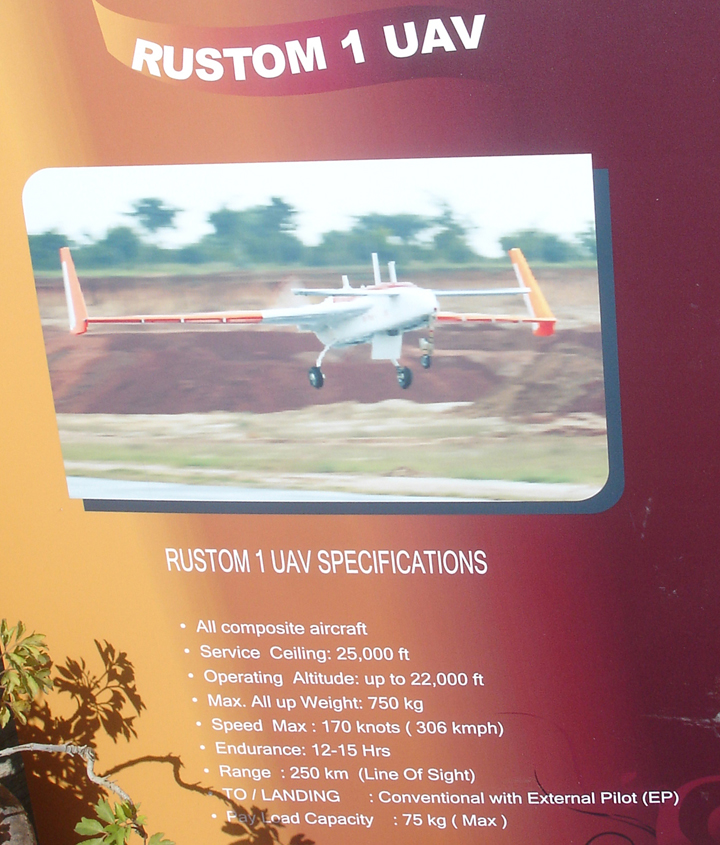
·  The DRDO is promising to deliver to the Indian Army an all-singing-and-dancing version of the Rustom-1 MALE-UAV—equipped with a belly-mounted optronic payload--by 2014. Also to be delivered by then will be a version of the Nishant tactical UAV equipped with a belly-mounted optronic payload and a wheeled undercarriage. The DRDO is focussing all its UAV-related R & D efforts on the Rustom-1, and those for the Rustom-2 MALE-UAV are not being accorded any importance at this stage.
·  The NTRO is steadily expanding its inventory of UAVs, with several Searcher Mk2 MALE-UAVs (equipped with optronic payloads) already operational as of now. Future plans call for the procurement of several Hermes-90 tactical UAVs.
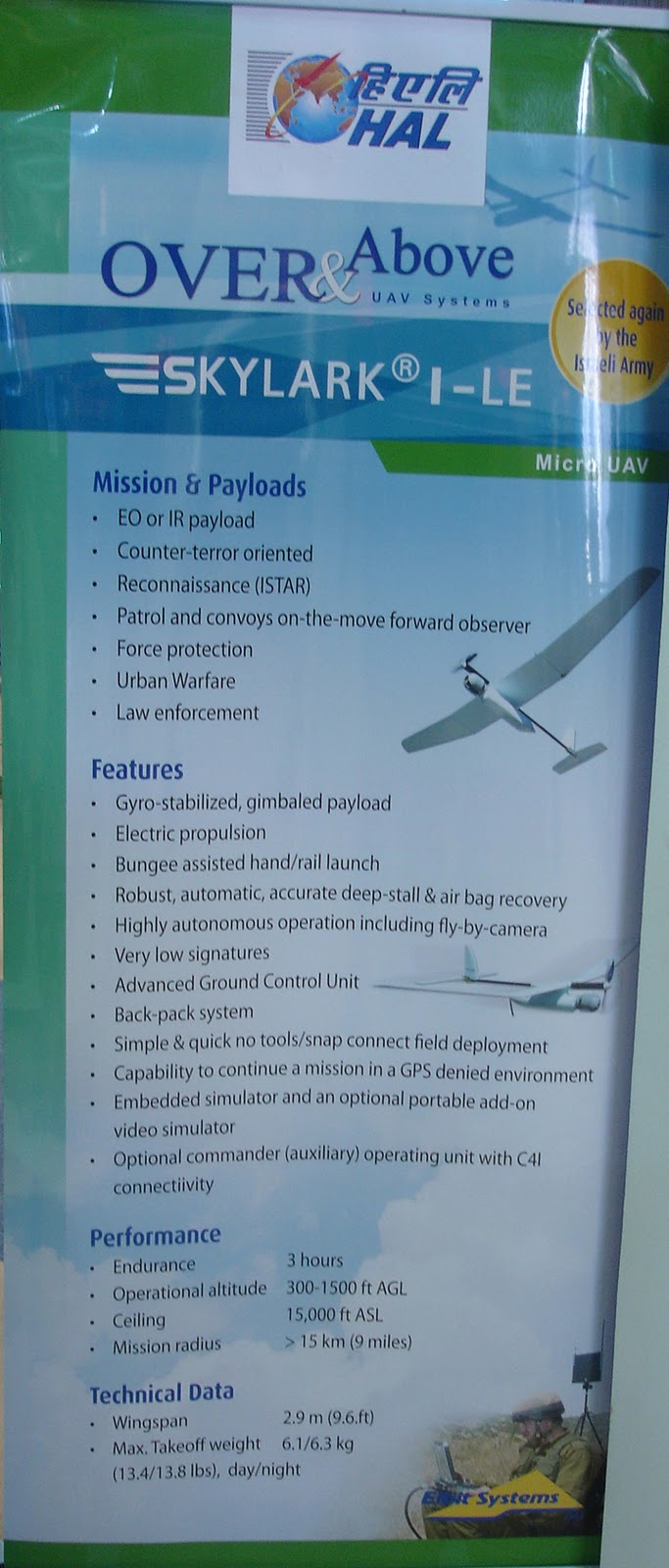
·  A customised version of the hand-launched Skylark-1LE—jointly developed by HAL and ELBIT Systems—has now been certified for operating at an altitude of 18,600 feet ASL, and first deliveries will be made to both the Indian Army and the ITBP. CAPFs like the CRPF and BSF too are expected to place large orders for both the Skylark-1LE and Hermes-90 UAVs.
·  The Indian Navy’s fleet of Heron-1 MALE-UAVs come equipped with three types of ELTA Systems-built mission payloads: the EL/M-2022U maritime search radar and MSOP optronic turret, plus a communications system capable of acting as a repeater station for relaying imagery-related data over-the-horizon to another Heron-1 UAV which, in turn, relays such data to a principal surface combatant deployed in the high seas. The Heron-1s of the Indian Army and Indian Air Force, on the other hand, come equipped with the MSOP optronic turret and the EL/M-2055D SAR/GMTI sensor. Israel Aerospace Industries’ (IAI) two subsidiaries--ELTA Systems and MALAT Division—have now developed the EL/M-2054 SAR/GMTI payload for all-weather, air-to-surface Intelligence, Surveillance, Target Acquisition and Reconnaissance (ISTAR) applications. It features modular, open architecture and can be easily configured into smaller tactical UAVs like the Nishant’s wheeled variant.
·  The Indian Navy has officially rejected the shipborne NRUAV project, which was first proposed in 2005 by HAL and IAI. Instead, the operational requirement has now been elevated to that for a shipborne UCAV, following which attention is being paid to the Northrop Grumman-built Fire Scout vertical takeoff and landing system.
·   Even though there are several private-sector SMEs that have developed mini-UAVs for use by central- and state-level law enforcement agencies, such solutions cannot be inducted into service since the Union Home Ministry, the MoD and the Ministry of Civil Aviation (all non-armed forces UAV users are mandatorily required to secure operating airspace clearances from this ministry) have yet to sit down together to evolve a clear-cut policy regarding their procurement and usage. Needless to say, the above-mentioned ministries are always hell-bent on being biased in favour of only those solutions that are put forth by the DPSUs (like HAL and BEL). This in turn has pissed off several CAPFs since they require such tactical UAVs in not only far larger numbers than those for the armed forces, but also as soon as possible from any available source.—Prasun K. Sengupta