
As
Jitendra Singh, India’s Minister of State for Defence, accompanied by Avinash
Chander, Scientific Adviser to India’s Defence Minister plus Secretary of the
MoD’s Department of Defence Research & Development plus Director-General of
the MoD’s Defence R & D Organisation (DRDO), toured the various pavilions
hosting Made-in-Republic of Korea (ROK) exhibits during the International
Aerospace and Defence Exhibition (ADEX-2013) at the KINTEX expo site in Seoul
between October 29 and November 3, 2013, they must have wondered exactly how
the DRDO’s counterpart in the ROK, the Daejon-based Agency for Defense
Development (ADD) has, since the 1980s, managed much faster turnaround times
when it came to exploratory development and systems development schedules for
new-generation weapon systems. Just sample the following comparative track-records:


The
Cheongung (Iron Hawk) MR-SAM (above) co-developed by a consortium of entities
that included Russia’s Almaz Design Bureau, the ADD, LIG Nex1, Samsung-THALES
and Doosan DST, was developed within a five-year period and entered the
series-production phase last year. In Russia, the Cheongung will soon be
produced as the S-350E Vityaz.

The
ADD and LIG Nex1, in the mid-1990s, co-developed the 180km-range Hyunmu-1 surface-to-surface
battlefield support missile (SSBSM), followed by the 300km-range Hyunmu-2 SSBSM
and the 1,000km-range Hyunmu-3 LACM (below), all within a decade.


The
ADD, along with ROTEM and Samsung-THALES, began co-developing 61-tonne K-2
Black Panther main battle tank (above) in 1995 at a cost of US$230 million and
by March 2007 the K-2 had entered limited series-production. Following this, in
June 2007, the ROK and Turkey successfully negotiated a contract worth $540
million under which a re-engineered K-2 will be licence-built in Turkey as the Altay
MBT.

The ADD, along with Korea Aerospace
Industries (KAI), began co-developing the KT-1 ‘Woongbi’ basic turboprop
trainer (below) in 1988. By June 1991, nine prototypes were built, and the
KT-1’s maiden flight took place in November 1991. The first of 85 KT-1s meant
for the ROKAF was delivered in 2000 and between April 2003 and May 2005, 27
KT-1Bs had been exported to Indonesia. In June, 2007, Turkey ordered 55 KT-1Ts
while in November 2012, Peru contracted KAI for the procurement of 20 KT-1Ps
worth $208 million.

In 1992, work began on developing the
T-50 Golden Eagle (below) multi-role combat aircraft (under the KTX-2 project),
with 70% of the R & D effort being funded by the ROK government, with KAI
picking up the tab for 17% of the required funds and Lockheed Martin the
remaining 13%. The T-50’s maiden flight took place in August 2002 and by
December 2003 the ROKAF had placed orders for 25 T-50s. The T-50 entered active
service with the ROKAF in 2005. In May 2011, Indonesia ordered 16 TA-50Is worth
$400 million, and deliveries commenced in September 2013.

In
less than a decade, the ADD along with LIG Nex1 has developed and delivered three
types of ASW weapons: the Blue Shark lightweight torpedo (below), the Red Shark
vertically launched anti-submarine rocket, and the Tiger Shark wire-guided heavyweight
torpedo).


The
Chun-ma (Pegasus) SHORADS, co-developed by the ADD, LIG Nex1, Doosan DST and Samsung-THALES
between 1989 and 1999, has since evolved into the Crotale Mk3 (below) and uses the LIG
Nex1-developed DS-20K
missile. 42% of the R & D work on vectronics was done by Samsung and 58% by
THALES.


The
C-Star subsonic anti-ship cruise missile (above) was co-developed by the ADD
and LIG Nex1 between 1996 and 2003, with exploratory R & D work being
undertaken between 1996 and 1998, followed by systems development between 1999
and 2003. On the other hand, the Ray Bolt ATGM’s exploratory R & D effort
lasted from 2007 till 2009, while systems development work began in 2009 and
will end next year.


India’s
Track-Record Thus Far
Since the time the programme for
indigenously developing the ‘Tejas’ multi-role light combat aircraft (LCA) was
initiated in August 1983, when India’s Ministry of Defence (MoD) sanctioned an
interim R & D expenditure of Rs5.6 billion for carrying out the project
definition phase (PDP), it has cost India Rs140.47 billion—spent over a period
of 28 years—to acquire the core technological and industrial competencies
required for producing a home-grown MRCA. In the process a total of 40
laboratories owned by the DRDO, 25 academic institutions, 300
public-/private-sector companies, and a combined design/engineering team made
up of 600 personnel had to be roped in to realise the national dream of developing
a fourth-generation MRCA for both the Indian Air Force (IAF) and Indian Navy
(IN).
 Despite such efforts, the production-series versions of the Tejas are not
yet available, nor are their flight simulators and various automated test equipment
(ATE)—required for the intermediate avionics workshops—anywhere near to being
delivered to the IAF, while drafting of the 30 MRO and six flight manuals is
nowhere near completion. Suffice to say that without all these, the IAF just
cannot initiate the process of service induction of the Tejas Mk1 MRCA, i.e.
operational conversion, be it initial or final, remains a distant pipedream.
Despite such efforts, the production-series versions of the Tejas are not
yet available, nor are their flight simulators and various automated test equipment
(ATE)—required for the intermediate avionics workshops—anywhere near to being
delivered to the IAF, while drafting of the 30 MRO and six flight manuals is
nowhere near completion. Suffice to say that without all these, the IAF just
cannot initiate the process of service induction of the Tejas Mk1 MRCA, i.e.
operational conversion, be it initial or final, remains a distant pipedream.


Following a 25-year R & D effort costing Rs 10
billion ($200 million), series-production of the 25km-range Akash-1 extended
short-range air-defence missile system (E-SHORADS) continues at a snail’s pace,
with delivery schedules not being adhered for both the IAF—its launch customer,
and the Indian Army (IA). The first IAF order for two Akash-1 squadrons, valued
at Rs 12.21 billion, was placed in May 2009 and comprised 250 missile rounds, 36 AAFL-1
wheeled launchers (built by TATA Power’s Strategic Electronics Division), nine
battery command centres, nine Rajendra L-band passive phased-array target
engagement radars, and nine S-band Rohini 3-D central acquisition radars. The
second order from the IAF, valued at Rs
42.79 billion ($925 million) came in November 2009 for an additional two
squadrons, which included 750 missile rounds. This was followed in January 2010
by the third order, this time for six squadrons. Prime contractor for the
IAF-specific Akash-1 E-SHORADS is the MoD-owned Bharat Electronics Ltd (BEL),
with Hyderabad-based Bharat Dynamics Ltd (BDL) being the principal
sub-contractor.


The IA in late 2011 had placed an order for up to nine
Regiments of Akash-1, valued at Rs 125 billion ($2.8 billion), approval for
which was obtained in June 2010 from the MoD’s Defence Acquisitions Council
(DAC). The Union Cabinet Committee on National Security (CCNS) on March 17, 2011 cleared the induction of an
initial two Akash-1 Regiments valued at Rs 14.18 billion, each with six
Batteries.

+&+Rajendra+BLR+&+BCC.jpg)

It was in July 1983 that the IA finalised
its General Staff Qualitative Requirement (GSQR) for the 214mm Pinaka-1 multi-barrel
rocket launcher (MBRL) system, with service induction being targetted from 1994
at a rate of one Regiment per annum. R & D work began in December 1986, following
the sanctioning of Rs 264.7 million in R & D funds. Targetted date for
systems development was December 1992. However, it was only on March 29, 2006
that the IA awarded Tata Power SED and Larsen & Toubro’s Heavy Engineering Division a $45 million contract to
produce the first 40 Pinaka-1 MBRLs.

The DRDO’s project to develop an L-band ‘Swathi’
weapon locating radar (WLR) at a cost of $49 million got the green light in
April 2002, with the DRDO promising to complete all R & D work within 40
months so that BEL could commence deliveries of the 42 WLRs as projected by the
IA. However, while all R & D work was completed in only late 2011, the IA
is now having second thoughts about procuring the ‘Swathi’ and has instead
decided to float global RFPs for procuring 29 WLRs worth $285.3 million through
the competitive bidding process.

The Nag ATGM, developed at a cost of Rs 17
billion since 1983, is nowhere near service-entry. Its THALES-designed and
supplied uncooled long-wave infra-red (LWIR) seeker was only last year
re-engineered to incorporate a new-generation focal plane array (FPA) supplied
by Sofradir of France.


It was in September 1988 that the IA
felt the need for tactical unmanned aerial vehicles (UAV). The IA finalised its
GSQR in May 1990, following which the DRDO’s Aeronautical Development
Establishment (ADE) began R & D work on the 380kg Nishant UAV. Despite the
first technology demonstration UAV making its maiden flight in 1995, the IA
placed its first orders for 12 Nishants in only May 2007. Similarly, the Lakshya
pilotless target aircraft, under development by the ADE since the late 1980s,
entered the series-production stage in only mid-2007 and to date only 27 units
have been ordered by the IA, IN and IAF from the MoD-owned Hindustan
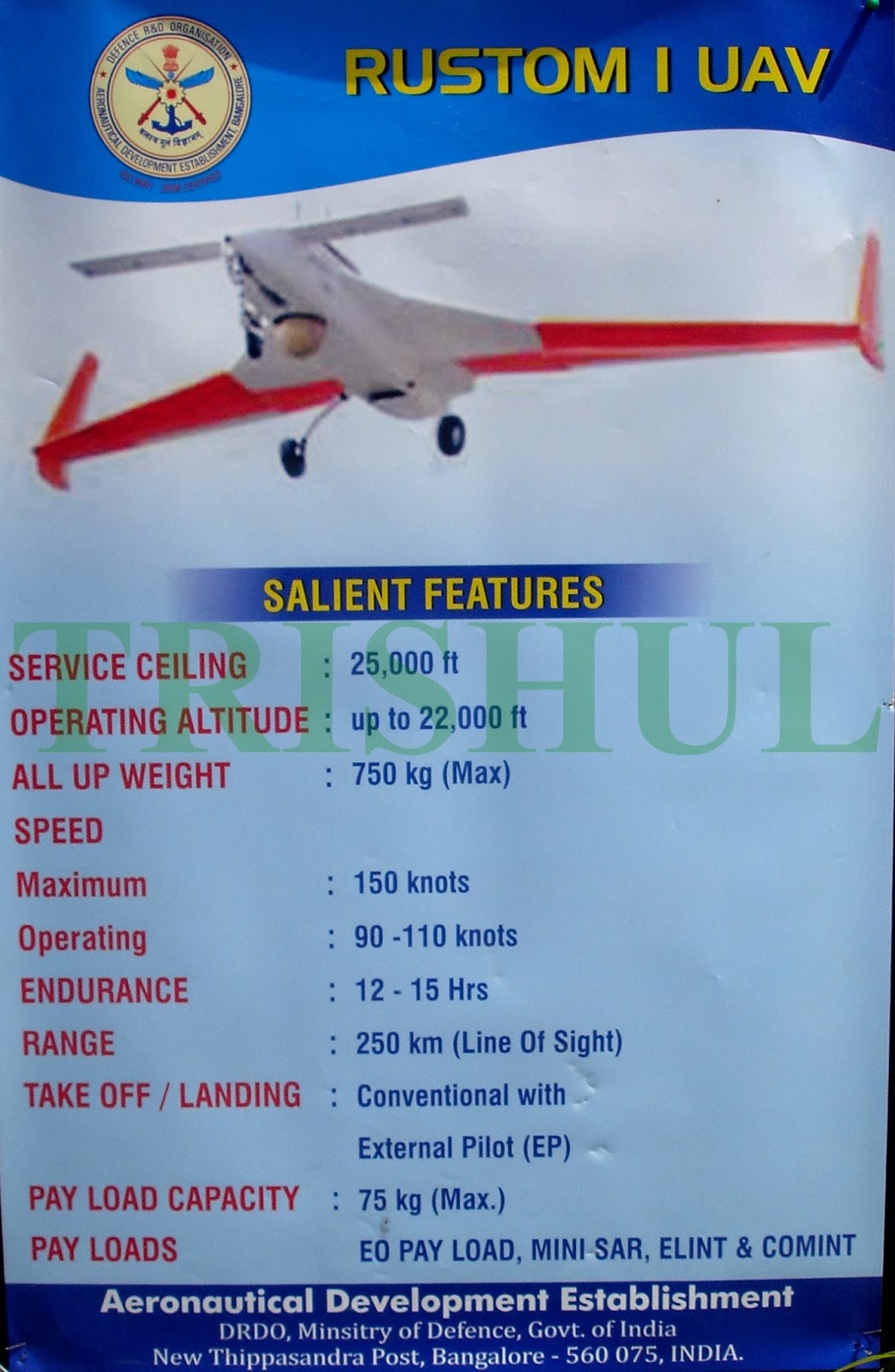
Aeronautics Ltd (HAL). And in late 2011, the DRDO promised to deliver to the IA
an all-singing-and-dancing version of the Rustom-1 MALE-UAV—equipped with a
belly-mounted optronic payload—by 2014. Also to be delivered by then will be a
version of the Nishant tactical UAV (also equipped with a belly-mounted
optronic payload) sporting a wheeled tricycle undercarriage.



After incurring an R & D expenditure
of $62.5 million since 1983, the DRDO officially terminated the project to
develop the ‘Trishul’ SHORADS on February 27, 2008.

It was in the late 1980s that the DRDO’s
Vizag-based Naval Science and Technological Laboratory (NSTL) initiated R &
D work on developing three types of torpedoes: a lightweight torpedo, a
heavyweight electric torpedo, and a heavyweight thermal torpedo. The first,
known Torpedo Advanced Light (TAL) was meant to be a 220kg torpedo capable of
being launched from warships and helicopters, have a top speed of 33 Knots in
both deep and shallow waters, incorporate a self-homing guidance system, and
was to be powered by electric batteries which would last for six minutes. It
was only in 1998 that the TAL’s technical trials began, while user-trials
commenced only by 2007. The IN began service-inducting the BDL-built TALs only
two years ago.

It was on December 24, 2008 that the
NSTL had stated that the ‘Varunastra’ heavyweight electric torpedo being
developed by it will be ready for service-entry by 2009. The Varunastra, weighing
1.5 tonnes, having a length of 7.6 metres and a 30km-range, was meant to be
launched from shipborne twin-tube launchers already developed indigenously by Larsen
& Toubro. However, it was only on September 26, 2013 that the NSTL stated
that it had completed the creation of state-of-the-art facilities required for the
design, testing and prototype production of heavyweight torpedoes like the
Varunastra, meaning user-trials of the Varunastra are still two years away.


Similar is the case of the
NSTL-developed Shakti thermal torpedo that runs on monopropellant fuel, which
can burn without oxygen and so is useful in underwater operations. Under
development since 1996, the NSTL took nearly seven years to develop the engine
and fuel for Shakti. The monopropellant fuel can generate 400kW of power and
enable the Shakti to move at faster speeds (almost double that of an electric
torpedo) and at depths of up to 600 metres. Technical trials of the Shakti are
still underway in shallow waters, and user-trials won’t commence till 2016 at
best.

So When And Where Did And Does
India Go Wrong?
(to
be concluded)
