At BAE Systems’ Farnborough
Airshow pavilion on July 16, the UK’s Defence Secretary Gavin Williamson unveilled
a full-scale conceptual model of a fifth-generation MRCA that would be
developed through international industrial partnerships. BAE Systems’ CEO
Charles Woodburn said that the UK government’s new Combat Air Strategy—released
on the same day—“is a powerful statement of intent to invest.” Royal Air Force’s
(RAF) Chief of the Air Staff Air Chief Marshal Sir Stephen Hillier said that
the RAF is "taking ownership of our next-generation capability.”

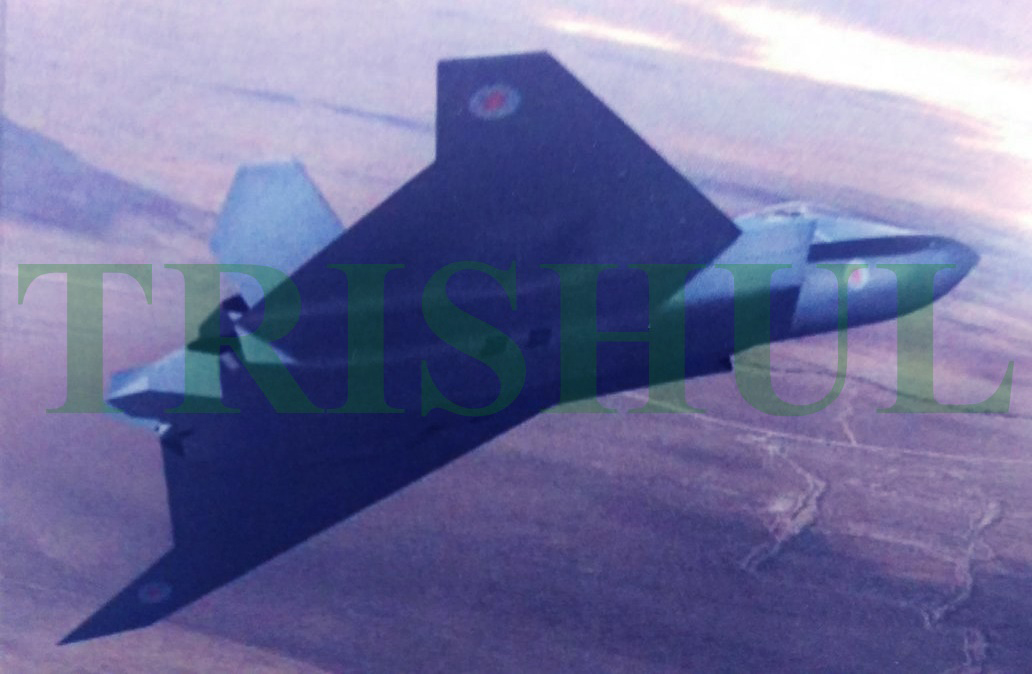
The conceptual model was
generated by Team Tempest, a partnership between the RAF’s Rapid Capabilities
Office (RCO) and the UK-based industry (including BAE Systems, Leonardo UK,
MBDA UK and Rolls-Royce). The Tempest comes out as a large, manned twin-engine
and twin-tail design with a near-delta wing, except for trailing-edge indentations
for stealth alignment. Additional images on display next to the model also
showed a scaled-down unmanned version, and industry officials have since cautioned
that the model should not be considered definitive, although some wind-tunnel
testing has been done already.

According to Williamson, more
than US$2.65 billion would be invested in the UK’s Future Combat Air Strategy
(FCAS) by 2025. The UK’s industry is contributing up to 50% of this on some of
the 60 “national technology demonstrations” that form part of the FCAS.
Williamson said that Team Tempest should deliver a business case by the year’s end
and take “initial conclusions” on international partners (like Japan( by next
summer. Further, he said, the partners could be “nations around the world,
including ones that we haven’t worked with before.” He continued: “Early
decisions on how to acquire the capability will be confirmed by the end of
2020, before final investment decisions are made by 2025. The aim is to have
operational capability by 2035.”

Officials from Team Tempest
later clarified that no commitment has yet been made to build a flying
demonstrator in the near-term. “We could do some tests on existing platforms,”
said BAE Systems’ Air Strategy Director Michael Christie. He added that the
size of the model on display had been driven by the need for a large payload
bay, whether for weapons, sensors or additional fuel. One accompanying illustration
showed four small drones in the bay that could be launched in a
"swarm" concept of operations. The MBDA Meteor beyond-visual-range
air-to-air missile and Spear-3 air-to-surface PGM was also on display, but an MBDA
official said that the definitive MRCA could carry future weapons from the
pipeline of developments already projected by MBDA and the UK Ministry of
Defence. They will likely include hypersonic and directed-energy weapons.

Conrad Banks, Chief Engineer
for Future Defence Programmes at Rolls-Royce, described advanced engine
technologies that would be incorporated. These include distortion-tolerant fan
systems; two embedded starter-generators that eliminate the accessory gearbox
and would provide greatly increased and continued electrical power; advanced
composite materials providing a “step-change” in thrust-to-weight ratio; and a
fully-integrated thermal management system. Other characteristics of a
future MRCA include a “virtual cockpit”; reconfigurable communications;
network-enabled cooperative engagement; artificial intelligence and machine
learning; “intrinsic ISR"; multispectral sensors fully integrated at the
subsystem-level; and advanced digital manufacturing processes.

But Air Commodore Linc Taylor,
Head of the RCO and Team Tempest, noted that a spiral strategy would be
employed to leverage existing technologies. “We will re-use what’s good enough
already,” he said, adding that this would particularly apply to mission data
reprogramming. His boss, Air Vice Marshall "Rocky" Rochelle, Chief of
Staff for Capability and instigator of the RCO, said: “We are working at pace,
and breaking traditional paradigms.” He added that past lessons about
unnecessarily complicated and protracted developments were being learned. While
admitting, “We will get some things wrong,” he also accepted, "We should
be measured by the outcomes.”


In unveilling its vision for a potential successor to the Eurofighter EF-2000,
the UK has thus upped the stakes in an ongoing European dogfight for supremacy
in producing a fifth-generation MRCA. Nations including Japan, Sweden and
Turkey are among those that the UK would be willing to work with, while the
companies behind a separate Franco-German project have called for greater
collaboration between European nations, potentially incorporating the UK. “The
UK is fully open to international partnership,” said ACM Sir Hillier. “It is an
entirely fitting way for the RAF to enter its second century.” Responding to
the Tempest concept’s unveilling, Airbus Military Aircraft has said that it “is
encouraged to see the UK government’s financial commitment to the project,
which supports the goal of sovereign European defence capability”. “A FCAS of
utmost importance to Europe’s armed forces and therefore we look forward to
continuing collaborative discussions in this area with all relevant European
players,” Airbus added.

Japan’s
homegrown effort to develop a fifth-generation MRCA are led by the state-owned Technical
Research & Development Institute (TRDI) which had, In July 2014, unveilled
photographs of its then engineless experimental Advanced Technology
Demonstrator (ATD-X) being towed out of a paint shop at the Mitsubishi Heavy
Industries’ (MHI) Komaki South Plant in Nagoya. The ATD-X was born out of a
feasibility study programme that was launched in 2007. Originally, what is now
the ATD-X was then given the enigmatic codename Shinshin, the two-kanji
combination that has the general meaning of mind or spirit, but this
appellation is no longer used. In addition to the undertaking of research into
flight control systems that would enable super-manoeuvrable flight, a more
sinister-looking, full-scale radar cross section (RCS) model was tested at a
French government facility in the latter half of 2005 and displayed at the
Japan Aerospace Expo in 2008 after the conclusion of that stage of development.
The ATD-X’s low RCS-optimised fuselage cross section, described as like that of
an abacus bead, arose from that research. The RCS model was followed by
flyable, one-fifth scale models, one of which was revealed in 2006. From that
year, five years of parallel research were conducted into the so-called smart
skin, whereby the external fuselage structure is embedded with self-diagnostic
micro-sensors.

Manufacture of the ATD-X and a
ground-test airframe commenced in 2009. As its full name implies, the ATD-X
will be used as a testbed for research and systems integration. The aircraft is
intended to act as a stepping stone on the way toward the possible production
of a scaled-up, next-generation MRCA, incorporating what have been dubbed i3
(informed, intelligent, instantaneous) technologies and counter-stealth
features. Released by the TRDI, the early examples of digital mock-up (DMU)
concept designs from 2011 and 2012 resembled the Lockheed Martin F.A-22
Raptor and Northrop/McDonnell-Douglas YF-23, respectively. Dubbed 25DMU (from
the Japanese calendar year Heisei 25, or 2013), the latest known
example incorporates some of the design features of its predecessors.
Following the RCS model, a combination of a model displayed at a TRDI event in
2007 and a 1/10th scale wind-tunnel model displayed in October 2012 had already
provided heavy hints with regard to the direction the ATD-X’s configuration was
taking, but closer inspection of the photos from July 2014 revealed more
details of the definitive version. Salient points included the four-sided
horizontal tail surfaces, which had been five-sided in the full-size mockup,
and the rounder air intakes. As tends to be the case in Japan’s aerospace
industry, the ATD-X represents a joint effort, with one prime contractor (MHI)
mating major assemblies from other companies; the wings and both the horizontal
and vertical tail surfaces were supplied by Fuji Heavy Industries (FHI).

Building on earlier research
that was also conducted in the 2000s, the ATD-X will be used to investigate axisymmetric
engine nozzle thrust-vectoring, achieved by three “paddles” mounted around each
tail pipe, similar to the system used on the Rockwell X-31. An axis-symmetric thrust vectoring nozzle is also being
developed for the full-scale production model. Ishikawajima-Harima Heavy
Industries (IHI) is developing the 33,000lb-thrust XF5-1 low-bypass turbofan using ceramic
composites-made turbine blades. The XF5-1 has its origins in basic research
carried out by the TRDI from 1991. The first of four test-engines was delivered
to the TRDI in 1998, but a full five-year prototype programme began only in
2015. All things considered, the ATD-X marks an important step in Japan’s
efforts to retain and build on the expertise accumulated in the production of
its own MRCAs. The JASDF’s definitive F-3 fifth-generation MRCA is due to enter
service in 2035.

Meanwhile,
technological challenges encountered in developing the 153kN-thrust Izdeliye 129 turbofan being developed by a
consortium comprising Ufa Engine Industrial Association (UMPO), MMPP
Salyut Moscow Machine building Production Enterprise and Rybinsk-based NPO Saturn; as well as
the unreliability of the transmit-receive modules made of Gallium Arsenide
(GaAs) for the Tikhomirov NIIP-developed N0-36
AESA-MMR have forced Russia’s air force to limit its orders for the Su-57 fifth-generation
MRCA to only 12 units. All these MRCAs will be powered by 147kN-thrust Saturn/Lyulka 117S/Al-41F-1S turbofans, and be
equipped with N0-35 ‘Irbis’ PESA-MMRs.
Here’s the UK government’s new Combat Air Strategy
document: