As part of her
planned transition from being a declared nuclear weapons state with ‘minimum
credible deterrence’ to acquiring ‘credible minimum deterrence’ status, India
is presently undertaking the construction of a mammoth multi-phase shore-based
naval base that will be the permanent home for the Indian Navy’s planned fleets
of four nuclear-powered ballistic missile-carrying submarines (SSBN), two SSGNs and six nuclear-powered attack submarines (SSN)—dubbed as the most
survivable of India’s nuclear triad.
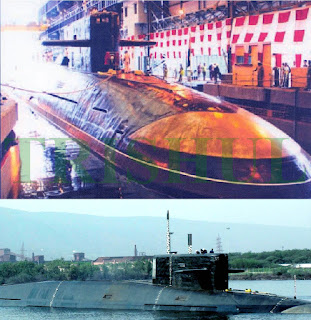

The S-2/ARIHANT
S-73 SSGN’s keel-laying ceremony took place on June 21, 1998 carrying the hull
codename P-4102. The SSGN was floated on the wet-basin on July 26, 2009 at the
Indian Navy-owned Shipbuilding Centre (SBC) at Visakhapatnam. Attainment of
reactor criticality criticality was attained on August 10, 2013. Commencement
of sea-trials took place on December 15, 2014 and on August 15, 2016 Prime Minister Narendra Modi
commissioned INS Arihant into the Indian Navy (IN). The 6,000-tonne
SSGN, which was constructed over a 11-year period, has a load water-line measurement
of 111.6 metres.


The S-3/Arighat was constructed over a period of eight years.
Its keel-laying ceremony took place on October 2009 and the completed SSGN was
floated at the SBC’s wet-basin on November 19, 2017. The S-4 SSBN took six
years to build. Its keel-laying ceremony was held in mid-2015 and the boat was
launched on November 23, 2021. It has a load water-line measurement of 125.4 metres
as it houses eight vertical launch-tubes for SLBMs one behind the other. The
Arihant and Arighat, on the other hand, house only four vertical launch-tubes.
These three boats will be followed by the bigger S-5, S-6 and S-7 SSBNs, each
of which will be powered by a OK-650V pressurised water reactor (PWR) rated at
190mWt, and will house 12 vertical launch-tubes in two rows of six.
Project
VARSHA
Under a contract
inked in January 2008, Russia has been providing technical expertise to the IN
for building this naval base at a cost of almost US$2 billion to build, which
will include twin underwater submarine tunnel entrances leading to separate berths
for accommodating both SSBNs and SSNs, a hardened underground tunnel for
storing nuclear warheads and submarine-launched ballistic missiles (SLBM), plus
a command-and-control centre and a related communications station. Civil
engineering work on Phase-1 of the Naval Alternate Operational Base (NAOB), being
built under the IN’s ‘ Project Varsha’, commenced in 2016 near Atchutapuram,
50km south of Visakhapatnam in Andhra Pradesh.

After soil testing, heavy
blasting was undertaken to construct various structures by deploying heavy
earth-moving equipment. Boundary wall construction was completed by 2018. Land
acquisition process for the NAOB was launched in 2005. In the first phase, nearly
4,500 acres, both private and government land, was acquired in Rambilli, Rajala
Agraharam, Marripalem and Vakapadu. Four villages—Velpugondupulam, Revuvathada,
Devallapalem and Pisinigottupalem—were totally displaced, following which
houses were shifted to a temporary rehabilitation colony. Phase-1, costing
Rs.30,000 crore, will be completed by
2022.
Underwater
Communications
Earlier, in
March 2012 the construction began for an extremely low-frequency (ELF)
communications station near the village of Vijaya Narayanam, about 23km north
of the Kudankulam Nuclear Power Plant (KNPP) in Tamil Nadu. It is co-located
with the IN's existing Very Low-Frequency (VLF) communications station (INS
Kattabomman), which transmits at 18.2kHz and was supplied by the US-based
Continental Electronics Corp (CEC). It may be recalled that CEC was selected as
the prime foreign industrial subcontractor by Larsen & Toubro (L & T)
to provide its experience and expertise for the design and manufacture of the
VLF communications station to support the India Navy Ships (INS) project. The
station was commissioned in 2014 after CEC had supplied to VLF transmission
equipment for underwater communications, including the Type 124 VLF solid-state
transmitter capable of delivering 6MVA (30 SSPAs). This is today the highest
power solid-state transmitter operating in the world. Also supplied were a
control system, ATUs, transmission line, loads and switches, as well as the RF
design of the antenna, which comprises two 470-metre tall slant-feed top-loaded
monopole antennae with ground mast. CEC’s expertise lead to satisfy the
project’s requirement of increased data capacity of up to 400 baud. The ELF station,
which is also being being built by Indian firm Larsen & Toubro, will have
nuclear-hardened underground bunkers and was commissioned in 2016. Russia was
closely associated with the research and development for this station, which is
expected to be similar to Russia's own ELF transmitter at the ZEVS facility
near Murmansk. ELF transmission is used to communicate very brief commands to
submerged submarines. Such transmissions can travel thousands of miles and
through extended depths of seawater. ELF transmissions are generally initiated
during circumstances in which conventional communications channels have been
disrupted or destroyed.

Reactor
Fuel Production
It was in 1984
that construction began of the Rattehalli Rare Materials Plant (RMP), located
near Mysore in Karnataka State, which is a pilot-scale gas centrifuge uranium
enrichment plant with several hundred gas centrifuges, and is capable of
producing several kilograms of highly enriched uranium (HEU) each year.
Construction of the pilot-scale gas centrifuge enrichment facility at began in
1987, took four years to complete, and began operating in 1991. The plant is
operated by Indian Rare Earths Limited (IREL), which is a subsidiary of India’s
Department of Atomic Energy (DAE). The DAE first confirmed the existence of the
plant in 1992. Items that the IREL initially imported to outfit the RMP, such
as vacuum pumps, vacuum furnaces, machine tools, vacuum bellows-sealed valves,
and canned motors for centrifugal pumps, were subsequently indigenised.
Thereafter, work began on producing low enriched uranium (LEU) for
submarine-based PWRs at a large uranium enrichment centrifuge complex, the
Special Material Enrichment Facility (SMEF), in Challakere Taluk, Chitradurga
District of Karnataka. Between 2009 and 2010, an area of approximately 10,000
acres in the Chirtradurga District of Karnataka was diverted for various
military-technical and military-industrial purposes. Within this area, 1,410
acres in Ullarthi Kaval and 400 acres in Khudapura were allocated to the DAE’s
Bhabha Atomic Research centre (BARC) for the purpose of developing the SMEF. In
2011, India announced publicly her intention to build this industrial-scale
centrifuge complex in Challakere Taluk, Chitradurga District (Karnataka). This
site has since been dedicated to the production of both highly enriched uranium
(HEU) and LEU for military and civilian purposes, although industrial-scale
production has yet to commence. BARC has been allotted many more acres in
Ullarthi Kaval compared to Khudapura (1,410 versus 400 acres respectively).

Despite such investments, the
fuel for powering the INS Arihant’s and INS Arighat’s PWRs had to be obtained
from Russia. Their PWRs are the third-generation OK-700A/VM-4SG model,
generating 89.2mW thermal (29.73mW electric) and producing 18,000hp when using
44% enriched uranium. The PWR was developed by the OJSC N A Dollezhal Scientific
Research & Design Institute of Energy Technologies (also known as NIKIET)
and which is now part of JSC Atomenergoprom. Such PWRs were series-produced in
Izhorsky Zavod, at Kolpino, near St Petersburg, and at the Nizhny Novgorod
Machine-Building Plant (Afrikantov OKBM). In India, JSC
Atomenergoprom authorised the DAE to licence-produce such PWRs. Such PWRs
have a total technical service life of 35 years and require refueling after 17
years. The reactor core of such PWRs comprises between 248 and 252 fuel assemblies.
Each fuel assembly contains tens of fuel rods, and these vary from the
traditional round rods to more advanced flat fuel-rods. The point of the flat
fuel-rod is to enlarge the surface of each fuel-rod so as to improve the
thermal efficiency. Most of the uranium fuel assemblies are clad in zirconium.
The fuel assemblies in the middle of the reactor core (weighing about 115kg)
are enriched to 22% U-235, while the outermost fuel assemblies are enriched as
much as 45%.

Shore-Based
Support Facilities
According to the
IN, a typical SSBN must have a 95-day cycle in which it puts out to sea, steams
to within range of its targets, carries out its operational patrol, returns to
port where it is refurbished, refitted, and made ready for going again to sea.
About 70 of the 95 days are spent at sea. To generate as little noise as
possible and to allow the in-house thin-line towed-array sonar array to operate
at high efficiency, the SSBN is typically required to cruise at speeds in the
range of 5 Knots. The IN defines ‘on-station time’ as the number of days at sea
during which an SSBN is within range of its target set. This time depends on
the range of the SLBM being carried, the distance an SSBN must travel from port
to the point where it is within range, and the speed with which it can travel
without being detected. In general, an SSBN's ‘target package’ is adjusted so
that in the early stages of the patrol, it is given a more geographically
accessible target set. Later on, when far from port, it can accept target
packages that are located in more remote regions of the adversary’s hinterland,
further from the oceans. To support such operational requirements, a mammoth
shore-based industrial infrastructure is required, especially in the domains of
PWR engineering and refuelling, fuel storage and the final assembly of recessed
SLBMs and their warheads, plus their loading/unloading gears.

Past experience
indicates that the most high-risk work is in refuelling the PWR, for the
following reasons: The work is done by many different people with varying
levels of qualification for the work at hand; and approximately 50 different
technical operations are carried out during the process, 25% of which may
potentially expose the operators to radiation. The most dangerous situations
during the removal of spent nuclear fuel include: Disassembly and mounting of
mechanisms for control and safety systems; disassembly and mounting of the
reactor lid; removal and replacement of fuel assemblies; refilling of primary
circuits in the thermal system and testing of hydraulics; connecting, adjusting
and checking of safety devices; manual checking for movement of the
compensation register; PWR start-up, measurement of neutrons and thermal
measurements and checking. It is for this reason that the NAOB will host hull refit
and PWR refuelling facilities located within a dry-dock. Typically, a SSBN or
SSN will be brought into a flooded dry-dock, a caisson will next positioned to
seal the dock’s entrance, and the dock will be dewatered, lowering the
submarine on to supports on the dock floor. Following docking, electrical and
cooling water services will be connected to support the on-board electrical
systems and the PWR, then the refit activities will commence. Before any
refuelling operations take place, the primary circuit will have to be
chemically decontaminated to reduce the background radiation in the reactor
environment. During refuelling, access holes will have to be cut in the
submarine’s hull and a reactor access house (RAH) will be installed over the
submarine. The top of the PWR will be removed and a shielded water tank will be
installed. Reactor components and single fuel elements will then taken out of
the PWR through the water tank into shielded containers. Used fuel will be
transferred from the dry-dock to a nearby underground on-site interim storage
facility. When all the fuel has been removed, the reactor components will be
inspected and serviced, and single new fuel elements will then be installed in
the reverse sequence.

The facilities
for undertaking final assembly of recessed SLBMs and their warheads, plus their
over-ground loading/unloading gears, are being built with the technical support
of Russia’s Ekatarinburg-based JSC MIC Mashinostroyenia and the St
Petersburg-based Rubin Central Design Bureau for Marine Engineering.
Collectively combing under the umbrella of ‘weaponisation logistics’, this
involves the warhead’s fissile cores coming under the custody of the DAR,
warhead integration sub-assemblies coming under the custody of the Defence R
& D Organisation (DRDO), and warhead/SLBM transport and loading/unloading
coming under the IN’s jurisdiction. Custody of the fully assembled warheads
will be transferred to the IN at the NAOB’s designated warhead receiving area,
with all subsequent handling, processing, and transport being undertaken within
a highly restricted area of operations called the ‘limited area’. After
arrival, each warhead will be stored in a magazine, remaining within its
shipping container. The SLBMs on the other hand will be assembled from
component stages within a single above-ground facility called the Vertical
Missile Packaging Building (VMPB). The mating of the first two stages of the
SLBM will be carried out in the horizontal position. The missile will then
raised to vertical and lowered into a liner situated in a ‘loading pit’ until
it is about flush with the ground. The liner acts as an environmental cover,
shielding the SLBM from view during outside loading operations and providing
some protection against small-arms fire.) The SLBM’s third stage will then be
mated in this configuration. Only after this will the warheads be transferred
from storage to-the VMPB, mated to the SLBM’s third-stage, and the nose-fairing
will then attached.

The mated SLBM
in its liner will next be hoisted from the pit, lowered on to a transporter,
and returned to horizontal. The unit will then be either stored or transported
to the explosives handling wharf adjacent to the SSBN parked alongside. At the
wharf, the SLBM in its liner will be erected to the vertical position, hoisted
by crane over the submarine, and lowered (without the liner) into the launch
tube. Once the SLBM is inserted, the liner will be taken away and the launch
tube hatch will be secured. Warheads for the SLBMs will be able to be demated,
mated, or serviced in place without removing the missile from the SSBN. For
this, the service unit will have to be placed over the launch tube, the hatch
opened, the nose fairing removed, and appropriate warhead-servicing operations
performed. The service unit shields warhead-servicing operations from outside
view. Both SLBMs and their warheads can be removed during routine maintenance
or submarine overhaul. Every few years, warheads will have to be removed and
serviced, typically for the replenishment of Tritium. It is estimated that the
great majority of the time during which the fully-assembled warheads will be in
the custody of the IN, it will be either in storage in its shipping container
or deployed on board the SSBN fleet. Only a small fraction of a SLBM’s lifetime
(less than a few tenths of 1%) will be spent in processing, maintenance,
handling, or transport within the limited area. Retired warheads will be
returned to the DAE for storage or disassembly.