Total Pageviews

Wednesday, May 9, 2012

PNS Azmat FAC-M’s Sea Trials To Get Underway

It may be recalled that the Pakistan Navy’s (PN) Chief of the Naval Staff, Admiral Muhammad Asif Sandila, was on April 23, 2012 the chief guest at the commissioning ceremony of PNS Azmat, Pakistan’s first fast attack craft (missile) at the Xinggang Shipyard in Tianjin, China. Admiral Sandila said that the contract for acquiring FAC-Ms included the construction of a second FAC-M in Pakistan by the end of 2012 by Karachi Shipyard & Engineering Works (KSEW). It may be recalled that the PN’s then Chief of the Naval Staff Admiral Noman Bashir was the Chief Guest on September 20, 2011 at the launching ceremony of PNS Azmat at Xingang Shipyard. Each FAC-M, displacing 260 tonnes and armed with eight C-802 anti-ship cruise missiles, is manned by a crew complement of 20. It was in late February 2010 that the PN had issued a restricted tender to the state-owned China Shipbuilding & Offshore International Company Ltd (CSOC) for the procurement of two FAC-Ms that would each have a length of 60 metres, radius of action equal to or greater than 500 nautical miles, maximum speed of 30 Knots, and be equipped with a surface/air search radar, optronic fire-control director, twin 25mm machine guns, a 30mm machine gun, and countermeasures dispensers.


In December 2010, Xinggang Shipyard was selected to fabricate the two FAC-Ms. Keel-laying of PNS Azmat, costing some US$50 million, took place on March 1, 2011. Its harbour trials commenced in October last year. The second FAC-M is now being fabricated under licence at KSEW.


Wednesday, April 25, 2012

RISAT-1 Poised For Liftoff…..At Last!

Later today, the ISRO-developed 1,858kg Risat-1 (radar imaging satellite) will be placed in a sun-synchronous orbit at an altitude of 608km altitude. Equipped with a SAR, the satellite, orifinally due for launch in 2009, will operate in any of the five modes, including coarse resolution (50-metre), wide swath (240km), narrow swath (10km) and high resolution spotlight (2-metre).

Below are the other ISRO-launched remote-sensing satellites to date that have been or are also being used for strategic weapons targetting purposes.

Friday, April 20, 2012

L & T’s Re-Engineered NAMICA Troop Commander Vehicle versus NORINCO’s GT-6 ATGM TEL

The photo above is from DEFEXPO 2012 and shows the NAMICA troop commander’s vehicle equipped with a raisable mast-mounted panoramic optronic suite for target acquisition. Contrast this with the photos below of the GT-6 TEL from NORINCO, which can fire up to eight AKD-10 laser-guided ATGMs.

Saturday, April 14, 2012

Weekend Musings

If all goes as per plans, then India’s Ministry of Defence (MoD) should be able to ink the contract for the Dassault Aviation Rafale M-MRCA and related hardware by December 15, 2012, thereby enabling the present CAS of the IAF, ACM Norman Anil Kumar Browne, to present the M-MRCA contract to the IAF as a return gift on his birthday. Presently, the MoD’s Contracts Negotiations Committee (CNC) led by Ranjan Ghosh—Joint Secretary (Air) at the MoD—is fine-tuning five main components of the contract:

1) The acquisition cost of the 126 Rafales, including the initial 18 Rafales in flyable condition, inclusive of 12 single-seaters and six tandem-seaters; the 108 Rafales to be licence-built in India that includes 74 single-seaters and 34 tanden-seaters of which 11 will be built from semi-knocked down (SKD) kits, 31 will be built from completely knocked down (CKD) kits, and 66 made from indigenously manufactured kits (IMK).    

2) The acquisition and establishment costs of creating intermediate-level and depot-level maintenance, repair and overhaul facilities for the Rafale fleet.

3) Acquisition costs for ‘unilateral upgrade’ capabilities for the Rafale fleet, which will enable the IAF to carry out in-country mid-life upgrades of the Rafale’s open-architecture avionics suite and weapon management systems, primarily with the help of operational source codes provided by Dassault Aviation and THALES Avionics for both the mission avionics suite and the fly-by-wire flight control system. It must be pointed out here that this is for the first time ever that the IAF will be the recipient for such source codes for not only the Rafale, but also for the upgraded Mirage 2000H/TH fleet, since even for the Su-30MKIs, Russia’s Rosoboronexport State Corp has refused to share the source codes with the IAF.

4) Acquisition costs for the weapons package, inclusive of beyond-visual-range air combat missiles, CALCMs, anti-ship cruise missiles, anti-radiation missiles and standoff PGMs, all to be supplied by MBDA and SAGEM.  

5) Acquisition costs for two Rafale-specific full-motion tactical simulators, two fixed-base cockpit procedures trainers, two avionics part-task trainers, one aircraft systems maintenance simulator, one navigation-and-attack system maintenance simulator, and one engine maintenance simulator.

When the first 18 Rafales begin arriving 36 months after contract signature, they will be home-based at Ambala AFS.

Also being negotiated concurrently by the CNC with Dassault Aviation, THALES Avionics and SNECMA Moteurs are the terms and conditions and the cost of the direct/indirect industrial offsets, representing 50% of the total contract value and to be implemented over a period of 13 years (the time taken to licence-build the 108 Rafales). The direct offsets have been sub-divided into three levels, with the first level dealing with major assemblies and systems integration, the second level dealing with sub-assemblies and components, and the third level—constituting the biggest chunk in terms of both financial value and work effort—comprising the rotables and consumables like lubricants, washers, filters, connectors, adapters, cables and wiring harnesses, brake-pads, drag chutes, landing gear tyres, and weapons ejector racks.   

The transfer-of-technology (ToT) component of the total quantum of direct industrial offsets has been sub-divided into five distinct categories:

1) Transfer of production engineering and manufacturing documentation by the French OEMs to their Indian counterparts for fabrication, assembly and testing of those items associated with the CKD kits and IMKs. For this category, the French OEMs are contractually required to give 60% ToT.

2) 60% ToT for items produced by the French OEMs’ authorised Indian sub-contractors based on engineering documentation provided by the OEMs to their Indian counterparts.  

3) ‘Built-to-specs’ ToT to the extent of 25% that includes the development and production of items on the basis of ‘procurement specifications’ sub-contracted by the OEM to various authorised Indian vendors.

4) 25% ToT for ‘bought-out items’ procured as ‘fully furnished items’ from the standard item parts catalogues of the OEMs.

5) Not beyond 15% ToT for proprietary items such as components for the RBE-2 AESA-MMR, fly-by-wire flight control system, and modules for the M88 turbofan.
 (to be concluded)

Saturday, April 7, 2012

More DEFEXPO 2012 Highlights

The above two illustrations show the Raytheon-built gunner’s sight being proposed by Larsen & Toubro for the T-72M1 MBT upgrade. This same sight is also on offer by L & T as a panoramic target acquisition system for the NAMICA troop commander’s vehicle. This sight will be mounted on a hydraulic mast on the NAMICA.  
The above two photos show the Prahaar NLOS-BSM mounted on a TATRA vehicle. This poster was on display only on March 29, 2012 and was removed the very same day and was replaced by the poster (shown below), although the full-scale model of the Prahaar was shown mounted atop a TATA-built TEL. Sure beats me why someone would pull off such a caper.
Shown below is the DRDO developed and BEL-built VARUNA shipborne passive surveillance system.
Below is a scale-model of the BEL-upgraded ZSU-23-4 Schilka, seen carrying two Python-5 VSHORADS missiles.  
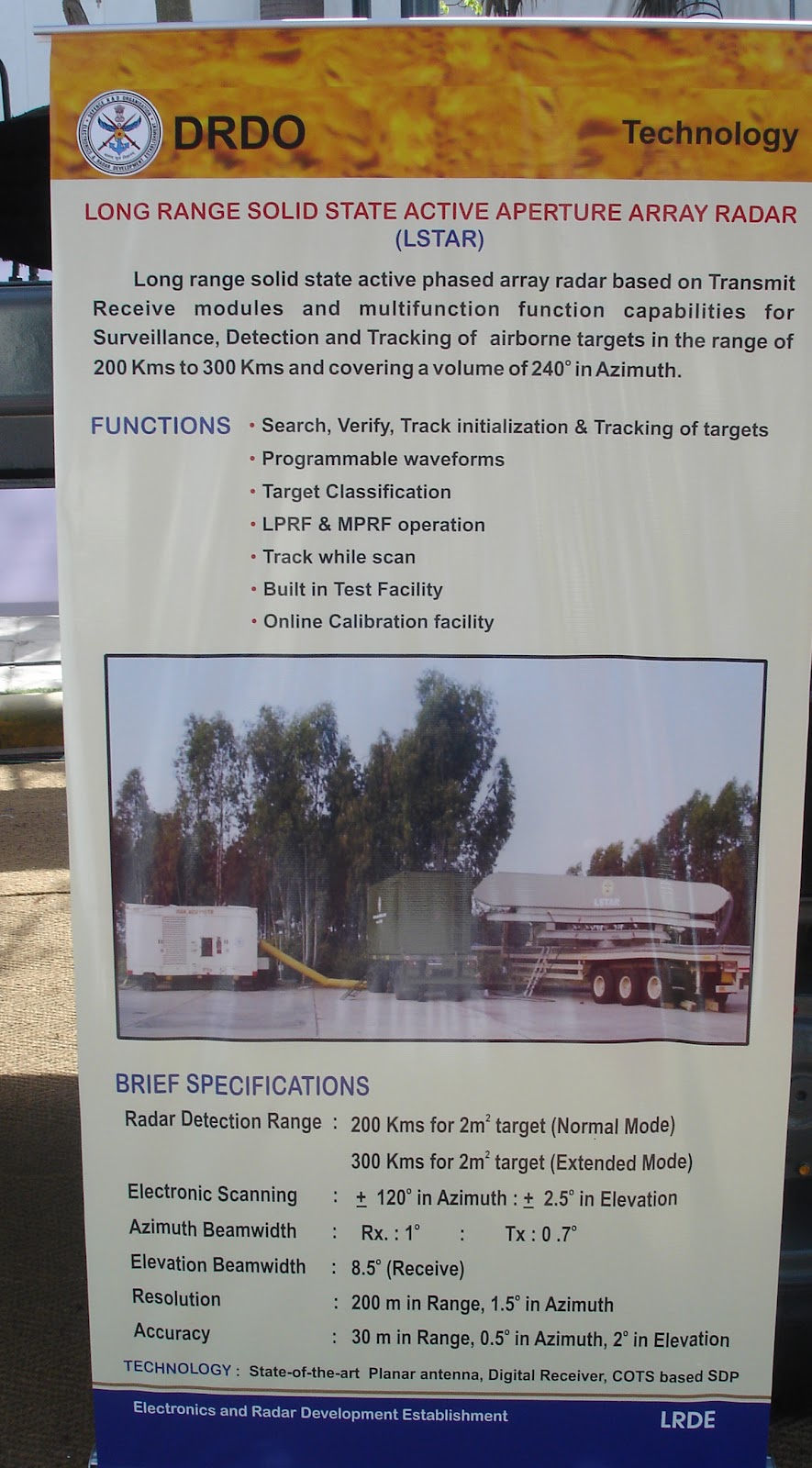
The eight-metre long L-STAR S-band active phased-array radar shown below (whose 6-metre long derivative will go on board the EMB-145 AEW & CS) is presently being used for developing new algorithms that will enable this type of radar to undertake interleaved airspace surveillance and maritime surveillance tasks. At the same time, this radar has already demonstrated its ability to operate in a dedicated ground moving target designation mode. According to the CABS officials who briefed me about the L-STAR’s future growth plans, future projections call for a wide-bodied aircraft like the B.737NG or A320 to be equipped with, on one hand  a fuselage-mounted AESA antenna capable of interleaved airspace surveillance and maritime surveillance; and a belly-mounted AESA antenna for air-to-ground battlespace surveillance inclusive of real-time  ground moving target designation. Additionally, by using SATCOM-based data-links, such platforms will also be able to act as airborne control stations for MALE-UAVs, thereby doing away with the need for two-way ground-based line-of-sight ground control stations for such MALE-UAVs. 
The poster below shows the terminal radar sensor for the supersonic ALCM/ASCM (Nirbhay?) being developed by the DRDO’s ASL. Needless to say, this very sensor is also very likely to be on board the Prahaar NLOS-BSM.
The illustration below clearly demonstrates how legacy communications systems like AREN compare with the new-generation software-driven TCS that the Indian Army is in need of.  
CASSIDIAN teamed up with ALPHA Technologies Pvt Ltd (which likes to describe itself as a BEL but in the private-sector, and has gainfully employed all the experienced scientists and engineers from BEL who have reached mandatory retirement age) is offering the MAWS and Ariel active towed-decoy for the Super Su-30MKI.
Below is a neat piece of kit from IAI for special operations forces and paratroopers.
RAFAEL’s booth displayed (below) the Derby and Python-5 missiles that make up the SpyDer-SR SHORADS, and the 10km-range Tamir missiles used by the Iron Dome air-defence system.
Below is Mahindra Defence’s sole exhibit showing its involvement with the FICV project. Rather disappointing when compared with what TATA had showcased.
Finally, for all those interested in EW and ELINT/SIGINT, the illustrations below will come in handy.
Never a dull moment during DEFEXPO 2012, wouldn't you all agree?