Total Pageviews

Thursday, January 16, 2020

From LCA Tejas Mk.1 to LCA-AF Mk.2 to MWF to AMCA to TED-BF; From NLCA To MRCBF To TED-BF

Two Technology Demonstrators, five Prototype Vehicles and seven LSP-series aircraft (total of 14 aircraft) were built for the Bengaluru-based Aeronautical Development Agency (ADA) by Hindustan Aeronautics Ltd (HAL) for flight-testing and airworthiness certification taskings between 1997 and 2013. The IOC-1 period lasted 10 years, while the IOC-2 period lasted two years and the FOC period lasted six years—all in all 18 years.
In contrast, on June 26, 1974, Mikoyan OKB was selected to develop the MiG-29 M-MRCA and the first of 14 prototypes to be built made its maiden flight on October 6, 1977. It entered service in August 1983. The MiG-29K variant has an empty weight of 11 tonnes, 5.5-tonne weapons-load, and MTOW of 24.5 tonnes.
In late 1978 Dassault Aviation was contracted for development of Project ACT-92 (Avion de Combat Tactique). In October 1982, Dassault Aviation was contracted for building a technology demonstrator named Avion de Combat expérimental (Experimental Combat Airplane), or ACX. Construction of the 9.5-tonne demonstrator (Rafale-A) commenced in March 1984, was rolled out in December 1985 and made its maiden flight on July 4, 1986. After 865 flights with four pilots, the Rafale-A was retired in January 1994. On April 21, 1988, Dassault Aviation was contracted for building four Rafale prototypes: one single-seat Rafale-C, two carrier-based Rafale-Ms and one tandem-seat Rafale-B. The Rafale-C flew on May 19, 1991 while the Rafale-B flew on April 30, 1993. The first Rafale-M flew on December 12, 1991, followed by the second on November 8, 1993. The first production-series Rafale-M flew on July 7, 1999, while in December 2004, the French Air Force received its first three F2-standard Rafale-Bs. The Rafale-C has an empty weight of 9.85 tonnes, internal fuel capacity of 4.7 tonnes, 9.5-tonne weapons-load and MTOW of 24.5 tonnes.
TD-1 (KH-2001) first flew on January 4, 2001; followed by TD-2 (KH-2002) on June 6, 2002. This was followed by the PV-1 (KH-2003) flying on November 25, 2003; PV-2 (KH-2004) on December 1, 2005; PV-3 (KH-2005) on December 1, 2006; PV-4 (KHT-2009) on November 26, 2009; and PV-5 (KHT-2010) on November 8, 2014. These were followed by seven LSP-series LCAs, comprising LSP-1 (KH-2011) that took to the skies on April 25, 2007 and was powered by GE Aero Engines-supplied F404-F2J3 turbofan; LSP-2 (KH-2012) first flying on June 16, 2008 and being the first to be powered by F404-IN20 turbofan; LSP-3 (KH-2013) flying on April 23, 2010; LSP-4 (KH-2014) on June 2, 2010; SP-5 (KH-2015) fitted with NVG-compatible cockpit lighting and autopilot on November 19, 2010; LSP-7 (KH-2017) on March 9, 2012 with a reshaped APU air-intake; and LSP-8 (KH-2018) in March 2013.
Between October 1985 and 2003, the IAF had accorded permanent waivers to 22 of the requirements listed out in its ASQR.
October 25, 2007: Tejas Mk.1 PV-1 test-fired a R-73E SRAAM in a ballistic non-guided) mode off Goa.
December 11, 2007: Tejas Mk.1 PV-2 flew with Litening-2 LDP.
October 2009: Tejas Mk.1 PV-3 and LSP-2 completed air-to-surface weapons delivery trials.
April 23, 2010: LSP-3 flew with a hybrid version of the Elta EL/M-2032 multi-mode radar, a homegrown IFF transponder and homegrown chaff/flare dispensers.
November 30, 2010: Tejas LSP-4 fired a R-73E SRAAM guided by the Targo HMDS off Goa.
January 10, 2011: Tejas Mk.1 was accorded the Initial Operational Clearance-1 (IOC-1) Release to Service Certificate by the Centre for Military Airworthiness and Certification (CEMILAC) after 32 performance parameters were waived by the IAF.
December 20, 2013: Tejas Mk.1 was accorded the IOC-2 Release to Service Certificate after logging 2,587 sorties covering over 1,750 hours with 13 prototypes flown by 17 test pilots of the IAF and Indian Navy. There were then 53 significant shortfalls in the L-MRCA’s developmental effort. However, the post-IOC-2 service induction process at Sulur air base began only on January 17, 2015.
October 1, 2014: Tejas Mk.1 SP-1’s maiden flight took place.
January 12, 2015: Tejas Mk.1 PV-1 flew with an internally-mounted integrated EW suite (UEWS) developed by the Defence Avionics Research Establishment (DARE).
January 17, 2015: SP-1 officially handed over to the IAF. HAL delivered one SP-series in 2015-16; two in 2016-17; five in 2017-18 aircraft and eight in 2018-19. The SP-1 first flew on October 1, 2014; SP-2 on March 22, 2016; SP-3 on September 28, 2016; SP-4 on March 3, 2017; SP-6 on June 30, 2017; SP-5 on February 8, 2018; SP-8 on March 13, 2018; SP-9 on March 24, 2018; SP-10 on July 27, 2018; SP-11 on October 10, 2018; SP-12 on November 28, 2018; SP-13 on January 30, 2019; SP-14 on January 20, 2019; SP-15 on March 22, 2019; and SP-16 on March 12, 2019. SP-17 to SP-20 and SP-37 to SP-40 will be tandem-seaters. Each SP-series Tejas Mk.1 undergoes three test-flights undertaken by HAL’s Test Pilots followed by another three by the IAF’s pilots. Build-standard of eight FOC-compliant tandem-seat operational conversion trainers was readied by April 2019. The first such aircraft will make its maiden flight in late 2021. The confirmed orders now stand at 32 Tejas Mk.1 single-seaters fighters (16 IOC-compliant and 16 FOC-compliant) and eight FOC-compliant tandem-seaters.
August 2015: UK-based Cobham handed over newly-designed quartz radome and bolt-on in-flight refuelling (IFR) probe to HAL for installation on Tejas Mk.1 LSP-8 (KH-2018). Cobham was awarded the contract in 2014, but it missed three successive delivery timelines (October 2014, end of January 2015 and April 2015) for both items. Had Cobham adhered to its delivery timelines, it would have been possible to wrap up ground check-outs for the IFR probe in October-November 2014 and then commence flight-trials. 25 day/night flights at different altitudes and speeds are needed to clear the IFR system and had the probe been delivered in September 2014, it would have easily been cleared for certification before mid-2015.
February 5, 2016: Tejas Mk.1 LSP-7 test-fired a Derby BVRAAM in a ballistic non-guided) mode in Jamnagar.
November 7, 2016: India’s Defence Ministry approved a plan for procuring 83 Tejas Mk.1As worth ₹50,025 crore under the Acceptance of Necessity (AoN) scheme.
January 31, 2017: Tejas LSP-8 (KH-2018) made its first flight fitted with a Cobham in-flight refuelling probe.
May 16, 2017: Tejas Mk.1 LSP-7 fired a Derby BVRAAM in guided ‘lock-on after launch’ mode at Chandipur. In addition, ADA equipped the LSP-2 platform with a LRDE-developed ‘Uttam’ AESA-MMR developmental prototype along with an integrated liquid cooling system.
October 2017: The provisional DAL (Drawing Applicability List) for FOC-compliant Tejas Mk.1 SP-series was released, followed by the amended one in August 2018. (DAL is the standard of preparation for production). In addition, the LCA-AF Mk.2’s design was modified to have a 1-metre fuselage plug-in module, all-up weight of 16.5 tonnes, a payload of 5.5 tonnes and 3,300kg internal fuel capacity.
December 20, 2017: The IAF issued a single-vendor tender to HAL for procuring 83 Tejas Mk.1As (73 single-seaters and 10 tandem-seaters) for equipping four IAF squadrons and HAL submitted its first technical and commercial response to it in March 2018. HAL quoted Rs.463 crore (US$64.5 million) for Tejas Mk.1A versus Rs.363 crore ($50.6 million) for the Tejas Mk.1.
February 27, 2018: Hot refuelling-cum-sortie was conducted by Tejas LSP-8.
April 27, 2018: Tejas Mk.1 LSP-7 fired a Derby BVRAAM in guided ‘lock-on after launch’ mode against a manoeuvrable unmanned aerial target-drone at Chandipur.
September 10, 2018: LSP-8 was successfully refuelled mid-air by an IAF IL-78MKI. LSP-8 took-off from Gwalior air base, before meeting up with an Il-78MKI operating from Agra air base. LSP-8 used a Cobham-supplied refuelling probe to connect with the IL-78MKI’s Cobham-supplied hose-and-drogue system for a series of dry contacts on September 4 and 6, before a first transfer 1,900kg of fuel took place when the LSP-8 was cruising at 270 Knots.
October 2018: The LCA-AF Mk.2 morphed into the Medium-Weight Fighter (MWF), whose fuselage would be 1.35 metres longer, will carry 6.5 tonnes of payload and 3,300kg of internal fuel. 
December 2019: LSP-7 successfully demonstrated dropping of OFB-built 250kg/450kg HSLD bombs, OFB-built Mk.11N retarder bomb, FAB-250 bomb, OFAB-100-120 bomb. Operating out of IAF air bases like Jamnagar, Jaisalmer, Uttarlai, Gwalior, Goa, Leh, Pathankot, the LSP-7 demonstrated weaponised platform readiness for ORP scramble missions and three-sortie/day turnaround service in all weather conditions and at different operating altitudes.
February 20, 2019: FOC certificate and Release to Service Document released after 10 performance parameters were waived by the IAF. These included the non-installation of the twin-barrelled Gryazev-Shipunov GSh-23 cannon.
March 11, 2019: Tejas Mk.1 SP-16 first flew for the first time, followed by SP-15 on March 22. SP-16 was the first of the SP-series to be using wings made by Larsen & Toubro (L & T) in January, and wiring harnesses and pipings supplied by HAL’s Prayagraj-based subsidiary Naini Aerospace Ltd (previously a sick industrial unit of Hindustan cables Ltd) on March 27, 2018.
September 2019: Revised price-quote by HAL after renegotiations stands at Rs.417 crore ($58.1 million) per Tejas Mk.1A in flyaway condition minus its weapons systems. In comparison, the HAL Nashik-built Su-30MKI costs Rs.415 crore ($57.8 million) per unit.
October 2019: SP-21, the first FOC-compliant Tejas Mk.1, began being assembled and will contain an IFR probe, pressure-refuelling with three drop-tank configuration, integration of 725-litre and 450-litre drop-tanks, improved wing navigation lamps, in-flight windmill relight, dual-ejector rack for SRAAMs, and zoom-climb flight mode. The Teajas Mk.1A too will not have the twin-barrelled Gryazev-Shipunov GSh-23 cannon on-board. Instead, an as-yet unselected pod-mounted 30mm cannon has been specified.
The MWF, whose maiden flight as per ADA’s claims will be in 2024 (following a rollout in 2022), will be built to LSP standards in Initial Operational Clearance (IOC) configuration. A total of four LSP-series MWFs are planned for construction and these will be subjected to a total of 2,000 hours of certification-related flight-tests. Series-production of 201 MWFs for equipping 12 IAF squadrons will begin in 2028 as per ADA’s prediction, and each MWF will have an empty weight of 7.7 tonnes, weapons-load of 6.5 tonnes, internal fuel capacity of 3.3 tonnes and MTOW of 17.5 tonnes. Powerplant will be a single 98kN-thrust F414-GE-INS6 turbofan.
The AMCA project was conceptualised in 2006 and between 2008 and 2014, five conceptual wind-tunnel scale-models were tested. In April 2010 the IAF had finalised the AMCA’s ASQRs. In October 2010, a sum of Rs.100 crore was released to ADA for preparing feasibility studies in 18 months. Feasibility Report was compiled and its review held in November 2013. The Feasibility Report was updated in October 2015. The conceptual phase began in 2015, while the detailed design phase began in February 2019. In April 2018, funding for building two AMCA technology demonstrators (whose maiden flight as per ADA’s claim is due for 2025) was released. The Engineering Technology & Manufacturing Development (ETMD) phase for producing four flying prototype aircraft has yet to begin. AMCA will have an empty weight of 16 tonnes, internal fuel load of 6.5 tonnes, internal weapons load of 1.5 tonnes, external weapons-load of 5 tonnes, and MTOW of 29 tonnes. Powerplant will be twin 98kN-thrust F414-GE-INS6 turbofans offering a total thrust of 180kN.
Since the Indian Navy requires only 57 TED-BFs for service-induction, this is too small a number for justifying the enormous developmental funds required. Neither is there any possibility of the IAF expressing its preference for a shore-based TED-BF variant by ditching the single-engined MWF option. Hence, ADA’s claim about the TED-BF making its maiden flight by 2026 and being ready for service-induction by 2031 tantamounts to an impossibility.
The maiden arrested recovery of the LCA Navy Mk.1/NP-2 technology demonstrator on board INS Vikramaditya on January 11, 2020 and its following maiden takeoff a day later marked the attainment of a crucial milestone in the Indian Navy’s (IN) developmental process for obtaining a homegrown carrier-based multi-role combat aircraft (MRCA) solution. It may be recalled that Phase-1 of full-scale engineering development (FSED-1) for the LCA (Navy) technology demonstration project was sanctioned in March 2003 by the Government of India with grant-in-aid seed funding of Rs.949 crore and a planned completion date of December 2009. The IN contributed 40% of the development cost, with the rest being put up by the Defence Research & Development Organisation (DRDO), which controls the Aeronautical Development Agency (ADA)—designer and developer of the LCA family of L-MRCAs. The objective then was to develop a naval carrier-borne MRCA capable of Ski-Jump Takeoff with Arrested Recovery for landing (STOBAR concept). It was initially envisaged that converting the already flying Tejas Mk.1 to a naval aircraft would take about six to seven years, with structural changes restricted to about 15%. The two naval prototypes sanctioned were to be used primarily to demonstrate Carrier Compatibility and also to demonstrate Initial Operational Capability with air-defence configuration. However, contrary to initial assumptions, during the aircraft design and development phase, it turned out to be significantly different from the time of sanction in 2003 and challenges increased progressively. Further, the major constraint of design space due to the existing Tejas platform resulted in a sub-optimal design and compromises leading to the LCA Navy Mk-1 variant (NP-1) being heavier than anticipated. Consequently, Navy LCA (NLCA) Mk2 design powered by a higher-thrust turbofan was taken up in the FSED-II stage of the project, which was sanctioned in December 2009. However, by 2014, the IN realised that even the NLCA Mk.2 would have shortfalls in the full-mission capabilities.
This realisation had dawned after the IN had done a comprehensive assessment of flight operations with its twin-engined MiG-29Ks from the STOBAR flight-deck of INS Vikramaditya. To fully understand the assessment, one must first understand what distinguishes land-based flight operations from carrier-based flight-operations, plus the difference between STOBAR and CATOBAR flight-deck designs. Usually, there are three parameters relating to the takeoff of any type of shore-based aircraft: 1) thrust-weight ratio, 2) rolling distance, 3) the minimum liftoff safety speed. When an aircraft attains a certain rolling distance (usually much longer than the length of an aircraft carrier’s deck) at an acceleration produced by its thrust-weight ratio for takeoff, it reaches the minimum lift-off safety speed. Upon reaching this, the lift force of the aircraft is equal to the weight of the aircraft, and then the aircraft lifts off. So the lift force of an aircraft is proportional to the square of its speed. If the aircraft slides at acceleration for a distance which is shorter than the runway length when it takes off and fails to reach the minimum safety lift-off speed, the lift force produced by the aircraft’s wings will be less than the weight of the aircraft, so it cannot lift off. The landing, on the other hand, is accomplished in five stages: (1) glide; (2) flatten (when the wheel is 2 metres above the ground, throttle back to the idle speed, reduce the glide angle, and exit glide state at the height of 0.5 metres); (3) level flight at a deceleration (minimum level flight speed); (4) fall to touch down (at this moment, the aircraft’s speed is decreased to an extent that the lift force is no longer enough to balance the aircraft’s weight); (5) roll to land (under the action of wheel friction and air resistance etc, rolling at a deceleration until it halls).
When it comes to carrier-based aviation, due to the limited length of the flight deck of the aircraft carrier, there are mainly three take-off options for carrier-based aircraft: vertical takeoff (namely the vertical/short-range rolling takeoff), ski-jump take-off (or called sliding-tilted takeoff), and ejection takeoff (such as steam ejection takeoff, electromagnetic rail-launch ejection takeoff). For ski-jump takeoff, the aircraft first rolls at acceleration on the runway of the flight deck of an aircraft carrier only depending on its own power, then it leaps into the air through the upswept deck on the front part of the aircraft carrier, and then takes off. The principle is that the upswept angle of the deck (14 degrees) is regarded as the ejection angle, although the aircraft has not yet reached the takeoff speed when it rolls and leaves the aircraft carrier. The landing on an aircraft carrier is achieved by gliding to directly hook the arresting cable on the aircraft carrier (without the above stages of level flight at a deceleration, etc). A total of 3 or 4 arresting cables are installed on the canted deck of the aircraft carrier, in which the first one is arranged apart from the aft by 60 metres, and the remaining ones are arranged at an interval of 6 metres or 14 metres. The height of the arresting cable is 50 centimetres above the deck surface. The aircraft glides from upper right of the stern of the aircraft carrier, which is travelling rapidly, hooks the arresting cable with the tailhook, and then rolls on the deck within 100 metres to brake. The statistics show that 80% of aircraft accidents on board aircraft carriers occur in the course of touching down on to the top-deck but not in the air. The factors attributing to a complicated, difficult and risky landing process for the aircraft include: 1) short on-deck runway; aircraft carrier is limited in length, and the section for the carrier aircraft to land is more limited, while the length of landing area on the aircraft carrier is relevant to the safety in landing of the carrier-borne MRCA; 2) high landing speed; in the existing technology, when directly gliding to touch down onto the flight-deck, the MRCA does not throttle back to decelerate, but requires an appropriate force, so that it can immediately undertake a Bolter in case the tailhook misses all the arresting cables; 3) the accuracy requirement for pre-determined landing point is strict; for the accuracy of the landing point, none of longitudinal, lateral and height errors can be large, otherwise the MRCA may not hook the arresting cable, or may land on the aft or on the right side of the flight-deck, while the MRCA needs to, during gliding at high speed, finish hitting the landing position on the moving flight-deck; 4) control of the gliding angle (between 3.5% and 4%); 5) alignment with the centreline of the runway, because an alignment is more important than the gliding angle. Since the runway of the aircraft carrier is very narrow, if the aircraft deviates to the right, it may hit the superstructure (island) of the aircraft carrier, and if the aircraft deviates to the left, it may hit other aircraft on the parking apron. So during the landing stage, the MRCA should fly (glide) in a vertical plane where the centreline of the runway is located. However, the centreline of the canted deck-runway used for landing is not consistent with the heading direction of aircraft carriers, and presents an angle of between 6 degrees and 13 degrees (namely the canted deck and the longitudinal axis of the aircraft carrier form an angle of 6 degrees and 13 degrees). Such a design aims to allow the MRCA to roll after landing so as to avoid other deck-based MRCAs that are awaiting takeoff at the front portion of the flight-deck.
When a carrier-based MRCA takes off from a curved STOBAR deck it suddenly jumps into free air. The objective is to approximately reach the suitable speed and AoA at the end of the ski-jump, without exactly respecting the MRCA’s lift-to-weight equilibrium. It may well be in an infra-lift condition, but the overall strategy aims at keeping the longitudinal acceleration by maintaining engine thrust, and giving full control to the pilot who, until this moment has hardly intervened in the manoeuvre. An acceptable aircraft-vessel compatibility matching implies that the flight speed will reach a minimum value to sustain level flight before the aircraft altitude over the sea crosses below a certain safety threshold. The thrust-to-weight ratio at take-off must thus be appropriately matched to the available deck length and the ski-jump geometry, including wind-on-deck effects. The approach speed must be compatible with wind-on-deck and the available landing distance to completely stop the MRCA after engaging the last arrestor-cable. And lastly, the thrust-to-weight ratio at approach must be high enough as to allow fast acceleration and safe liftoff (Bolter) should the aircraft hook failing engaging the arresting pendants.
A twin-engined naval MRCA operating from a STOBAR flight-deck can at best only take off with half-load (of either fuel or weapons payload), and the engine is in the state of thrust augmentation at the time of takeoff, thus shortening the aircraft’s service-life. The MRCA is also required to be added with some structural weights, such as increasing the wing area, just in order to improve the lift force for realising the ski-jump takeoff. The takeoff weight and takeoff efficiency of takeoffs from STOBAR flight-decks are thus less than that of the ejection takeoff, and the combat efficiency is thus poorer than that of the MRCA taking off from a CATOBAR flight-deck. The STOBAR flight-deck design thus limits MRCA takeoff weight and shifts the full burden of takeoff propulsion onto the aircraft, thus increasing the amount of fuel consumed at that stage. This in turn restricts the fuel and weapons payload that the MRCA can carry, thereby reducing its range, loitering time, and strike capabilities. STOBAR is also more affected by wind, tide, rolling, and pitching. Furthermore, it needs more flight-deck space for takeoff and landing, thus limiting the parking space and having an adverse effect on takeoff frequency–based crisis reaction. For instance, on all existing STOBAR aircraft carriers (Project 11430 INS Vikramaditya, Project 1143.5 Kuznetsov and the two PLA Navy vessels CV-16 Liaoning and CV-17 Shandong) there are two types of runway lengths—the shorter 115-metre one in a right-to-left orientation for launching MRCAs with greatly reduced weapons/fuel loads; and the longer 180-metre one in left-to-right orientation for launching MRCAs with greater but not maximum weapons/fuel loads.
In comparison, the CATOBAR design, which is mostly associated with large carriers, minimises aircraft fuel consumption on takeoff, thus enabling better payload, range, loitering time, and strike capability. Its runway requirement is also minimal, thus allowing more flight-deck parking and faster launches, even simultaneous launch and recovery, resulting in quicker crisis response. Lastly, unlike STOBAR flight-decks, CATOBAR flight-decks can also launch heavier fixed-wing AEW and ASW aircraft.
NLCA Developmental Milestones
The LCA (Navy) programme has involved development of the NP-1 tandem-seat operational conversion trainer and NP-2 single-seat multi-role combat aircraft, one structural test specimen for fatigue-testing, creation of Navy-specific flight-test facilities in Bengaluru and Goa, construction of a shore-based flight-test facility or SBTF at INS Hansa in Goa (for enabling arrested landing recovery, plus takeoff from a half-metal half-concrete 14-degree ski ramp and a flight deck ranging from 195 metres to 204 metres in length, and validating the simulation model for flight performance within ship-motion limits, validating the flight controls’ strategy with all-up weight and asymmetric loading, validating the load analysis methodology), and flight-tests/flight certification for aircraft carrier-based flight operations. The SBTF also has its integral flight-test centre equipped with line-of-sight telemetry/high-speed three-axis photogrammetric systems, systems for validating thrust measurement algorithms, systems for measuring wind-flow patterns, INS/DGPS-based trajectory measurement systems, RGS integration facility, plus a workshop.
To date, the LCA Navy Mk.1 has demonstrated the following IN-specific technologies while operating from the SBTF: supersonic flight; takeoffs from the Ski-Jump was successfully demonstrated, including 12 Ski-Jumps when armed with R-73E SRAAMs missiles, plus night-time Ski Jumps; hot-refuelling; flying of 3-hour duration achieved in one sortie; in-flight jettisoning; Integration of AHS with the NP-2 airframe; and the development of a weight-optimised telescopic landing gear for high sink-rate landing with the help of consultancy from Airbus Military. In addition, a naval standard Structural Test Specimen (STS) has been built and integrated with the Main Airframe Structural Test (MAST) rig to test horizontal and vertical loads during a deck recovery, including 7.1 metre/ssecond sink rate and a 45-tonne load on an arrester wire. Compared to the Tejas Mk1, the LCA (Navy) Mk1/NP-2 is a technology demonstrator that features a drooped nose section, strengthened airframe structure, twin leading-edge vortex control surfaces or LEVCONS (for attaining lower approach speeds), main landing gear with higher sink-rate, increased internal fuel capacity, a Navy-specific avionics suite (including the locally developed autopilot and auto-throttle) and weapons package, and an arrester hook. The NP-2 is now being subjected to a carrier-based flight-test regime on board INS Vikramaditya, where seaborne wind conditions winds-on-deck envelopes (especially ship motion, cross-winds and high wind-on-deck speeds) are far more favourable than those around the SBTF. Integration with carrier-based support and weaponisation facilities, plus jettisioning of ventral stores, thrust data validation, and attaining hands-free and non-disorienting takeoff with supplied HUD symbology formats and high AoA are being demonstrated and validated in this phase of flight-tests. Incidentally, since the IN is involved for the very first time in its history with developing a carrier-based MRCA, it is resigned to the possibility of the NP-2 technology demonstrator ‘breaking up’ while in the process of subjecting the aircrafts’ main landing gears to arrested recoveries at sea. It must be noted here that the undercarriages of carrier-based aircraft collapse or break-up is not due to compression, but due to suspension.
Of utmost importance during the Carrier Compatibility Trials (CCT) are the data-points to be obtained for validating the flight-control logic during the NP-2’s carrier-borne flight operations. This in turn will help in the optimisation of the flight-control logic by the National Control Law Team (that comprises talents from FMCD, ADA, CAIR, and HAL and operating from the premises of NAL’s Flight Mechanics & Control Division, or FMCD). Data-points pertaining to boundary-limiting, automatic low-speed recovery, carefree manoeuvring, autopilot functionality (that supports hands-free takeoff mode , altitude and flight path select & hold mode, as well as auto level off features with both horizontal and vertical navigation modes) will be the most crucial. In addition, the service-life of the Arrestor Hook System (AHS)—designed and built by HAL’s Aircraft Research & Design Centre (ARDC)—too will be determined during the ongoing CCT. After having verified in-air operation of the AHS in Bengaluru on July 23, 2018, NP-2 fitted with the AHS has been operating from INS Hansa Goa, since July 28, 2018.
Due to limited area in deck landing zone and the demand for bolting and go-around, carrier-based MRCAs usually land on deck via impact method under high sinking speed and high engaging speed along a fixed glide-path angle. The impact load, braking load of arresting cable, and other loads at the moment when the MRCA touches the flight-deck put forward higher requirements for design and analysis of landing gears and airframe structure, especially for the structures closely related to landing. Gas-oil leakage in the shock absorber of any carrier-based MRCA’s landing gear is a frequent and common failure, which can deteriorate the absorbing performance. Since shock absorber performance varies with different gas-oil ratio caused by gas-oil leakage, this will be another crucial area of data-point assessment. Since the NP-2’s nose landing gear is comprised of the shock strut, drag brace, launch bar and power unit, all these major structural elements will be subjected to gruelling usage in order to determine their maximum operating limits. Presently, the landing gear assemblies of all fourth-generation naval MRCAs are built from Aermet 100 high-strength non-stainless steel, which is known for its damage tolerance and resistance to crack growth. However, this alloy is highly susceptible to both corrosion and hydrogen embrittlement, which can lead to stress corrosion cracking (SSC). This sensitivity makes SSC the primary failure mechanism for landing gear—a failure that often causes significant collateral damage to the aircraft, even though the failure usually takes place while it is parked. As a result, a number of aircraft components, such as landing gears, require a costly cadmium coating process to protect against corrosion. Cadmium, a known carcinogen, represents significant environmental risks in both primary manufacture and at MRO facilities. Eliminating this coating process thus has a tremendous potential for reducing long-term maintenance costs and eliminating environmentally hazardous processes. The US Navy is now experimenting with Ferrium S53 steel that provides much greater resistance to general corrosion and to SCC; excellent resistance to fatigue and to corrosion fatigue; and high hardenability. Its resistance to general corrosion is similar to that of 440C stainless steel, but it has much greater fracture toughness.
Next, a US Navy Carrier Suitability Test Team will audit all the data-points obtained from the CCT and its experience in developing and maintaining carrier-borne MRCAs will be most useful, since the IN wants to replicate almost all those flight-safety-related features that are now finding their way on board all US Navy carrier-based MRCAs. One such feature is the US Navy’s latest Maritime Augmented Guidance with Integrated Controls for Carrier Approach and Recovery Precision Enabling Technologies (MAGIC CARPET), a software package that makes a carrier approach nearly as routine as a runway landing. The system works with the carrier-based aircraft’s autopilot to maintain the approach using ‘direct lift control’. In other words, once the pilot sets the glide angle of the approach, it becomes the ‘neutral’ setting for the controls. The autopilot then tracks the position of the flight-deck, adjusting the throttle, flaps, ailerons, and stabilisers to keep the flight path and AoA on point. Instead of maintaining continuous pressure on the stick and making myriad inputs before landing, the pilot can instead relax. Any adjustments he/she does make are incorporated into the autopilot settings. However, the system is not fully automated, and pilots remain in control. MAGIC CARPET just simplifies the descent. And because it augments existing flight-control systems, it does not require hardware modifications.  Pilots typically perform 300 corrections to their flight-path in the final 18 seconds of an approach. MAGIC CARPET drops that between 10 and 20. Beyond reducing stress, MAGIC CARPET also minimises the time and effort needed to train pilots for carrier deck landings, thereby allowing more time for tactical training. It also reduces the time and money spent on manoeuvring aircraft carriers into ideal landing positions. Lastly, the fewer aborted landings saves fuel, and fewer hard landings saves wear-and-tear on aircraft.
NLCA Timeline
July 6, 2010: The first NP-1 prototype is rolled out.
April 27 2012: NP-1 makes its maiden flight, nine years from the sanction of the programme.
2013: SBTF is built by Goa Shipyard Ltd along with the construction arm of DRDO CCER & D (W) Pune. Restraining Gear System (RGS) installation also successfully completed.
December 19, 2014: NP-1 takes off from the SBTF for the first time, piloted by the IN’s Chief Test Pilot Cmde Jaideep Maolankar of the National Flight Test Centre (NFTC). It was planned to have a minimum climb angle of 5.7 degrees for the first launch. However, there was an unexpected bonus in terms of excess performance and the actual minimum climb angle was in excess of 10 degrees. The AoA after ramp exit reached 21.6 degrees.
February 7, 2015: NP-2 prototype takes to the skies in Bengaluru, flown by Captain Shivnath Dahiya from the NFTC, who ensures that the 35-minute maiden sortie is smooth. NP-2 has been customised (plug & play) to incrementally accept modifications for landing aids like LEVCON Air Data Computer, Auto-Throttle, and internal/external AoA lights. NP-2 is the lead aircraft for AHS integration.
January 24, 2017: The IN releases a RFI for procurement of approximately 57 multi-role carrier-borne fighters (MRCBF) for its future aircraft carriers.
December 2, 2017: Then Chief of the Naval Staff Admiral Sunil Lanba states that the IN is scouting for another carrier operations-compatible MRCA besides the MiG-29K, since both the existing NLCA Mk.1 and the projected NLCA Mk.2 lack the payload required to be effective when operating from an aircraft carrier.
September 19, 2018: NP-1 takes off from the Ski-Jump and then makes an arrested landing at the SBTF in INS Hansa, Goa. The same day, NP-2 accomplishes the same feat.
October 19, 2019: At the Indian Defence & Aerospace Summit, Chief of the Naval Staff Admiral Karambir Singh reveals that the IN wants ADA to develop a Twin-Engine Deck-Based Fighter (TED-BF) with MTOW of 25 tonnes.

Saturday, December 28, 2019

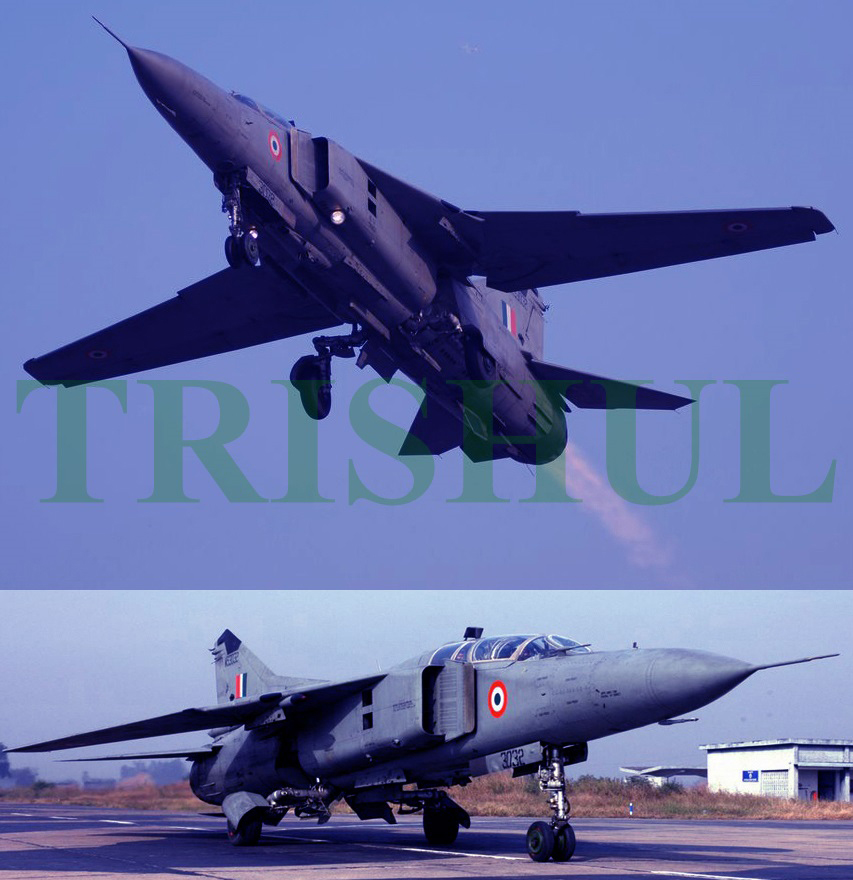
IAF’s MiG-23BN ‘Vijay’ & MiG-27M ‘Bahadur’: Under-Utilised Workhorses


The Indian Air Force’s (IAF) association with ‘swing-wing’ combat aircraft came to an end on December 27, 2019 when the last remaining seven MiG-27UPGs were decommissioned from service. These aircraft, along with the already decommissioned MiG-27Ms and MiG-23BNs, had been procured for serving as all-weather tactical interdiction platforms with eight IAF squadrons.
In all, 95 MiG-23BNs were delivered between late 1980 and late 1982 and they served with No.10 ‘Winged Dagger’. No.220 ‘Desert Tigers’ and No.221 ‘Valiants’ Sqns between January 1981 and March 6, 2009 and having flown more than 154,000 hours), with each carrying a 3-tonne weapons payload. The IAF subsequently began procuring 165 MiG-27Ms (however, only 125 of which were licence-built by Hindustan Aeronautics Ltd or HAL between 1986 and 1992) for equipping No.222 ‘Tiger Sharks; No.2 ‘Winged Arrows’, No.18 ‘Flying Bullets’, No.29 ‘Scorpions’, and No.22 ‘Swifts’ Sqns from October 1984 till May 2, 1992. Each MiG-27M could haul a 4-tonne weapons payload. Of these, 40 were subsequently upgraded to MiG-27UPG standard—the upgrade work involving only the mission avionics suite. Latter batches of HAL-built MiG-27Ms had 74% local industrial content.
While the MiG-23BNs all came from Irkutsk Aviation Production Association (IAPA), for the MiG-27M licenced-production programme, a team of specialists from both IAPA and Mikoyan OKB worked in Nashik for the entire second half of 1982. In the first phase, the initial batch of MiG-27Ms were delivered from Irkutsk in semi-knocked-down condition (they were partially dismantled for transportation by sea). In the second phased, fully knocked-down kits were delivered for final assembly by HAL. The first locally-assembled MiG-27M was rolled out in October 1984. And on January 11, 1986, the first MiG-27M-equipped squadron (No.222 ‘Tiger Sharks’) of the IAF had achieved full operational status.
The MiG-27M licenced-production programme was divided into four phases, with Phase-1 involving the final assembly of aircraft that had been delivered in semi-knocked-down condition, Phases-2 and -3 involving the final-assembly of aircraft that had arrived in fully-knocked-down condition, and Phase-4 involving the supply from the USSR of only materials, sheet duralumin, forgings and blanks, which were all machined by HAL with the help of numerically controlled machines procured by HAL from Western European countries.
While the airframes of both the MiG-23BN and MiG-27M had a total technical service life (TTSL) of 3,000 flight-hours, the airframe developer—Mikoyan OKB—had subsequently certified both airframes for an additional 1,200 flight-hour service-life. However, if the airframes were to be subjected to total refurbishment by HAL, then the service-life could be increased by another 3,000 flight-hours based on structural fatigue tests that could have been carried out by the National Aerospace Laboratories (NAL).
However, an engine-change was called for and Mikoyan OKB along with Moscow Machine-building Production Company (MMPP Salyut) had by the late 1990s had proposed that the Tumansky R29-300 and R29B-300 turbofans be replaced with AL-31F turbofans that offered 1-tonne maximum extra thrust-rating. This was accepted in-principle by the IAF.
In parallel, the Defence R & D Organisation’s (DRDO) Defence Avionics Research Establishment (DARE) began a deep-upgrade of the MiG-27M’s avionics suite in 2002. Only 40% of the on-board systems, mainly of the mechanical type, were retained as original factory equipment of Russian design. The first prototype MiG-27UPG flew on March 25, 2004, followed by a second prototype on November 4, 2004. Together, during their flight-trials, they flew more than 300 hours.
In June 2006, came the MiG-27UPG’s Initial Operational Clearance (IOC) certification from IAF HQ. It opened the way for work on aircraft building. After modernization, they equipped two squadrons. Modified cars received the designation MiG-27UPG.
Back in 2003, Vladimir Labazin, MMPP Salyut’s Deputy Chief Designer, described how the re-engining of MiG-23UBK tandem-seat operational conversion trainers, the MiG-23BN and MiG-27M with AL-31F turbofans could have been achieved. “Having taken stock of our capabilities, we realised that we could cough up some funds to invest into the initial-stage assessment of mounting the AL-31F. Our design bureau began looking into this in late 2002. Aircraft and engine dimensional analysis and computerised, visual and assembly coordination showed that minor airframe and engine modifications would make them compatible in terms of size. The aircraft features some room for improvement as far as airflow is concerned and we can reduce the AL-31F’s takeoff airflow a little while maximising airflow at high altitude. Early mechanical problems have already been overcome.”
“For example, the AL-31F used to keep setting against the fuel tank or some other structural elements and we had to modify the positions of some components for the engine to fit in. To keep aircraft systems intact, MMPP Salyut, retained all aircraft accessories mounted on the R29B-300’s reduction gear, with only the accessory gearbox replaced–the gear ratio of the old engine was different, so we had to replace the reduction gear. However, even though we have retained all aircraft accessories, we had to rearrange them to avoid altering the airframe and engine nacelle’s inner mould lines, fuel tanks and heavy frames.
In addition, introduction of advanced engine mounting components, re-arrangement of the accessories, generator and starter unit, and modification of the dimensions of certain engine components enabled us to squeeze the AL-31F into the nacelle without disturbing primary structural and fuel system elements of the aircraft.
During the spring and summer of 2003, MMPP Salyut developed the mock-up of the AL-31F, and after exhaustive tests conducted the final fitting. “We are planning to manufacture the engine by year-end and launch its bench tests in January 2004, and count on doing flight tests in July or August 2004. After this has been completed, we will commence full-scale improvement of the IAF’s MiG-27Ms to begin with.
To avoid redesigning the load-bearing structure of the airframe fuel cells, MMPP Salyut’s designers came up with a new load-bearing element—a longitudinal beam—that mounted the main attach fitting for the AL-31F. In addition, an extra engine attach fitting was introduced to the rear fuselage to fix the AL-31F relative to the axis, thus ensuring necessary thermal movement. Engine mounting procedures too were altered. The R29B-300 comprised two parts. The fore part was first to be mounted, then the aft one, after which both would be put together.
The AL-31F is a single-piece design and therefore it has to be installed into the fuselage mid-section, with the tail section to follow. To this end, a dedicated trolley was made, on which the AL-31F rolled into the fuselage, was then attached to main bracket supports and aligned with the aircraft’s centreline and was then fixed in this position with a dedicated rod on the fore end of the AL-31F.
Then the tail section was rolled on to the AL-31F using the dedicated trolley and linked with the mid-section. The AL-31F was then aligned with the tail bumper and detaching the hoist fitting. Then all systems were assembled. In addition, minor modifications to the aircraft had to be introduced. For example, the starter had to be rotated 200 degrees with a new exhaust shutter made, and new air ducts installed to cool the assemblies. Main modifications were made to the AL-31F. To reduce costs and time, the new accessory gearbox was made of two sections. Aircraft accessory elements were ‘borrowed’ from the previous R29 and the engine’s portion from the AL-31F. Both parts of the gearbox were linked by virtue of the new reduction gear and the casing. The engine oil system was revamped drastically because the oil tank and the oil pump pack had to be positioned where there was room to house them instead of where it was best for the engine.
Fitting the AL-31F on to the IAF’s MiG-23UBKs, MiG-23BNs and MiG-27M would have had another benefit: if those aircraft were to be discarded from service before their engines’ service-life had expired, then 70% of their components could be used for overhauling the AL-31FPs now powering the IAF’s Su-30MKI H-MRCAs. And that is because the core portions of the AL-31F and AL-31FP are identical, with only their outer componentry—casings, oil systems and outer plumbing and wiring— having been modified.
Deliveries of AL-31Fs to power the MiG-23UBKs, MiG-23BNs and MiG-27Ms were scheduled to kick off as early as the first quarter of 2005. However, to everyone’s consternation, the re-engining contract was not inked and the IAF decided not to re-engine the MiG-23UBKs, MiG-23BNs and MiG-27Ms. So, what were the consequences of this decision?
The IAF lost 13 of its MiG-27Ms aircraft between 2001 and 2016. In the last 10 years, 11 MiG-27Ms, have crashed. Subsequent boards of inquiry shockingly revealed that majority of the MiG-27Ms went down because of “engine-related technical defects” like perennial engine oil leaks from ill-serviced fuel-pumps of the R29B-300 turbofans. Nearly 40% of these turbofans and related accessories licence-produced by HAL’s Koraput Division had to be returned by the IAF for some or the other defects. The problems ranged from oil leaks, metallic particles in oil filters and hot-air leaks from rear casings to troubles in compressor-blades and even in the turbines.
Most of the cause factors can be classified as defects during manufacturing or overhauling processes. The MiG-27M suffered Low-Pressure Turbine Rotor (LPTR) failures in at least 11 incidents. HAL in some cases even lied while overhauling the LPTR, saying that it had followed the overhaul manual, but subsequent IAF investigations revealed that the procedure recommended by the original equipment manufacturer (OEM) was not being implemented by HAL. Such lapses had also led to previous crashes of MiG-21 Bisons. The springs installed in the fuel pump of the MiG-21 Bison’s R25-300 turbofans were failing frequently. A MiG-21 Bison crashed in November 2012 in Gujarat, which was attributed to spring failure. Of the five main fuel-pumps fitted with HAL-manufactured springs, at least three springs failed, which is unforgivable as it would have certainly resulted in accidents. Shockingly, the main fuel pumps of the MiG-21 Bison continue to leak fuel, despite four studies conducted and implemented since the 1990s. Despite incorporating changes, fuel leak from the main fuel-pump has continued unabated from throttle-end.
However, another reason behind the poor quality of production and engine repairs is attributed to mass production work in the last leg of a production year in order to achieve the projected target. For example, in the first six months of 2012-2013 production year, HAL finished overhaul work on only four RD-33 turbofans of the MiG-29B-12, but in the last quarter of the year, four RD-33 were completely overhauled within three months. Similarly for the R29B-300s, HAL finished overhauling nine engines in nine months, but interestingly another nine engines were completed within the last three months. The issue was flagged by the IAF, saying that such industrial productivity trends were adversely affecting the quality of overhauled turbofans.
Thus, it appears that HAL was not interested in providing quality turbofans to the IAF and instead was only interested in meeting the production numbers every year. There is also an impression that the workforce in HAL deliberately delayed the production to last three months to earn few extra bucks for ‘overtime’ perks, which is disgusting, given the fact that human lives are at stake. Interestingly, throughout their service-lives, none of the MiG-23BNs, which had come off-the-shelf from IAPA, displayed any engine-related equipment malfunctions!
The end-result: premature decommissioning of the IAF’s MiG-23UBKs, MiG-23BNs and MiG-27Ms, thereby denying the IAF another 10 operational combat squadrons.

Monday, December 23, 2019

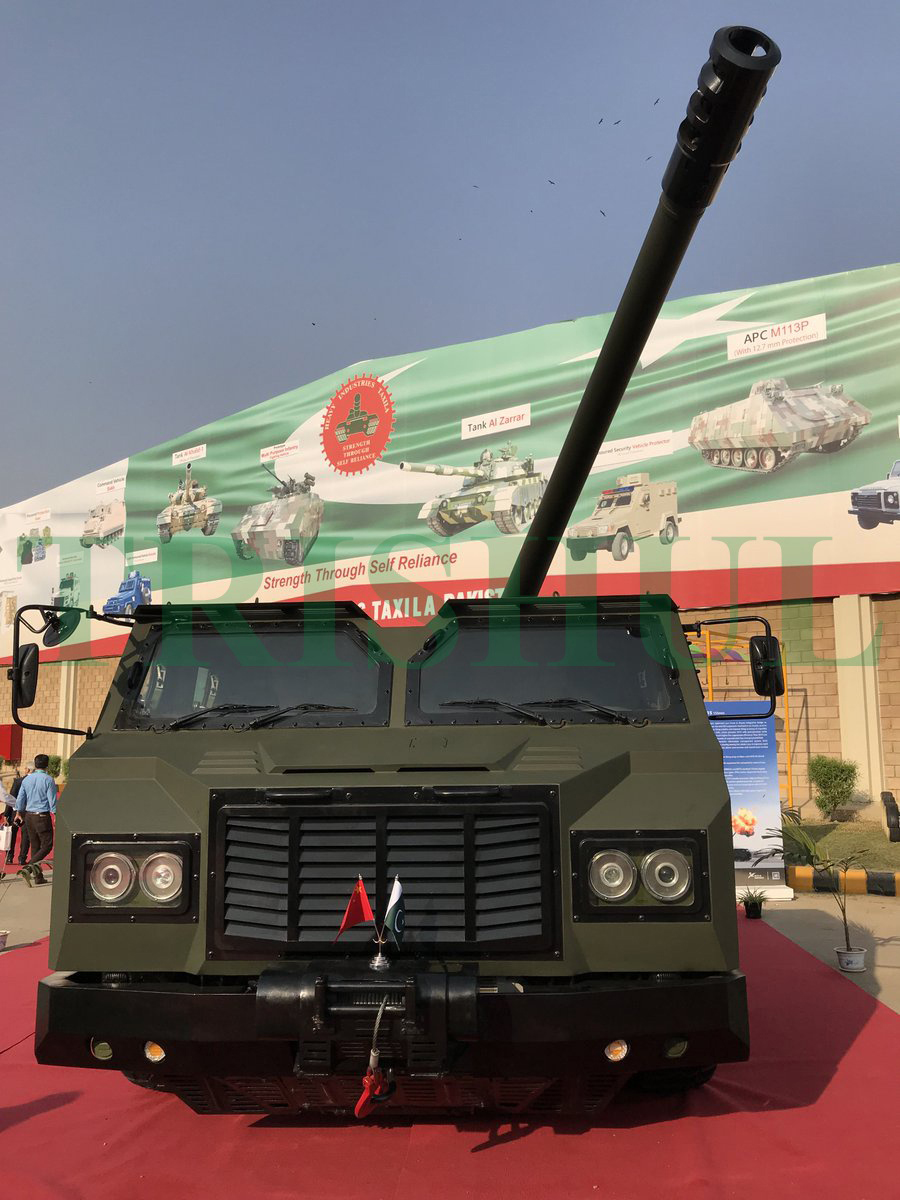
Pakistan Army's SH-15 MGS Package

The Pakistan Navy had last August inducted into service the NORINCO-supplied Sharp Eye tactical UAS for use along the contested Sir Creek area bordering India’s state of Gujarat and Pakistan’s Sindh province.
OFB-Developed Dhanush-52 MGS

Thursday, December 19, 2019

Escalation Dynamics Under Nuclear Overhang

The two rounds of aerial engagements between the air forces of India and Pakistan on February 26/27 after the February 14 Pulwama terror-attack hold important lessons for conventional deterrence as well as answers to the question of whether high-intensity limited war options are possible under a nuclear overhang. India has since the early 1990s accused Pakistan of playing the conflict game at the sub-conventional level, while denying India the justification to retaliate through her superior conventional capabilities by signalling the resolve to introduce nuclear weapons first and early into a conventional conflict. At the same time, after the limited conflict fought at the forbidding heights of northern Jammu & Kashmir (J & K) in mid-1999 and the subsequent 10-month long total military mobilisation (OP Parakram) starting mid-December 2001, has been conceptualising how to punish Pakistan conventionally while remaining below the nuclear threshold. Put simply, India thought that there was a bandwidth limited by time and space within which she could act militarily and punitively while making it extremely difficult for Pakistan to escalate to the nuclear-level because such an escalation would be considered highly disproportionate and would draw international opprobrium. The argument was that the certainty of international diplomatic and economic isolation would force Pakistan to stay its hand and not escalate to the nuclear-level. The banal analogy of this translates into someone punching another person in a crowded bazaar and the victim, instead of keeping himself to the fistfight, chooses to draw and fire a handgun. Not only would such a person lose the sympathy of the crowd, he would also invite the full coercive and normative weight of the law. Corollary: whoever ups the ante in a basic fight ends up as the loser.

However, while India’s military decision-makers have been thinking about this and rehearsing various related scenarios since 2004, until the arrival of the NDA-2 government led by India’s Prime Minister Narendra Modi in late May 2014, New Delhi had continued to shy away from actualising a short, sharp military option against Pakistan, focussing instead on exercising strategic restraint while exploiting diplomatic channels by using the country’s diplomatic heft. For instance, had the then NDA-1 government had by May 1998 publicly announced its intention to conduct a comprehensive strategic defence review aimed at restructuring India’s three armed services in order to address the new ground realities associated with the conduct of limited high-intensity conventional warfare under a nuclear overhang, the chances of Pakistan launching OP Koh-e-Paima against India in northern Jammu & Kashmir (J & K) would have been slim. Given the total ratio of land forces of India and Pakistan, which then was about 2.25:1.2 the Pakistan Army’s Military Operations Directorate had then concluded that the initial Indian military reaction would be to rush in more troops inside J & K, thereby further eroding the Indian Army’s offensive capabilities against Pakistan. As a consequence, the MO Directorate concluded that India would not undertake an all-out offensive against Pakistan, since by doing so she would run the risk of ending in a stalemate, which would be viewed as a victory for Pakistan. It is for this reason that the Pakistan Army had then appreciated that an all-out conventional war, let alone nuclear war, was never a possibility. The Pakistan Army’s consequent operational plan envisaged India amassing troops along the Line of Control (LoC) to deal with the threats at Kargil, Drass, Batalik, Kaksar and Turtuk, thereby resulting in a vacuum in the rear areas. By July 1999, the Pakistan-origin Mujahideen were required step up their sabotage activities in the rear areas, thereby threatening the Indian lines of communication at pre-designated targets, which would have helped isolate pre-determined pockets, forcing the Indian troops to react to them. This in turn would have created an opportunity for the Pakistani forces at Kargil, Drass, Batalik, Kaksar and Turtuk to push forward and pose an additional threat. India would, as a consequence, be forced to the negotiating table. While it is useless to speculate on whether it could in fact have succeeded, theoretically the plan for OP Koh-e-Paima was faultless, and the initial execution, tactically brilliant. But at the strategic-level the Pakistan Army was caught totally off-guard by India’s vertical escalation (by involving the Indian Army through OP Vijay, the Indian Air Force through OP Safed Sagar and the Indian Navy through OP Talwar) that lasted from April 29 till August 3, 1999.

However, what totally bemused Pakistan’s military leadership at that time was the totally defensive mindset on the part of India’s then ruling political leadership. This was subsequently articulated by none other than Lt Gen Javed Hassan—who as the then GOC Force Command Northern Areas (FCNA) had played a key role in commanding both the Pakistan Army and the then paramilitary Northern Light Infantry (NLI) forces. He had in the mid-1990s been commissioned by the Pakistan Army’s Faculty of Research & Doctrinal Studies to produce a guide to India for serving officers of the Pakistan Army. In ‘India: A Study in Profile’, published by the military-owned Services Book Club in 1990, Lt Gen Hassan had argued that the ruling Indian ‘baniya’ class is driven by “the incorrigible militarism of the Hindus.” “For those who are weak,” he had gone on, “the Hindu is exploitative and domineering.” A highly intelligent and well-read officer, he was more of an academic than a commander, and bore that reputation. He, therefore, was the best-placed with a point to prove in a subsequent military appreciation of OP Koh-e-Paima—this being that OP Koh-e-Paima had provided India with a splendid opportunity to enact its February 22, 1994 parliamentary resolution by embarking upon a prolonged high-intensity AirLand offensive across the LoC that could eventually have resulted in the capture of almost the entire district of Baltistan (inclusive of Skardu and the Deosai Plains) at a time when both the Pakistan Army and Pakistan Air Force (PAF) were clearly unable to give high-intensity battle for more than a week, since the US, by invoking the Pressler, Glenn-Symington and Solarz Amendments since October 1990 had stopped providing product-support for all US-origin military hardware in service with Pakistan’s military, and also because Pakistan was holding only 48 hours worth of military POL stockpiles at that time.

This inexplicable defensive mindset and timorous posture-cum-conduct of India’s ruling political elite was again in full display during OP Parakram, which was launched in the wake of the December 13, 2001 terrorist attack on India’s Parliament, and was the first full-scale mobilisation since the 1971 India-Pakistan war. It began on December 15, 2001 after receiving the Cabinet Committee on National Security’s (CCNS) authorisation and was completed on January 3, 2002. It finally ended on October 16, 2002 when the CCNS belatedly recognised that the law of diminishing returns had been operative for many months already. In the snow-bound areas of J & K the Indian Army had by then relatively few options to launch offensive operations across the LoC, while in the plains of Punjab and Rajasthan the climatic conditions were ideal, but the nuclear overhang became the inhabiting factor. By that time, approximately 52,000 hectares of land along the International Boundary (IB) and LoC had been mined with about 1 million landmines. Till July 2003, the Indian Army had suffered 798 fatalities due to mishaps in minefields, mishandling of ammunition and explosives, and traffic accidents, and 250 injured during mine-laying operations. The cost of sustaining OP Parakram was pegged by India’s National Security Advisory Board (NSAB) at Rs.7 crore a day. This worked out to approximately Rs.2,100 crore over 10 months and did not include the cost of mobilisation and de-induction.

Eventually, India’s Parliament was informed in October 2002 that OP Parakram had cost Rs.6,500 crore (almost US$3 billion), excluding the Rs.350 crore paid as compensation to people residing in border states where Indian troops were deployed. The Indian Army was the biggest contributor to the expenses. Figures collated by Army HQ indicated that the cost of mobilisation of 500,000 troops, including pay and allowances, field allowance for one year and transfer grant alone was Rs.700 crore. The wear-and-tear cost of equipment added up to Rs.1,300 crore, while the depletion of mines, ammunition and warlike stores was around Rs.550 crore. Transport and fuel costs together added up to Rs.850 crore. The total figure for the Army stood at Rs.3,860 crore and did not include the cost of withdrawal of troops (estimated at around Rs.500 crore) and the cost of demining 1 million mines for which new demining equipment had to be bought from Denmark. Nor did this figure include the cost of deploying (and redeploying) the Indian Navy, the IAF and the Coast Guard, which was estimated to be another Rs.1,000 crore.

The first one to voice the Indian armed forces’ intense frustration over the continued myopia of India’s then ruling elite was none other than Gen. Sundararajan ‘Paddy’ Padmanabhan, who had served as the Indian Army’s Chief of the Army Staff from September 30, 2000 till December 31, 2002. Going on-the-record on February 6, 2004 (see: http://www.hindu.com/2004/02/06/stories/2004020604461200.htm), he explicitly stated that problems with India’s then prevailing (or obsolete) military doctrine and a lack of clarity within the then Union Cabinet on its war objectives had undermined OP Parakram at the very outset. Gen. Padmanabhan argued that significant military gains could have been achieved in the first quarter of January 2002, had India’s rulers made the decision to undertake a high-intensity limited conventional war. These objectives, he said, could have included the “degradation of the enemy’s forces, and perhaps the capture of some chunks of disputed territories in J & K. They were more achievable in January, less achievable in February, and even less achievable in March. By then, the balance of forces had gradually changed.” Pakistan, the Indian Army planners had then believed, had an interest in taking the conflict towards a nuclear flash-point as soon as possible. The Indian Army on the other hand believed that the best prospects of avoiding such a situation was having forces in place that could rapidly secure limited war objectives across the LoC. “If you really want to punish someone for something very terrible he has done,” Gen Padmanabhan said, “you smash him. You destroy his weapons and capture his territory.” “War is a serious business,” he continued, “and you don’t go just like that.” Doctrinal baggage, he accepted, had thus crippled India’s early options in 2002. “You could certainly question why we are so dependent on our three Strike Corps,” he said, and “and why my Holding Corps (since renamed as Pivot Corps) formations don’t have the capability to do the same tasks from a cold start. This is something I have worked on while in office. Perhaps, in time, it will be our military doctrine.”

From India’s perspective, the most important lesson that emerged from this standoff was that political and military instruments of national power must work together in a synchronised manner. Deciding to adopt a pronounced forward and aggressive military posture to coerce/compel Pakistan was basically a political decision, and India’s armed forces, excluded from the decision loop, could not immediately adopt the posture its political masters desired. Admiral Sushil Kumar, the Indian Navy’s Chief of the Naval Staff till December 30, 2001, later opined that OP Parakram was the most punishing mistake for India’s armed forces because the government of the day then lacked any political aim or objective for deploying the Army along the IB and LoC. “There was no spelt-out aim or military objective for OP Parakram. I don’t mind admitting that OP Parakram was the most punishing mistake for the armed forces. When the Parliament attack took place, in the (CCNS) board-room it was a super-charged atmosphere. As you are aware in the CCNS board-room, the three Service Chiefs sit opposite the Union Cabinet. In the end, PM (Atal Bihari) Vajpayee turned to me and said ‘aap khush nahi lag rahe hain Admiral Sahab’ (You don’t seem to be happy). I said I beg your pardon, Sir, can you give us what is your political aim? We need to derive a military aim from it. That is the whole principle of war. What is the aim, you need an aim and military objective.”  He was then told by PM Vajpayee: “Woh hum baad mein batayengey” (we will tell you later). Referring to nuclear versus conventional warfighting capabilities, Admiral Kumar explained that nuclear deterrence should not be considered as the replacement for conventional warfighting capabilities of the country. “The problem is that the nuclear mindset we have is a false sense of security. Nuclear deterrence is required but it does not replace conventional deterrence. Conventional deterrence is the real deterrence, it gives you a credible response capability,” he said.

In the armed forces, there was seething anger against the then government having achieved so little with so much. Hollow now sounded Vajpayee’s rhetoric of “aar paar ki ladhaai” and several such allusions to a decisive battle. Those with a sense of history had then asked: is 2002 to Vajpayee what the 1962 debacle with China was to Nehru? Vertical escalation, if calibrated and maintained, would not have spiralled out of control. But after the initial weeks, the strategic surprise was lost by early February 2002. Matters were imprecisely conceived, and that there was no clear political objective to the mass military mobilisation. The subsequent military deployment became a losing gamble of meaningless brinkmanship. No informed cost-benefit analysis about the contours of the available military responses was undertaken. Nor were they preceded by politico-military war-gaming. It came about suddenly, and reeked of ad hocism. In developed countries, such war-gaming is a continuous process, enabling military planners to factor in the strains the political system could come under during wartime, and ways in which it could affect the operation. Of what use then was New Delhi's bluster and sabre-rattling?

The verdict: the 2001-2002 total military mobilisation was a disaster, perhaps the biggest since 1962. Political masters of that time never issued orders to realise any tactical objective, thereby underlining that the military mobilisation was never intended to launch attacks against Pakistan. But this inactivity ultimately extracted a tremendous price. Firstly, it bolstered the assiduously-cultivated Pakistani myth that deterrence has worked for it.  Secondly, India’s armed forces seriously degraded their operational reserve of combat hours. What would have happened if India was faced with a repeat requirement in three months? New orders for weapons had to be placed, with consequent lag-times in terms of delivery schedules. Thirdly, as a consequence, India would have had to open herself to new strategic vulnerabilities, thereby getting squeezed in the process. Fourthly, since all combat and support equipment, especially air-defence hardware and precision-guided munitions, have a defined storage life that is measured in terms of hours, once taken out to the field and exposed to uncontrolled environment, such hardware quickly begins to degrade and become useless for combat purposes. This applies across the board, which if kept revved up for 10 months in the desert, would have had their functional abilities impaired.

This was the beginning of India’s ‘Cold Start’ warfighting doctrine, which was vaguely explained by the then COAS of the Indian Army, Gen Nirmal Chander Vij, on April 28, 2004. According to him, the reconfigured ground combat formations at each level will be task-oriented in terms of varying composition of armour and infantry elements, with integral attack helicopters of the Army Aviation Corps and the Indian Air Force (IAF), besides battlefield air interdiction (BAI) support coming from the Air Force. Also, there was then much hype about integrated Army Aviation surveillance helicopters, plus command-and-control helicopters.  As per Army HQ at that time, the future battlefields along India’s western borders would involve the use of eight permanently forward-deployed ‘integrated battle groups’, meaning Brigade-sized integrated armoured/mechanised infantry forces with varying composition of armour, field/rocket artillery, infantry and combat air-support that are available to the Army’s Pivot Corps-level formations. These ‘integrated battle groups’ would be mobilised within 48 hours and will be operating independently and will thus have the potential to disrupt or incapacitate the Pakistani leadership’s decision-making cycle. As per this school of thought, when faced with offensive thrusts in as many as eight different sectors, the Pakistan Army would be hard-pressed to determine where to concentrate its forces and which lines of advance to oppose. In addition, having eight ‘integrated battle groups’ capable of offensive action will significantly increase the challenge for Pakistani military intelligence’s limited exploration/exploitation assets to monitor the status of all the tactical battle areas, thereby improving the chance of achieving surprise. Furthermore, in a limited war, India’s overall politico-military goals would be less predictable than in a total war, where the intent would almost certainly be to destroy Pakistan as a functional state. As a result, Pakistan’s defensive ripostes against Indian attacks would be more difficult because the military objectives would be less obvious. Lastly, if Pakistan were to use nuclear weapons against the advancing Indian ‘integrated battle groups’, such dispersed formations operating over narrow frontages would present a significantly smaller target than would Corps-level formations.

In reality, the Indian Army’s declared cold-starting of the forward-deployed ‘integrated battle groups’ WRONGLY PRESUPPOSES that in the next round of military hostilities with Pakistan, the politico-military objectives will be clearly spelt out far in advance. And there was no credible evidence on the ground about this being the case either during the dastardly 26/11 Mumbai terror-strikes, of after any subsequent Pakistan-origin terror-attacks inside India since then. Any military offensive strategy hinging on high-intensity limited war can only be successful if India’s political leadership at the given time of operational execution of this strategy has: the political will to use offensive military power; the political will to use pre-emptive military strategies; the political sagacity to view strategic military objectives with clarity; the political determination to pursue military operations to their ultimate conclusion without succumbing to external pressures; the political determination to cross nuclear thresholds if Pakistan seems so inclined’ and the determination to not shy away from enunciating India’s national interests from which flows all military planning. If any of the above are missing, as they have been from 1947 to till now, the Indian Army’s ‘Cold Start’ doctrine will not add up to anything. Interestingly, while India for long denied that such a doctrine existed—despite conducting several field exercises at the Divisional-/Corps-levels to validate it—the present-day COAS of the Indian Army, Gen Bipin Rawat, acknowledged its existence barely three weeks after taking office on December 31, 2016. The ‘Cold Start’ doctrine assumes that:

1) There is a time-/space-limited bandwidth within which India can exercise her conventional military options;
2) That bandwidth can be further exploited diplomatically;
3) India has the conventional superiority to make it work;
4) If India does so in response to an attack she can pin on Pakistan through undeniable corroborative evidence, she then has enough diplomatic leverage to exercise in order to have the world opinion on her side for a limited but high-intensity military campaign;
5) India can make it work through a military surprise which can achieve the desired military objectives;
6) Pakistan, having suffered a setback, will be hard-pressed to retaliate because it will have to climb up the escalation ladder—a costly proposition both for reasons of the earlier military setback as well as international diplomatic pressure;
7) Given India’s upper hand, both militarily and diplomatically, Pakistan will choose to not escalate;
8) If, however, Pakistan did choose to escalate, India will still enjoy escalation dominance because of her superior capabilities and because she will have international diplomatic support; and
9) India, given her diplomatic and military heft, will be able to raise the costs for Pakistan in an escalation spiral.

The end-result: Pakistan will weigh the consequences as a rational-choice actor and prefer to climb down.

The interesting assumption in all of the above, and one that should not be missed, is this: the first-round result. Every subsequent assumption flows from what India could achieve militarily in the opening round. Somehow, most of the available literature to date on this subject has taken for granted that the first round would obviously go in favour of India. And therefore, Pakistan’s costs for retaliation would increase both militarily and diplomatically. In fact, this does make sense if it can be guaranteed that India’s gambit will work. Except, the opening round success could be guaranteed only if India were applying force on an inanimate object or if her conventional war-waging capabilities and capacities were far superior to those of Pakistan. The second crucial point in assessing these assumptions is the limited nature of the engagement. It should be noted that India’s politico-military strategy post-OP Parakram has looked at any punitive military action in a limited, not full-scale, mode: military action below the nuclear threshold. Pakistan, on the other hand, has never drawn clear red-lines, thereby choosing instead to managing risks through ambiguity. The only time a former—and longest-serving—Director-General of the Strategic Plans Division of Pakistan’s National Nuclear Command Authority, Lt Gen Khalid Kidwai, enunciated four parameters for resorting to nuclear weapons of mass destruction (WMD) was during an interview to two visiting Italian physicists:

1) India attacks Pakistan and conquers a large part of its territory (geographic/territorial threshold);
2) India destroys a large part of Pakistan’s military forces/assets (military threshold);
3) India strangulates Pakistan economically (economic threshold);
4) India destabilises Pakistan politically or through internal subversion (domestic political threshold).

Lt Gen Kidwai was thus using hypothetical scenarios, and his four thresholds were not red-lines defined and understood by the adversary or other parties, because clearly defined red-lines dilute deterrence and provide room for conventional force-manoeuvring. The point about the limited nature of India’s military plans is important because, while a case can be made for India possibly overwhelming Pakistan in a limited AirLand military campaign—if there is not a huge differential in war-waging capabilities/capacities—may not necessarily play to the stronger adversary’s advantage. In other words, if the presumably weaker side denies the stronger side success in the opening round and draws its own blood successfully while showing restraint, it can raise the costs for the militarily stronger side by up-ending the latter’s assumptions based on the success of the opening round.

And this is exactly what transpired on February 27, which has been been explained by Pakistan as: deterrence was upheld because the initiator of military kinetic operations (India) had to factor in the nuclear dimension and keep her military options (that were thus labelled as ‘non-military, pre-emptive, counter-terror strikes) below that threshold. The defender (Pakistan), having defended successfully and then drawn blood, opted to show restraint. Third parties (like the US, China, the UK, Saudi Arabia and the UAE) got involved in no time knowing and realising that any attempt by one or both sides at escalation dominance could spiral. It can have both the conventional and the nuclear dimensions. Essentially, deterrence is the ability to discourage an actor from undertaking an unwanted action, including an armed attack. It is, in other words, about forestalling/prevention, i.e. convincingly stopping an actor from an action. The sister concept, known as compellence, is about forcing an actor to do something in line with what the compeller (adversary) wants it to do. By India’s reasoning, her limited military options are about deterring Pakistan to undertake actions at the sub-conventional level and to deter India from making use of her conventional strength because of the existence of nuclear WMDs. This is where the problem begins.

Deterrence is not just about threatening an adversary with punitive action. In order for it to be successful, it must also shape the adversary’s perceptions, i.e., force the adversary to change its behaviour by estimating that it has options other than aggression and which are more cost-effective. Shaping perceptions of the adversary that needs to be deterred would then require the deterrer to understand the motives of the actor who has to be deterred. Without that exercise, any limited action, even if it were temporarily successful, would fail to induce a behaviour change or incentivise a state actor to do something different. Also, deterrence by denial—the ability to deter an action by making it infeasible—is a far better strategy than deterrence by punishment which, as the term implies, promises the resolve and the capability to take punitive action(s) and inflict severe punishment. So, in the case of the February 27 IAF/PAF aerial engagements, deterrence for Pakistan has been perceived to have worked at two levels: First, the overall, umbrella deterrence that flows from the possession of nuclear WMDs on both sides. This level ensures that even if one or the other side decides to initiate military hostilities, it must keep it limited. The second level is about conventional deterrence. If India has undertaken a military action, Pakistan can prevent her from achieving her objective, and by successfully undertaking its own action, can force India to rethink her use of any military option. The rethink is important because, in such a play, if Pakistan has prevented India’s action and successfully undertaken its own, India cannot simply retaliate to a reprisal. India will have to climb up the escalation ladder, i.e., she has to scale-up by using an escalatory option to defend her commitment to moral/military ascendancy. Escalation is about a higher cost and the rethink is a function of forcing India into that cost-benefit analysis. It is precisely for this reason that the opening round is so crucial for the initiator of kinetic operations, in this case India.

To recap, as noted above in the list of assumptions, every subsequent assumption flows from the success of the opening round. At this point it would be instructive to view all this from the perspective of the NDA-2 government, which is of the view that the previous Indian governments did not make use of available conventional military options because they were myopic and indecisive. After all, from India’s unilateral undertaking of “no first use” of nuclear WMDs to declarations that “war is not an option” after 26/11, India seemed to have conveyed an unintentional guarantee of immunity to those contemplating inimical actions against her. In sharp contrast, the NDA-2 government had resolved from the outset to teach Pakistan a lesson and create a “new normal”. On the morning of September 29, 2016, the Indian Army’s Director-General Military Operations announced to a packed press conference that India had conducted ‘low-intensity, counter-terror shallow cross-LoC raids’ against terrorist launch pads along the LoC. Target-1 was at Dudhnial, Neelum Valley (34 42 09.97 N, 74 06 28.75 E), target-2 was at Mundakal, Leepa Bulge (34 17 21.1 N, 73 55 25.7 E), target-3 was at Athmuqam, Keran Sector (34 34 48.65 N, 73 57 01.09 E), while targets 4, 5 and 6 along India’s Rajouri sector/Pakistan’s Battal sector were diversionary in nature. Pakistan did not retaliate because India did not admit to crossing the LoC into Pakistan-occupied-Kashmir (PoK). But by hyping these raids, the NDA-2 government locked itself further into a commitment trap. On February 14, therefore, when a suicide-bomber mounted the deadliest attack at Pulwama, J & K, against Central Reserve Police Force personnel in recent times, the NDA-2 government was left with no option but to exercise a limited military option. Only this time it had to be more than just a fire-raid across the LoC. Delhi jumped a few rungs on the escalation ladder by deciding to use the IAF. The important and crucial point was that India had challenged Pakistan and the latter needed to put an end to the “new normal” talk. Pakistan chose its targets (all lying within southern J & K) and struck with alacrity to demonstrate resolve and capability.

At the same time, in order to conserve its force-capacities and discourage India from climbing the escalation ladder, Islamabad internationalised the conflict by claiming on February 27 that since India was preparing to launch long-range cruise missiles (land-launched BrahMos-1s) for hitting nine targets inside Pakistan, the latter too had readied its cruise missiles for counter-strikes and had informed India that it will retaliate against any further kinetic actions initiated by the former. That, as per claims made by Pakistani Prime Minister Imran Ahmed Khan Niazi, forced India to back off due to increasing international pressure. Of course, there is no way of knowing now whether this is true or false. Thus, the two sides are back to the ‘old normal’, i.e. cross-LoC fire-assaults. However, Pakistan must not underestimate India based on these limited aerial engagements. While India cannot not coerce Pakistan militarily at this moment, if the growth differential between the two countries continues to grow, the technological asymmetry will increase to the point where India’s strategies of coercion would kick into play, which could well spawn very different results on the ground. For instance, after the IAF starts inducting its anti-access, area-denial S-400 LR-SAMs into service by next year, such weapons will be used not just for defensive missions, but also in support of for pre-emptive offensive air operations undertaken by mixed formations of the IAF’s Su-30MKI H-MRCAs and Rafale M-MRCAs. Typically, anti-access, area-denial systems ensure that they can deny a mission to incoming hostiles (anti-access) and ensure safety of their own area against any hostile action (area denial mode). And that would be an entirely different ballgame altogether.

But as of now, a robust and sustained punitive Indian response to cross-border terrorism still remains a distant dream, since India has only so far demonstrated her professional competence and the will to go deep inside and strike at targets located in a country with a horizontal width of only 427.52km. Enhancement of mission-optimised force-capacities, on the other hand, are sorely lacking. In addition, at the strategic-level, India needs to urgently revise and introduce a degree of ambiguity in her nuclear weapons employment doctrine. At the operational-level, India must convey clarity and resolve by openly declaring: a “no negotiations” policy vis-a-vis terrorists and hijackers; her right to respond in self-defence to cross-border terrorist attacks at their sources and three, that while the response may not be instant it will be certain. In order to implement this policy, quick-reaction conventional and sub-conventional military forces-on-hand with suitable capabilities should be earmarked and kept in the requisite state of readiness at all times.