PLA Air Bases
east of Arunachal Pradesh
Yanggong
Plateau, Heqing, Dali, Yunnan, China
PLA Air Bases in
Qinghai Plateau & Opposite CARs
ALGs in
Arunachal Pradesh
ALGs in Sikkim
PLA Helipad at
Yushagang in Chumbi Valley
PLA SIGINT
Station North of Doklam Plateau
PLAAF Airspace
Surveillance Radar Station North of Doklam Plateau
PLA SIGINT
Station Opposite Finger Area
PLA BDR Garrison
& Helipads north of Doklam Plateau
Yadong’s
Helipads
PLA SIGINT
Station Opposite Sora Funnel
PLA Helipads
Opposite Sora Funnel
PLA BDR
Rapid-Reaction Garrison at Duojiaka in Chumbi Valley
PLA BDR
Battalion HQ north of Bum La
PLA Helipad
North of Bum La
PLA SIGINT
Station North of Bum La
PLA BDR Garrison
near Thagla Ridge
Nyingchi
Helicopter Base
PLAAF Airspace
Surveillance Radar Station North of Linzhi
Linzhi Military
Garrison
PLA Helipad
Opposite Barahoti
Lhasa Gonggar
Airport
PLAAF Airspace
Surveillance Radar Station at Ganba La Near Lhasa
HQ-12 MR-SAM
Site in Lhasa Gonggar
Lhasa's Dongguan
Helicopter Base
Yaophu POL Storage Facility North of Lhasa
Qiama POL
Storage Facility in Lhasa
52 (Mountain) Motorised
Infantry Brigade at Linzhi
53 (Mountain) Motorised
Infantry Brigade at Bayi
Nyingchi
54 Mechanised Infantry Brigade at Sangri
651 Independent
Anti-Aircraft Artillery Brigade at Bayi Nyingchi
Shigatse Airport
Ngari Gunsa
Airport
Shiquanhezhen
Helicopter Base
Rutog POL
Storage Facility Near Aksai Chin
PLAAF's Hetian
Air Base
PLAAF's Kashi
Air Base
For conducting theatre-wide airborne reconnaissance along the LAC, the PLAAF employs four Tu-154Ms equipped with belly-mounted SAR sensors that were imported from Russia in the mid-1990s. They are based at Beijing
Nanyuan air base and are operated by the 102
Air Regiment of 34 Transport Division.
The Indian Air Force, on the other hand, makes use of two Bombardier
Aerospace Global 5000 ISTR platforms that operate out of Charbatia Airport in Odisha State.
For real-time battlefield air reconnaissance, the IAF makes use of Su-30MKIs equipped with EL/M-2060P SAR sensors in pod-mounted configuration.
Lightning Strike Through Vertical Envelopment In The North East: The PLA’s Options
The year 2016’s series of annual People’s
Liberation Army (PLA) exercises within that portion of the Western Theatre
Command that includes the Tibet Military District (TMD) and Xinjiang Military
District (XMD)—facing the Sino-Indian Line of Actual Control (LAC)—which
commenced in late March 20016 and continued through to September, witnessed
significant accretions, with the most notable among them being the introduction
of a solitary KJ-500 turboprop-powered airborne early warning and control (AEW
& C) platform of the PLAAF, plus the deployment of LY-80 MR-SAMs in place
of the HQ-12 ADK-12 KS-1D MR-SAMs, and lastly the air-dropping of a Regiment of
ZBD-03 airborne infantry combat vehicles (ICV) along with ‘Pathfinder’ elements
drawn from the PLA Air Force’s (PLAAF) XV Airborne Corps at two distinct
locations: at the base of the Kunlun mountain
range under XMD’s jurisdiction, and at a firing range southeast of Lhasa
but north of the Yarlong Tsangpo (Brahmaputra) River.

The exercises also
revealed unmistakable signs of the PLA’s Western Theatre Command’s efforts to
develop two staging areas for offensive air-mobile campaigns: one in Qionglai air
base in western Sichuan that will become the fourth permanent base for the PLAAF’s
XV Airborne Corps; and Feng Huang Shan
helicopter base to Army Aviation Brigades equipped with Z-19WZ ‘Black Cyclone’ tandem-seat light attack
helicopters (LAH), plus Mi-17V-5 and Z-8K utility helicopters for ferrying
the PLA Army’s Battalion-sized light mechanised infantry regiments (LMIR, or kuaisu fanyin budui, also known as Resolving
Emergency Mobile Combat Forces, or REMCF) whose principal role will be to seize
and hold the string of advanced landing grounds (ALG) and gapfiller air-defence
radar stations belonging to the Indian Air Force (IAF) in Arunachal Pradesh,
Mizoram and Nagaland.
Airpower
Developments
It may be recalled that the PLAAF has
since 2010 been deploying Su-27SK/Su-27UBK/J-11A heavy-MRCAs belonging to the Shizuishan-based 6th
Air Division’s 16th Air Regiment, and J-10A
MMRCAs from the Mengzi-based 44th Air Division’s 131st Air
Regiment (based in Luliang) out to the dual-use airports at Lhasa Gonggar
(facing Sikkim and northern West Bengal) and Ngari (facing Ladakh in Jammu
& Kashmir, plus Himachal Pradesh and Uttarakhand) twice every year during
summertime and wintertime for two-week-long deployment periods. These used to
be accompanied by corresponding deployments of the HQ-12 ADK-12 KS-1D MR-SAMs of
the PLAAF’s Chengdu-based 11th Anti-Air Artillery Brigade (Unit
95607), which has three Regiments--21st, 22nd and 23rd--equipped
with the HQ-64/LY-60D E-SHORADS, and HQ-12 ADK-12 KS-1D MR-SAMs. The latter
were routinely deployed at fixed launch-sites located at Lhasa Gonggar and the
dual-use Shigatse Airport until now.

Since late 2012, the 651st Independent Anti-Aircraft Artillery
Brigade, based at Nyingchi, began
taking over from the HQ-12 ADK-12 KS-1Ds of the 11th Anti-Air
Artillery Brigade’s 22nd Regiment. The 651st comprises a
regiment of LY-80 70km-range MR-SAMs (containing 16 TELs each loaded with six
MR-SAM vertical launch-cells), a Regiment of 18 tracked PGZ-04As (each armed
with four FN-6 VSHORADS launchers missiles and four 25mm cannons), a Regiment
of FM-90 SHORADS, and a composite battalion that has 108 FN-6 VSHORADS/MANPADS
launchers, 24 Type 73 towed 37mm anti-aircraft guns and 18 towed twin 35mm
PG-99 ‘Giant Bow’ anti-aircraft guns. Also included are LIMAN ground-based
jammers, JY-27A VHF-band anti-PGM volume-search radars as part of the LY-80
MR-SAM regiment, YLC-18 S-band 3-D acquisition radars for the FM-90s (now
replacing the older LSS-1/Type 120 L-band 2-D low-altitude acquisition radars),
YLC-6 S-band 2-D low-level air-defence radars for the FN-6s, Type 73s and PG-99s.
For airspace surveillance, there is one
JL-3D-90A S-band 3-D radar operated by the PLAAF at the Ganba La radar station
southwest of Lhasa, plus another one north of Shigatse
Airport. These are joined by three Army-operated YLC-2V 3-D S-band acquisition
radars located around Ngari Airport and Qamdo Bangda Airport, and these are
supported by SIGINT Stations located in an arc stretching from the Depsang
Bulge in Ladakh all the way up to Walong in Arunachal Pradesh. The PLAAF’s
Air-Defence Reporting Centre for monitoring the TMD’s air-defence
identification zone (ADIZ) is located at Ganba La. A new radar station was
commissioned in June 2016 in the western Sichuan plateau at an altitude of
3,996 metres.

Going hand-in-hand with these
developments are increasing efforts by both the PLAAF and the Pakistan Air
Force (PAF) to undertake joint air campaigns that since 2011 have been
rehearsed under the ‘Shaheen’ series of joint exercises. It may be recalled
that the ‘Shaheen’ series of bi-annual exercises commenced in 2011 when, for
the first time ever as part of EX Shaheen-I, a PLAAF contingent with four
Su-27UBKs from the 8th Flight Academy
(also known as ‘Blue Army Aggressors’) deployed to Rafiqui air base in
Shorkot, Pakistan. This exercise, lasting for over two weeks starting March 11,
saw the PAF fielding its Mirage VEFs and F-7PGs executing
various various air-to-air and air-to-ground combat scenarios.

The PLAAF’s 8th Flight Academy operates Su-27UBKs and
Su-30MKKs that simulate enemy air force tactics during dissimilar air combat training
exercises. The PLAAF possesses three such ‘Blue Army Aggressor’ squadrons (the
first of which was raised in June 1987), with the other two flying J-10As and
J-7E light interceptors. All three squadrons operate under the PLAAF’s
Canzhou-based Flight Test and Training Base in Hebei province. The second joint
air exercise—EX Shaheen-II—was conducted between September 3 and 22, 2013 at
Hotan air base in the Hetian Prefecture of Xinjiang
Uygur Autonomous Region. For this, the PAF flew in its F-7PGs and
Mirage-IIIEPs. This was for the
first time in the PLAAF’s history that a foreign air force had conducted a
joint exercise inside China’s airspace. Participating PLAAF assets
included J-10As of the Hotan-based 109th Brigade, JH-7As of the Urumqi-based 37th Air Division Division’s
110th Brigade, J-8Fs from the Hotan-based 109th
Brigade, and Su-27SKs and Su-27UBKs from the Korla-based 111th
Brigade.

The third such bilateral air exercise—EX
Shaheen-III—was held at the PAF’s Rafiqui air base in the northeastern province
of Punjab between May 5 and 28, 2014. The PLAAF sent four J-10A/B M-MRCAs along
with a detachment of air-defence
controllers and ground-support crew, while the PAF deployed up to eight of its
JF-17s and Mirage-VEFs. EX Shaheen-IV was conducted at the Yinchuan air
base in the Southern Command (previously part of Langzhou MR) between September
12 and October 4, 2015. During these exercises, three different types of
frontline combat aircraft from each of the two air forces were fielded—this
being a first. In addition, the PLAAF for the very first time deployed one of
its KJ-200 turboprop-powered AEW & C platforms, while for the PAF this was
the first time that it went for air exercises outside China’s Xinjiang Uygur Autonomous Region. The PLAAF’s combat
aircraft assets taking part in the exercises included J-11As and Su-27UBKs
belonging to the Shizuishan-based
6th Air Division’s 16th
Air Regiment, J-10As from the Mengzi-based 44th Air Division’s
131st Air Regiment (based in Luliang) and a detachment of JH-7A
bombers from the Urumqi-based 37th
Air Division Division’s 110th Brigade. The PAF sent two JF-17
Thunder light-MRCAs, two Mirage-IIIEP tactical interdictors and two F-7PG light
interceptors, which were accompanied by an IL-78MKP aerial refuelling tanker. EX
Shaheen-V began on April 9, 2016 and lasted till April 30. During this
exercise, the PAF for the first time deployed its ZDK-03 Karakoram Eagle AEW
& C platforms (from which the KJ-500 is derived) for airborne battle
management missions.

Manoeuvre &
Air-Mobile Warfare
Since mid-2009, the PLA’s mechanised
formations located in TMD and Sichuan province have been inducting into service
new-generation tracked armoured vehicles, like Type 96A medium battle tanks
(replacing the earlier Type 85 tanks) and ZBD-04A/B ICVs (replacing the ZBD-89
ICVs) equipped with integral, mast-mounted battlefield surveillance radars and
anti-UAV radars. First to be re-equipped was the 2nd Armoured
Battalion of the 54th Mountain Brigade (Unit-77625), located in Duilongdeqing
County; followed by an armoured regiment of the Chongqing-based 13th
Group Army’s 37th Mechanised Infantry Division and another armoured
regiment of the 149th Light Mechanised Infantry Division (located at
Leshan, Sichuan province) that also comes under the 13th GA; and
lastly, the armoured regiment of the 14th Group Army located in
Kunming, Yunnan province.


These formations every year in December undergo
mobility-cum-firepower exercises at the Yanggong Plateau (at an altitude of
5,000 metres) in northwestern Yunnan, where the cold
and dry environment of the type prevalent in the Dolam Plateau and Chumbi
Valley along the Bhutan-China-India tri-junction along the Siliguri Corridor offers
a realistic training ground in terms of both climate and terrain. A medium
battle tank with a 105mm rifled-bore cannon and powered by water-cooled 780hp
diesel engine that has been undergoing user-evaluations throughout TMD since
2012 is the ZTQ-105, which has now begun entering service in limited
numbers.

For the swift insertion of mechanised
forces specialising in blocking/choking operations in the highlands along
mountain passes inside TMD that are facing Ladakh and Arunachal Pradesh, the
PLAAF’s XV Airborne Corps (presently headquartered in Xiaogan, north of Wuhan in Hubei province) plans to relocate
one of its Divisions near to Qionglai air base in western Sichuan so
that they can be airlifted by the PLAAF’s Y-9 and Y-20 transport aircraft
belonging to the 10th Air Regiment and 12th Air
Regiment of the 4th Transport Division that is located at Qionglai.

Presently,
the XV Airborne Corps’ 43rd Airborne
Infantry Division is stationed at Kaifeng in Henan province, while the 44th
and 45th Airborne Infantry Divisions are in the Wuhan area at
Guangshui and Huangpi. Starting early April
2016, a ‘Pathfinder’ Company of the XV Airborne Corps equipped with Type
OL-2 combined laser rangefinder/target designators, meteorological sensors and
secure tactical radios was parachuted from
PLAAF IL-76MDs and Y-9s (taking off from Qionglai) at locations in the Dolam
Plateau and practiced forward air control operations.
In early May, a mechanised regiment equipped with
ZBD-03 ICVs, CS-SH-1 122mm motorised howitzers and 4 x 4-mounted CS-SM1
WM-81 82mm breech-loading mortars was
air-dropped near the Kunlun mountain range.
Subsequently, after the melting
of the thick snow covering the Ngari Prefecture in TAR in late June,
two additional air-drops of a similar nature were carried out in late June and
mid-August. Also ferried in to Lhasa and Ngari by IL-76MD transports were
vehicular TS-504 multi-point field troposcatter communications systems.

Future force multiplier accretions in
support of the XV Airborne Corps will take the form of Y-20 airlifters, the
first of which was delivered to the PLAAF on June 15, 2016 and it was formally inducted into the PLAAF on
July 6. The first two Y-20s with the serial numbers 11051 and 11052 were
delivered to the 12th Air Regiment located at Qionglai. Developed
by Xi’an Aircraft Corp (XAC), the Y-20 has an empty weight of 110
tons. The Y-20’s R & D effort was
accelerated after the large earthquake in 2008 in Sichuan province. Assistance was sought from Ukraine’s Antonov
Design Bureau. The head-section of a full-scale metal mock-up was
constructed by 2008. On August 20, 2009 XAC started to build the rear fuselage
of the first prototype. In April 2010 the full-scale mock-up was completed. In January 2012 the airframe of the
first prototype was built. A total of three prototypes (001-003) were built by
2013, with the 002 prototype
being the static fatigue-test airframe. The first low-speed taxiing of prototype 20001 took place on December 21, 2012 at the
China Flight Test Establishment (CFTE) in Yanliang.

The maiden flight first took place on January 26, 2013.
The 001 prototype (serial no.781) later wore a dark blue colour scheme after
being transferred to CFTE. The
third prototype (serial no.783) made its maiden flight on December 16, 2013 and
it underwent various tests at different locations. Additional prototypes were built and flew in 2015, including
nos.785 and 788. The last prototype (no.789) flew for the first time on February 6, 2016. The
Y-9, apart from air-dropping ZBD-03 ICVs, can also carry 25 tonnes of cargo, or
132 paratroops. The YunShuji-9
project was begun back in 2001 as an enlarged version of the PLAAF’s workhorse
Y-8 (An-12B clone) transport aircraft. The Y-9 has a built-in ro-ro rear-ramp
for quick offloads/airdrops. It has a maximum range of 3,000km.
Vertical
Envelopment
Since late 2008, the PLA Army’s LMIRs
located in TMD, Sichuan and Yunnan provinces have been hard at work on devising
innovative ways and means of undertaking offensive air-mobile, especially
heliborne, operations across wide frontages. Formations that have already
undergone ‘transformation’ include the battalion-sized LMIRs of the 52nd
Mountain Brigade, 53rd Mountain Brigade and 54th Mountain
Brigade, all spread over the military sub-districts of Shannan, Shigatse and Nyingchi
in TMD; plus the 149th Highland Mechanised Infantry Division, located
at Emei in Sichuan province.

The LMIRs are optimised for highland and
high-altitude warfare. Within each LMIR, tactical formations are task-organised
Groups instead of the traditional 3 x 3 structured organisations. Digital
messaging in the form of ‘call-for-fire’ is standard norm, along with an
automated situational awareness protocol. In a style of warfare where the ‘shock-and-awe
effect’ really matters, the impact of an LMIR overrunning hostile command-and-control
nodes, ALGs, radar stations and logistics centres could truly be devastating. While
a full PLA infantry regiment normally comprises three manoeuvre battalions, in
the LMIR its three companies combine the flexibility of dismounted infantry
with the mobility of motorised forces without having a significant logistics
tail. Unique to the LMIR is the fleet of 8 x 8 ‘Mountain Cat’ family of all-terrain
vehicles (ATV), each of which routinely carries six infantrymen: a squad leader,
gunner, driver, and three others that form a dismounted fire-team.

The 8 x
8 ATVs and weapons (built by Yongkang ADBTEV Vehicle Co Ltd in Zhejiang,
Chongqing Yonghui Technology Development Co Ltd, Chongqing Jinguan
High-Technology Group, and Shaanxi Baoji Special Vehicles Manufacturing Co Ltd)
are lightweight with reduced logistical footprint, thereby allowing for more
roads and bridges to be used during operations. Each ATV is also equipped with
a winch, tactical radio, ‘Beidou’ (Compass) GPS receiver, and tactical data
terminal. It is capable of negotiating very rough terrain and with a quick
modification, is amphibious. The ATV can be armed with either a QJZ-89
12.7mm heavy machine-gun, QLZ-04/Type-91 35mm magazine-fed automatic grenade
launcher, LPD-50 flamethrower, or one 82mm mortar. The ATV also has a provision
for mounting a NDM-86 7.62mm sniper rifle, or a 120mm PF-98A recoilless light
anti-tank weapon on a pintle at the front-left of the ATV.

Other vehicles used by the LMIR are the
4 x 4 SX-1 ‘Brave Warrior’ and ‘Iron Eagle’ fast attack vehicles (FAV). For
direct fire-support, these FAVs each mount a 12.7mm machine gun. For
indirect fire-support the FAVs come armed with CS-SM1 WM-81 82mm breech-loading
mortars. Several air-defence versions with a secondary direct-fire role
are armed with the Type 87 twin 25mm cannons, HJ-12 ‘Red Arrow’ anti-armour
guided-missiles, LG-5
40mm automatic grenade launchers firing programmable airburst grenades, JS
12.7mm sniper/anti-materiel rifle, and dual FN-6 surface-to-air missiles. Both
the 8 x 8 ATVs and 5 x 5 FAVs can be both internally loaded inside utility
helicopters, or are underslung.

Two new types of hardware now entering
service with the LMIR are the CH-901 loitering tactical attack drone and the ‘Hunting
Eagle’ gyrocopter. Powered by high-power lithium ion battery, the CH-901 can
carry either an explosive warhead, or additional cameras and a recovery
parachute. The CH-901’s takeoff weight is 20 lb, is armed with a 6 lb fragmentation
charge or a shaped-charge warhead capable of penetrating four inches of armour.
The standard CH-901 configuration comprises a group of three drones, one
launch-tube and a controller, with a total weight of 100 lb. the drone cruises
at up to 75mph with an endurance of 2 hours in the reconnaissance configuration,
or 1 hour as an attack drone, with a range of 10 miles. The recce version has
an estimated lifespan of 20 missions. Target detection is achieved from a
distance of 1 mile while flying 1,500 feet over its target. The operator
acquires the target using the on-board camera (visible light or thermal
imaging) and then locks-on for the attack phase. Once locked-on, it can follow
even a fast-manoeuvring target trying to escape. The
‘Hunting Eagle’, developed by Shaanxi Baoji Special Vehicles, operates
in the search-and-rescue, border control, reconnaissance, anti-riot, and other surveillance
roles. It can also be used to self-deploy special operations forces on missions
inside enemy territory. Gyrocopters are different from helicopters in having an
unpowered main rotor. A rearward-facing, engine-powered propeller provides
thrust, and once sufficient speed is gained, the main rotor begins to rotate, providing
lift.


Another
force-multiplier that has been operational since early 2013 in support of LMIRs
is the Z-19WZ ‘Black Cyclone’ LAH built by the Hongdu Aviation Industry Group
(HAIG). This LAH features
a narrow forward fuselage with tandem compact layouts. The aft fuselage sports a fenestron-type tail
rotor section. Maiden flight of the first Z-19WZ prototype took place in May
2010. It comes fitted with a
nose-mounted gyro-stabilised sensor/targetting ball-style turret, a
mast-mounted millimetric-wave radar, and stubby wings with weapons pylons. The
powerplant comprises two WZ-8A turboshafts developing
632kW (848hp). The Z-19WZ’s main role will be armed reconnaissance and
scouting. It does not carry a rapid-fire cannon, and instead comes armed with
laser-guided Blue Arrow BA-7 anti-armour and TY-90
anti-aircraft missiles, and unguided rockets.

Thus, the specialised heliborne air-assault
credentials of the LMIR make it ideally suited for sub-conventional warfare
scenarios, while offering greatly increased tactical flexibility (in terms of
pick-up, insertion, and extraction of forces) when performing special
operations against hostile air bases, ALGs, rear-area POL sites and ammunition
storage warehouses. There is no requirement for the utility helicopters
for airspeed reduction while en route, nor any manoeuvring restrictions at the
landing zone due to the pendulous sling-load.


Logistically too, the LMIR
has a small footprint. All ammunition consumed does not require material
handling equipment to move, and can thus be internally loaded within
helicopters. Fuel consumption for an entire LMIR during a 450km-long march
is estimated at a modest 225 gallons (846 litres) of diesel. Resupply of an
inserted LMIR is easily accomplished via utility helicopters like the Mi-17V-5,
which is routinely capable of carrying two 242-gallon (915 litre) internal fuel
tanks for ferry-flight purposes and these fuel-tanks can be re-configured for
refuelling vehicles. All these advantages make the LMIR a superb tool for
executing lightning fast air-assault raids.

While dismounted air-assault forces
traditionally land on their objective, the added mobility of an LMIR allows it
the option of being inserted a terrain-feature away from the objective. By
inserting the LMIR away from the defenders instead of on top of them, the most
vulnerable phase of an air-assault operation is thereby avoided. Land,
unload, form up, orient leaders, and then advance toward the objective is the
typical sequential mission protocol that is followed. While some surprise
may be lost, the tremendous tactical mobility of the LMIR adds an element of
deception as its actual objective is not obvious.
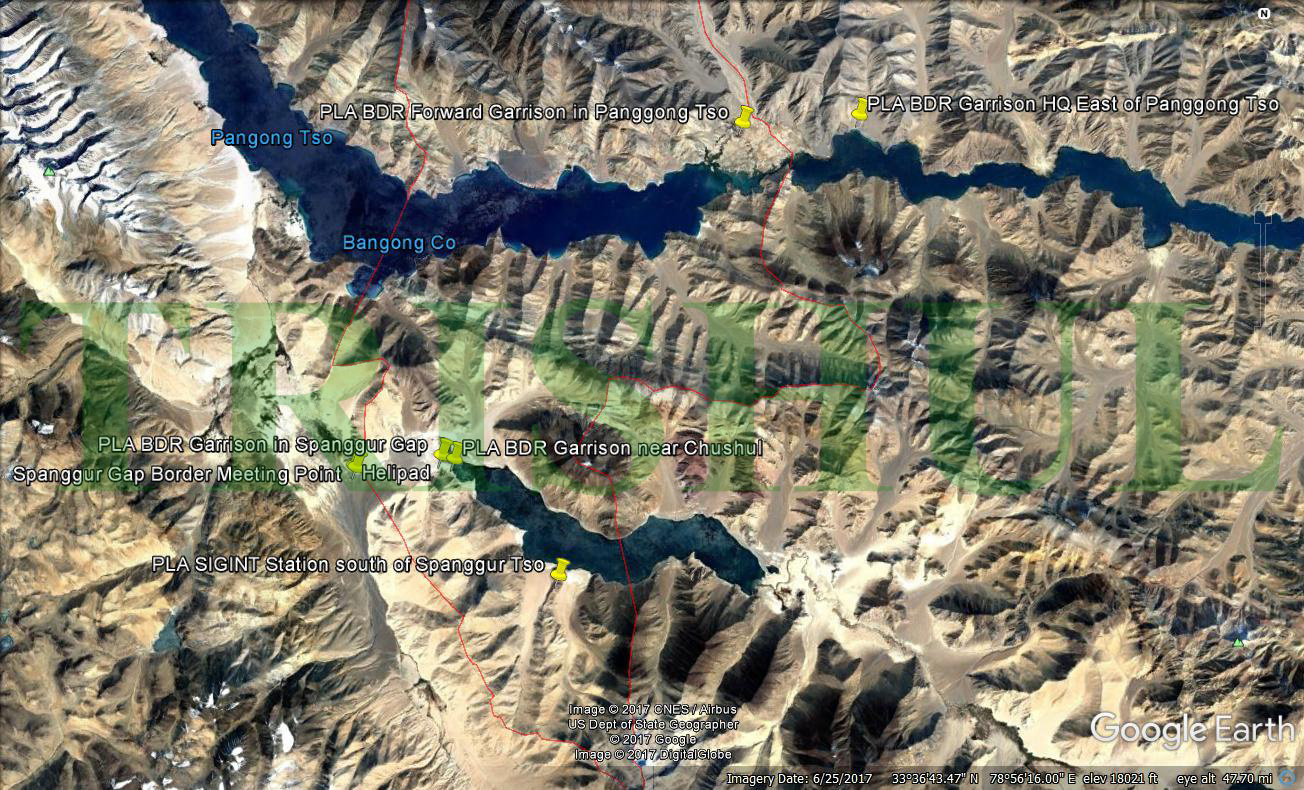
PLA Facilities In Western Sector